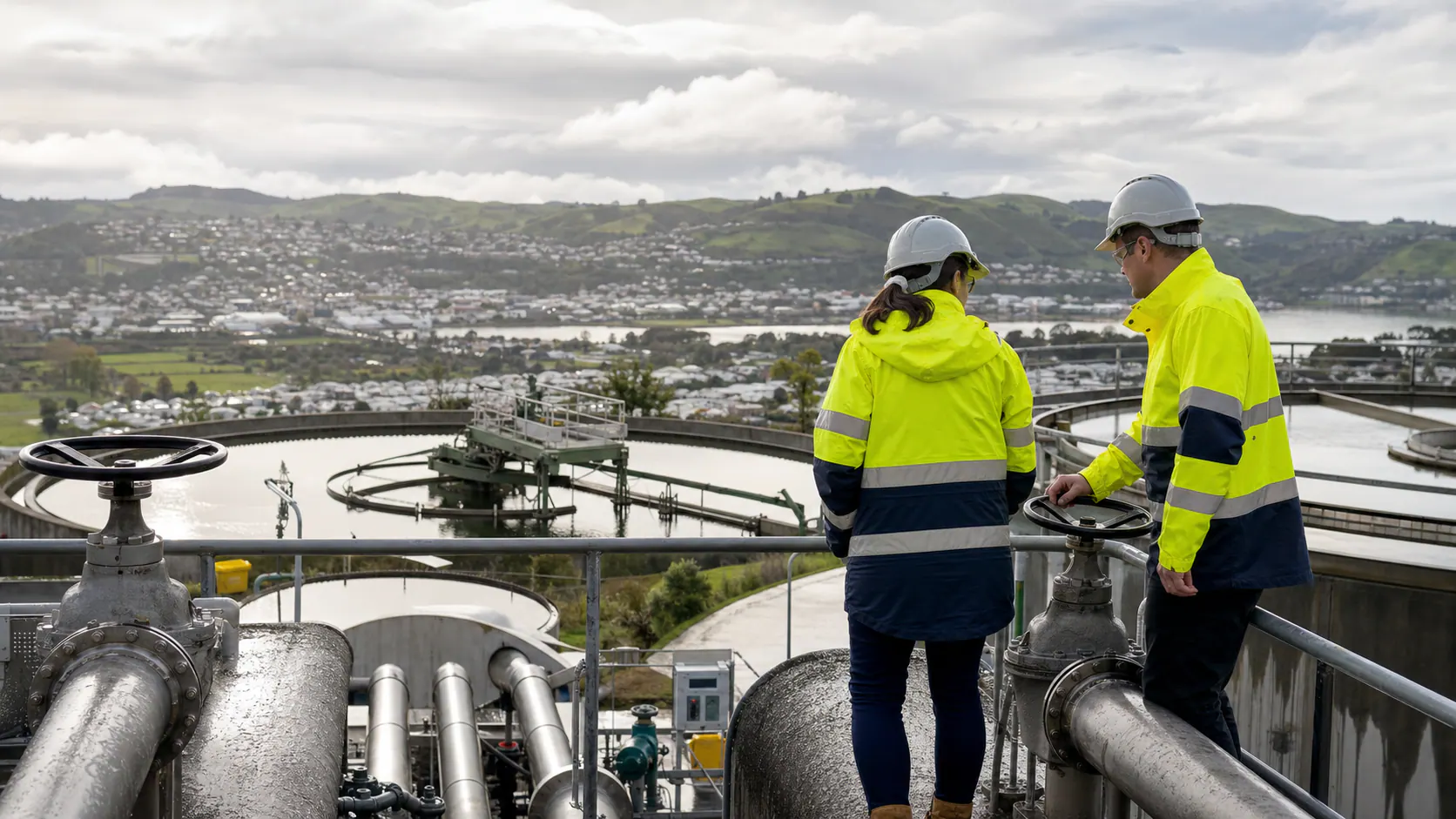
Most water infrastructure is designed to disappear. A tap works, a toilet clears and stormwater leaves the street; the public rarely sees the reservoirs, pumps, treatment barriers and kilometres of pipe that make those ordinary actions possible. Political reform is highly visible. Asset condition is not.
New Zealand’s latest water-services framework gives councils choices about delivery while introducing stronger financial and regulatory disciplines. The decisive question is no longer which slogan wins. It is whether providers can turn fragmented records and deferred renewals into credible, funded plans.
The first infrastructure problem is knowledge
A provider cannot manage what it cannot locate, date or assess. Pipe age alone is an imperfect proxy: soil, pressure, material, installation quality and repair history all affect failure. Good asset management combines records with leak data, sampling, inspection and consequence-of-failure modelling.
This sounds technical, but it determines fairness. If uncertainty is hidden, today’s low charge can become tomorrow’s emergency rate increase. Publishing confidence levels alongside renewal forecasts would make plans more honest and help communities distinguish a real unknown from a convenient omission.
Scale can help, but geography still matters
Larger organisations may pool engineering expertise, borrow against a broader revenue base and standardise procurement. Yet a regional entity can still neglect a small town if investment criteria reward population volume over public-health consequence. Scale does not automatically create accountability.
Governance needs local service information: outage frequency, boil-water notices, overflows, compliance, leakage, renewal backlog and response time. Residents should be able to see what they pay, what risk is being reduced and when promised work moves.
Funding reform is about time
Water assets last for decades, so financing them entirely from current rates can be unfair and politically unstable. Long-lived borrowing can match costs to generations that use the asset, but debt capacity is not free money. It requires dependable revenue, transparent assumptions and protection against underpricing.
Development levies should fund the growth share of new capacity, while existing communities pay for renewals and agreed improvements. The difficult cases are mixed projects and towns with a small rating base but high compliance costs. A national framework must decide how solidarity works rather than leaving it to crisis grants.
Regulation and delivery must meet
Drinking-water safety, wastewater discharge and economic performance are different disciplines. Providers can face incentives to satisfy the most visible requirement while deferring less visible maintenance. Regulators therefore need compatible data and enough technical capability to detect when a plan is formally compliant but operationally fragile.
Workforce is another constraint. Engineers, operators, laboratory staff and contractors cannot be produced by legislation. Stable pipelines of work, training and regional career paths are part of reform, especially when every council tries to renew assets at once.
Climate changes the design baseline
Yesterday’s rainfall and drought assumptions are becoming less reliable. Stormwater capacity, source-water security, treatment resilience and backup power must be tested against future conditions. Building only to the old baseline can lock in the next failure.
Adaptation also raises distributional questions. Protection cannot be allocated solely to places with the strongest balance sheets. Vulnerable communities, marae, rural supplies and fast-growing edges need explicit assessment.
A test the public can actually use
The public should judge reform through a small set of outcomes: fewer avoidable outages and overflows, improving compliance, measured leakage reduction, credible renewal rates and charges that change predictably rather than suddenly. Annual reporting should explain failures as well as celebrate capital spending.
Water politics will continue because ownership, rates and local identity matter. But the durable verdict will form underground. If records improve, pipes are renewed before they burst and operators have the resources to act, reform will become boring. For essential infrastructure, boring is a serious achievement.