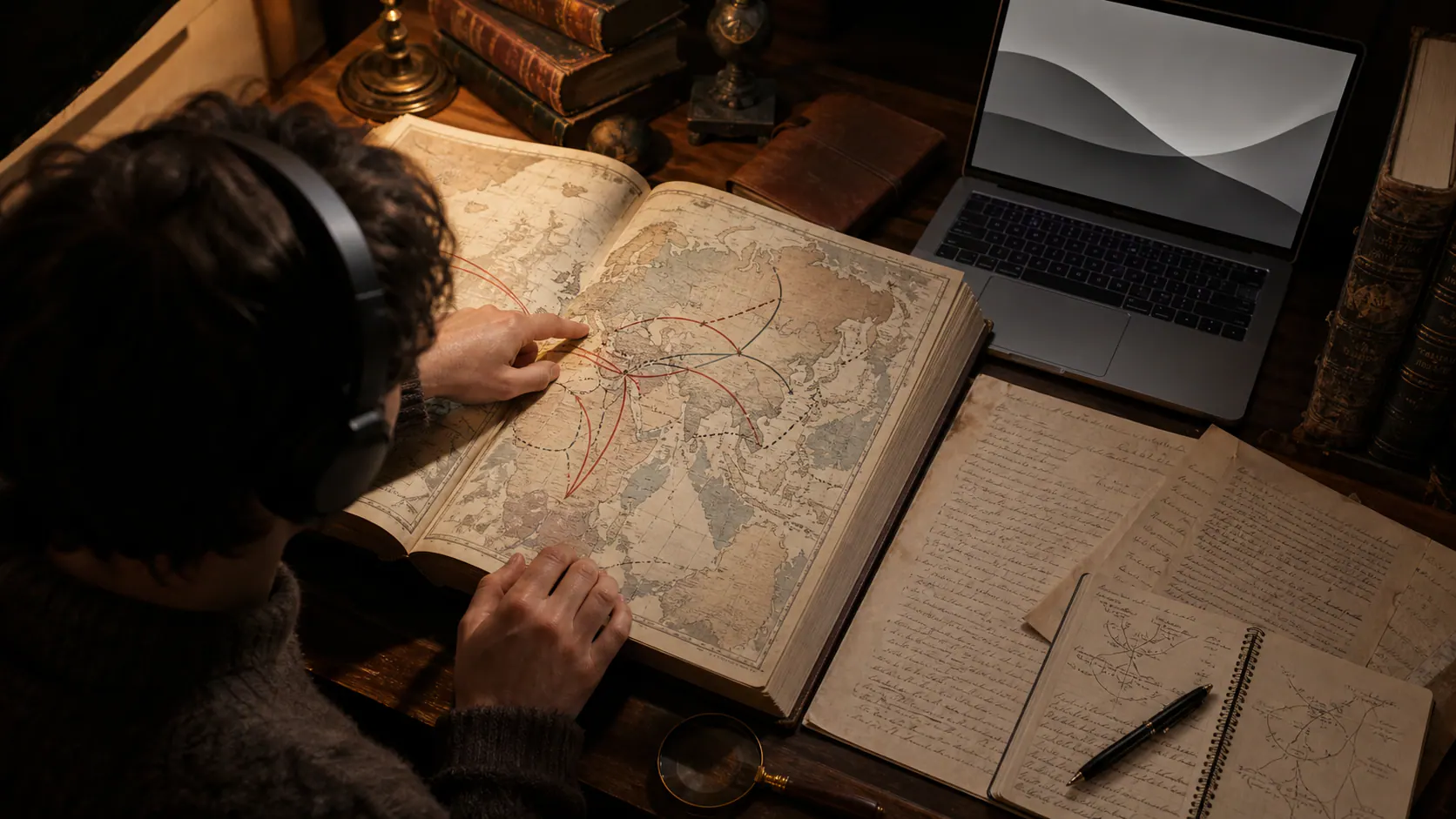
A familiar word can carry a journey longer than any person’s lifetime. Its sounds shift, its meaning narrows or expands, and speakers carry it across mountains, trade routes and political borders. NativLang’s videos make those journeys visible without pretending that language history is a neat family tree.
This is a channel for viewers who enjoy maps and etymology, but its deeper subject is human contact. Conquest, migration, religion, schooling, isolation and technology all leave marks on speech. The videos are strongest when they use one linguistic puzzle to open a much larger historical room.
Sound change becomes evidence
Historical linguists do not simply notice that words look alike. They identify regular correspondences across many words and test whether a proposed relationship fits known patterns. A good explainer shows why systematic change is stronger evidence than a single coincidence.
NativLang uses reconstructed pronunciations, maps and examples to make this reasoning approachable. Viewers should still treat simplified family trees as introductions; debates about dating, subgrouping and contact can remain open.
Languages borrow without losing themselves
Everyday arguments about “pure” language ignore how normal borrowing is. Trade brings objects and terms, prestige languages influence administration and scholarship, and bilingual communities create new patterns. Borrowing is not proof that speakers lacked creativity; it is evidence that communities met.
The channel’s historical framing helps separate inherited vocabulary from loans and shows why similar words can travel without implying a close genetic relationship. That distinction is one of the most useful forms of media literacy in language content.
Maps are powerful and dangerous
A coloured language area can imply uniform speech and hard borders where neither existed. Pastoral routes, ports, multilingual towns and seasonal movement rarely fit clean polygons. The best way to watch is to ask what period the map represents and whose speech became the label.
Political borders also influence what counts as a language or dialect. Mutual intelligibility matters, but institutions, writing standards and identity matter too. A ten-minute video can reveal the issue without settling it.
How to choose a first video
Start with a language, writing system or historical migration you already care about. Pause when a reconstruction or map appears and write down the chain of evidence. Then follow one source or term independently rather than immediately watching five recommendations.
Headphones help because sound is evidence, not decoration. Try repeating the examples; physical differences in where consonants and vowels form make abstract change more intelligible.
Use it as a doorway
YouTube rewards confidence and compression, while historical linguistics often contains uncertainty. NativLang’s polished narratives should lead toward dictionaries, grammars, academic overviews and voices from the communities being discussed. No channel can substitute for them.
The reward is a changed way of hearing. An accent stops being a defective version of a standard, and a borrowed word stops being an impurity. Both become records of people adapting language to place and circumstance. That is why NativLang is worth watching slowly: it turns speech from background noise into history you carry in your mouth.