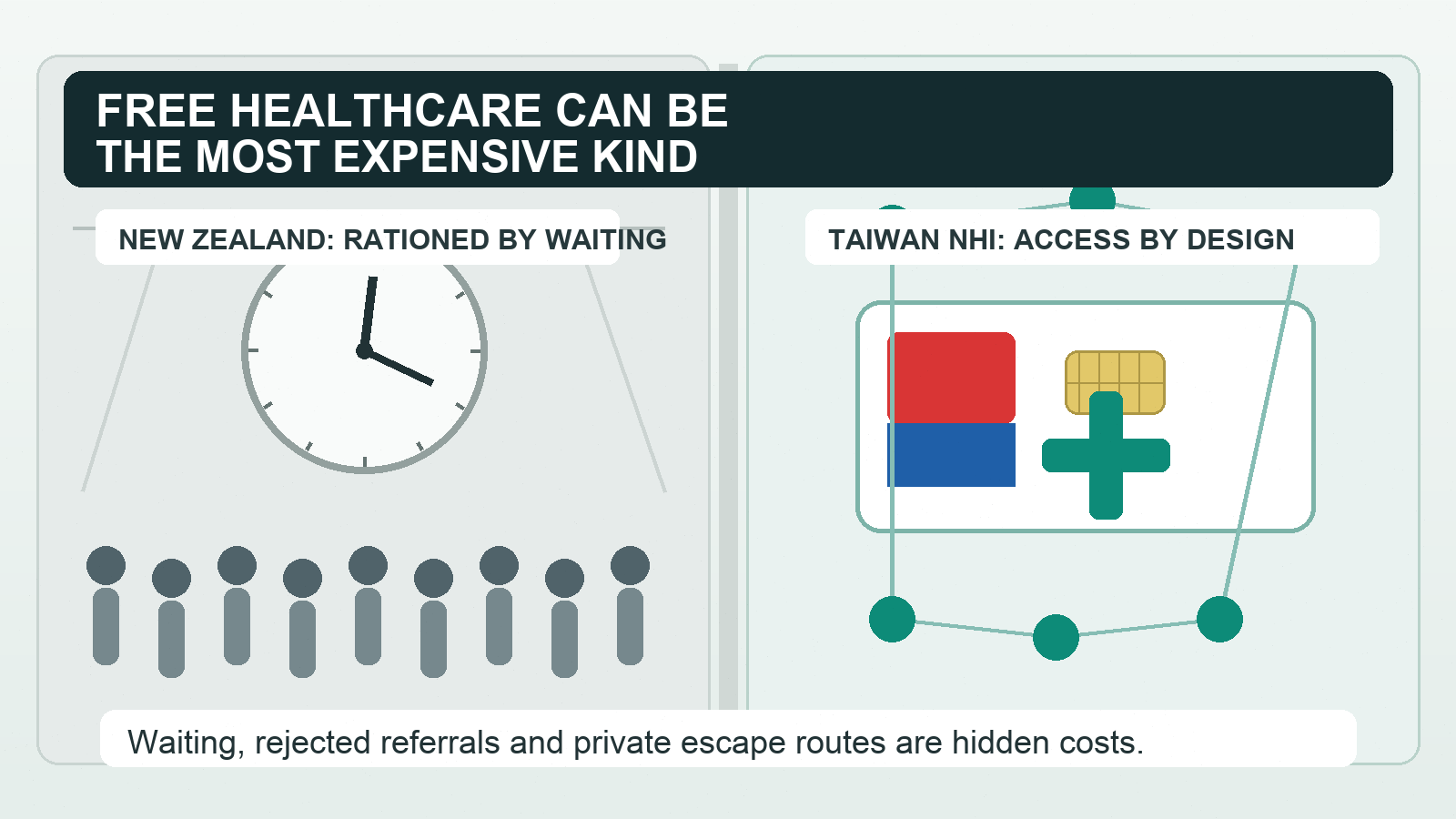
Opinion: The most comforting myth in New Zealand healthcare is also the most expensive one: because the public system is free at the point of care, we tell ourselves it is fair.
But care that arrives too late is not free. Care that requires a patient to deteriorate before they qualify is not free. Care that forces families into private insurance, private specialists, emergency departments, unpaid time off work, pain, anxiety and avoidable decline is not free. It is simply paid for somewhere other than the hospital invoice.
The real bill for New Zealand healthcare is not always a dollar figure. Sometimes it is a four-month wait. Sometimes it is a rejected referral. Sometimes it is a cancer scare that sits in a household like a second mortgage. Sometimes it is a person giving up because the system has trained them to expect delay.
Free at the point of care is not the same as access
New Zealand’s official health targets make the problem visible. The Ministry of Health target for first specialist assessment is that 95% of patients should wait less than four months. The elective treatment target is also 95% within four months. Emergency departments are expected to admit, discharge or transfer 95% of patients within six hours.
These targets are better than having no targets. But they also reveal how low the public expectation has become. A system can call a four-month specialist wait a performance benchmark while the patient calls it fear, pain or lost time. The language of targets can make suffering sound administratively tidy.
New Zealanders often defend the system by saying, “at least you do not get a huge bill.” That is true in many hospital settings for eligible patients. It is also incomplete. If a patient waits long enough for a condition to worsen, if they pay privately to escape the queue, or if they lose income while waiting for diagnosis and treatment, the bill has still arrived. It just arrived through the side door.
The hidden waiting list is the scandal
The harshest part of the system is not only the visible waiting list. It is the people who never make it onto the list in the first place.
In its 2026 report Unmet, unmeasured and unseen, the Association of Salaried Medical Specialists highlighted a gap between official specialist waiting lists and the much larger pool of unmet need. The report said the official waiting list for a first specialist assessment was 198,812 people in December 2025. It also estimated that, if trends from seven districts applied nationally, more than 255,000 specialist referrals could have been declined across New Zealand in 2025.
That matters because a declined referral is not the same as a cured patient. It can mean a GP is left managing a problem that needed specialist input. It can mean the patient is told to come back later, when the condition is worse. It can mean the health system reduces pressure on itself by pushing uncertainty back onto the person least able to carry it.
This is rationing by delay and invisibility. It is politically easier than charging a fee, but morally it can be more dishonest. A co-payment is visible. A declined referral can disappear into statistics, family stress and worsening symptoms.
Taiwan exposes New Zealand’s excuse
Taiwan is useful in this debate because it breaks a lazy argument: that public healthcare must choose between universal coverage and speed.
Taiwan’s National Health Insurance is not literally free. That point is important. It is a compulsory, single-payer social insurance system funded through premiums, government contributions and some co-payments. According to Taiwan’s National Health Insurance Administration, the NHI was launched on March 1, 1995; global budget payment systems were fully implemented in 2002; NHI Smart Cards replaced paper cards in 2004; and later digital systems such as PharmaCloud, MediCloud and My Health Bank were built into the system.
That is exactly the lesson New Zealand should study. Taiwan does not pretend healthcare has no cost. It makes the cost structured, pooled, visible and administratively connected to access. The system has problems – including pressure on doctors and nurses, high service volume, low fees and sustainability concerns – but its basic design treats access as the core product, not as an aspiration after the budget has already failed.
The Commonwealth Fund’s Taiwan profile describes a national insurance administration that collects premiums, pools risk, pays providers, oversees utilization and quality, and uses a global budget to distribute resources. Patients can access different levels of care, with co-payments used to encourage lower-tier care when appropriate. That is not a perfect model, but it is a model with machinery.
New Zealand, by contrast, too often has slogans where machinery should be.
The real difference is design, not compassion
New Zealand is not short of compassionate health workers. It is full of them. Nurses, doctors, specialists, ambulance crews, allied health workers and GP teams carry the moral burden of a system that asks them to absorb political underinvestment and public frustration at the same time.
The failure is not that frontline staff do not care. The failure is that the system has normalized scarcity and then wrapped that scarcity in the language of fairness.
In New Zealand, rationing often happens through time. You wait for a GP appointment. You wait for a referral. You wait to find out if the referral is accepted. You wait for the specialist. You wait for imaging. You wait for surgery. At every stage, the system can still describe itself as free, because the patient may not have paid at the counter.
But time is not neutral. Waiting is a clinical event. Waiting can turn a manageable condition into a complex one. Waiting can turn uncertainty into mental distress. Waiting can punish people who cannot advocate loudly, pay privately or navigate bureaucracy.
What New Zealand should learn from Taiwan
New Zealand does not need to copy Taiwan blindly. Taiwan’s NHI has its own pressures, and no country should romanticize another country’s health system. But New Zealand should stop using the word “free” as a shield against honest reform.
- Count declined referrals nationally. If a patient is rejected before entering the specialist queue, that unmet need must still be measured. A system should not be allowed to improve its numbers by making patients invisible.
- Make waiting-time targets patient-centred. Four months may be a planning metric, but for many patients it is not humane access. Targets should account for deterioration, pain, risk and the cumulative wait across the whole pathway.
- Invest in specialist capacity and diagnostics. More targets without more workforce, theatres, scanners and clinic capacity is theatre of another kind.
- Build digital infrastructure that actually follows the patient. Taiwan’s smart card and NHI data systems are not magic, but they show what happens when a national insurance system treats information as part of healthcare delivery.
- Be honest about cost. If New Zealand refuses visible funding mechanisms but accepts hidden costs through delay, it has not protected patients. It has only moved the price tag into their private lives.
- Stop treating private healthcare as an accidental pressure valve. When more people feel forced to go private to receive timely care, the public system becomes less universal in practice even if it remains universal in rhetoric.
Free can become cruel when it is slow
The strongest argument for public healthcare is moral: a person’s access to necessary care should not depend on wealth. That principle is worth defending. But defending it honestly means admitting when the current model is failing to deliver the access it promises.
A humane system is not one that promises care eventually. It is one that sees the patient before the illness becomes more expensive, more frightening and harder to treat.
New Zealand’s healthcare problem is not that it is too public. It is that it is too comfortable calling itself free while patients quietly pay through delay. Taiwan’s lesson is not that healthcare can be costless. The lesson is that universal healthcare needs hard design, transparent financing, national data, provider capacity and relentless accountability.
The cost of New Zealand healthcare is not only the bill you do not receive. It is the care you cannot access when you need it.
Sources
- New Zealand Ministry of Health: Health targets
- Health New Zealand: Health targets
- ASMS: Unmet, unmeasured and unseen report
- Taiwan National Health Insurance Administration: NHI timeline
- Taiwan National Health Insurance Administration: How premiums are calculated
- Commonwealth Fund: Taiwan health system profile
- Health and Human Rights Journal: Maintaining the Right to Health in Taiwan