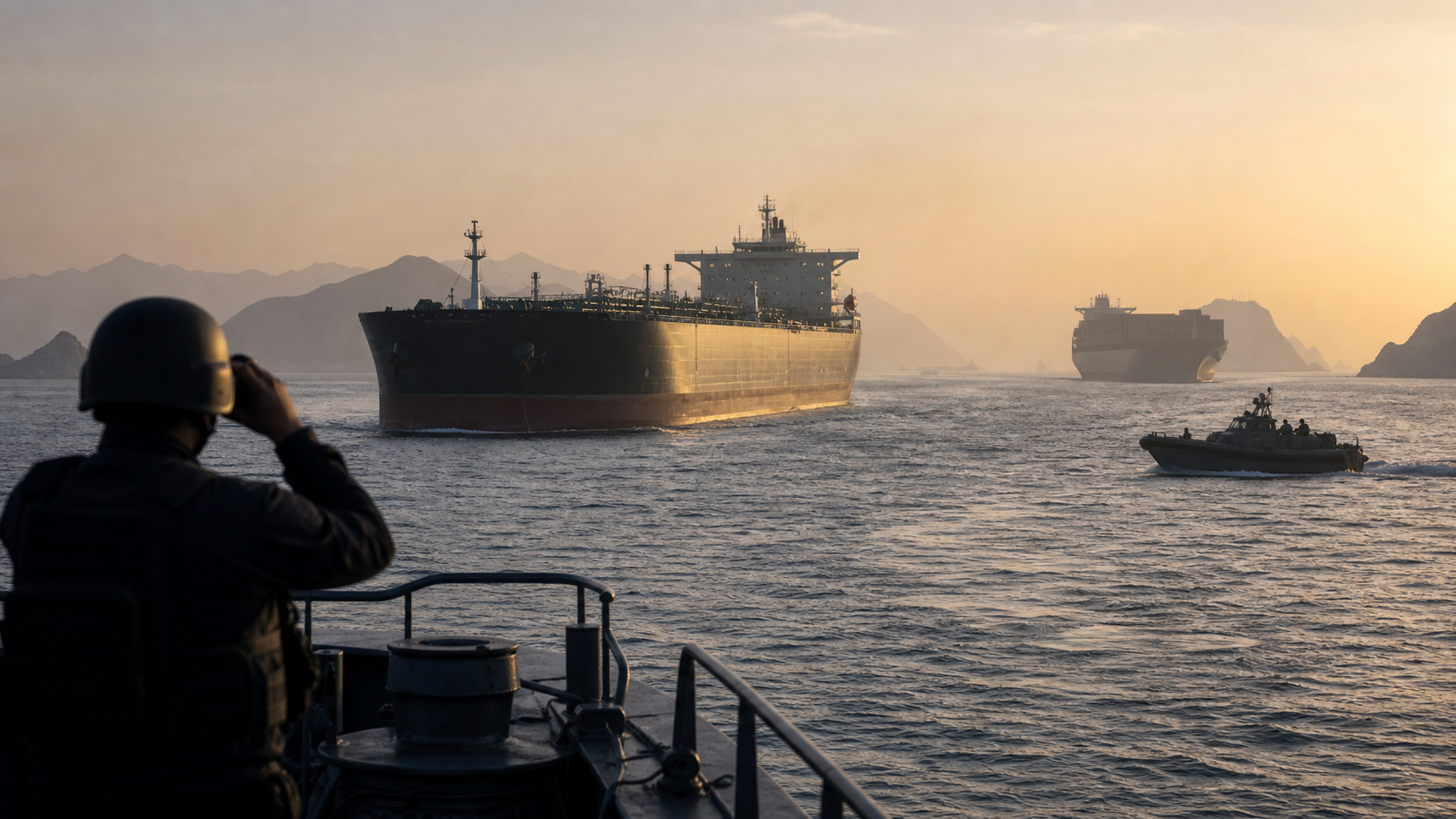
A maritime chokepoint does not reopen the moment a deal is signed. It reopens when shipowners, insurers, crews, port operators and energy buyers believe the water is safe enough to use.
That distinction is now central to the Strait of Hormuz. Financial Times reporting has warned that shipping through the strait may remain limited for months because of mine risks and industry caution. Al Jazeera has examined how safe passage might be assured after the strait’s reopening, while the U.S. Energy Information Administration describes Hormuz as one of the world’s most important oil transit chokepoints. The legal and diplomatic language can shift quickly; commercial confidence moves more slowly.
Why Hormuz matters
The Strait of Hormuz is a narrow passage between Iran and Oman connecting the Persian Gulf with the Gulf of Oman and the Arabian Sea. It carries a major share of global oil and gas flows. Even when markets do not panic, the strait sits inside energy pricing, shipping insurance, naval planning and inflation expectations.
That is why disruptions there matter far beyond the Gulf. A delay can affect crude shipments, LNG cargoes, petrochemicals, fertilizer inputs, freight schedules and risk premiums. Importers in Asia watch it closely. European energy planners watch it. Insurers watch it. So do households who never hear the phrase “war risk premium” but may feel it later in fuel and goods prices.
The mine problem is different from the blockade problem
A blockade can be negotiated, threatened, challenged or lifted. Mines are different. They leave behind uncertainty. Even a small number of mines can change behaviour if ship operators do not know where they are, how sophisticated they are, or whether clearance is complete.
Mine clearance is slow because the cost of being wrong is catastrophic. A tanker is not a small risk object. It carries crew, cargo, environmental danger and enormous financial exposure. A captain asked to transit a recently mined corridor is not simply making a route choice; they are trusting intelligence, clearance operations, naval guarantees, insurance cover and the stability of a political agreement.
That is why shipping can resume in a trickle rather than a wave. Some vessels may pass through narrow channels. Others may wait. Some cargoes may reroute. Some insurers may price the risk so high that a voyage becomes uneconomic.
Markets can underreact before they overreact
Energy markets often appear calm until physical constraints become undeniable. Traders may assume disruption will be temporary, strategic reserves will cushion supply, or diplomatic pressure will keep flows moving. Sometimes they are right. But chokepoints are awkward because they combine physical geography with political risk. A narrow waterway cannot be diversified overnight.
The EIA’s chokepoint work is useful because it reminds readers that energy security is not only about production. It is about movement. Oil in the ground, gas under contract or cargoes on order do not help consumers if the route between supplier and buyer is unsafe, delayed or prohibitively expensive.
Insurance and crew confidence are part of infrastructure
Public debate often treats shipping as if vessels move automatically once governments say they can. In reality, commercial shipping depends on a chain of confidence. Insurers must be willing to cover hull, cargo and war risks. Crew members and unions must accept the danger. Banks and charterers must tolerate uncertainty. Ports must be ready. Naval forces must provide credible information.
If any part of that chain weakens, traffic remains below normal. This is why the private sector’s caution matters. A government may want a symbolic reopening. A shipping company has to decide whether the risk to crew and vessel is acceptable.
The global lesson
Hormuz is a reminder that globalisation rests on surprisingly fragile corridors. The world often talks about supply chains as if they are spreadsheets. They are also bridges, canals, ports, straits, undersea cables, rail lines and insurance markets. When one corridor becomes unsafe, the shock moves through systems that were optimised for efficiency rather than spare capacity.
That does not mean every Hormuz disruption becomes a global crisis. It does mean that policymakers should stop treating chokepoint security as a specialist naval issue. It belongs in energy policy, climate transition planning, food security, inflation management and trade strategy.
What to watch next
The next indicators are practical. How many vessels transit each day? Are insurers lowering or raising premiums? Are major carriers returning or only testing the route? Are mine-clearance operations independently credible? Do naval warnings become calmer or sharper? Do oil and LNG buyers rebuild inventories or wait?
The strait’s reopening will not be proven by a communiqué. It will be proven by routine. When crews, insurers and cargo owners stop treating each voyage as an exceptional risk, Hormuz will be closer to normal. Until then, the world is watching a chokepoint that is technically open but not yet trusted.
Sources: Financial Times reporting on mine risks and shipping caution, Al Jazeera on Hormuz reopening and safe passage and EIA world oil transit chokepoints.