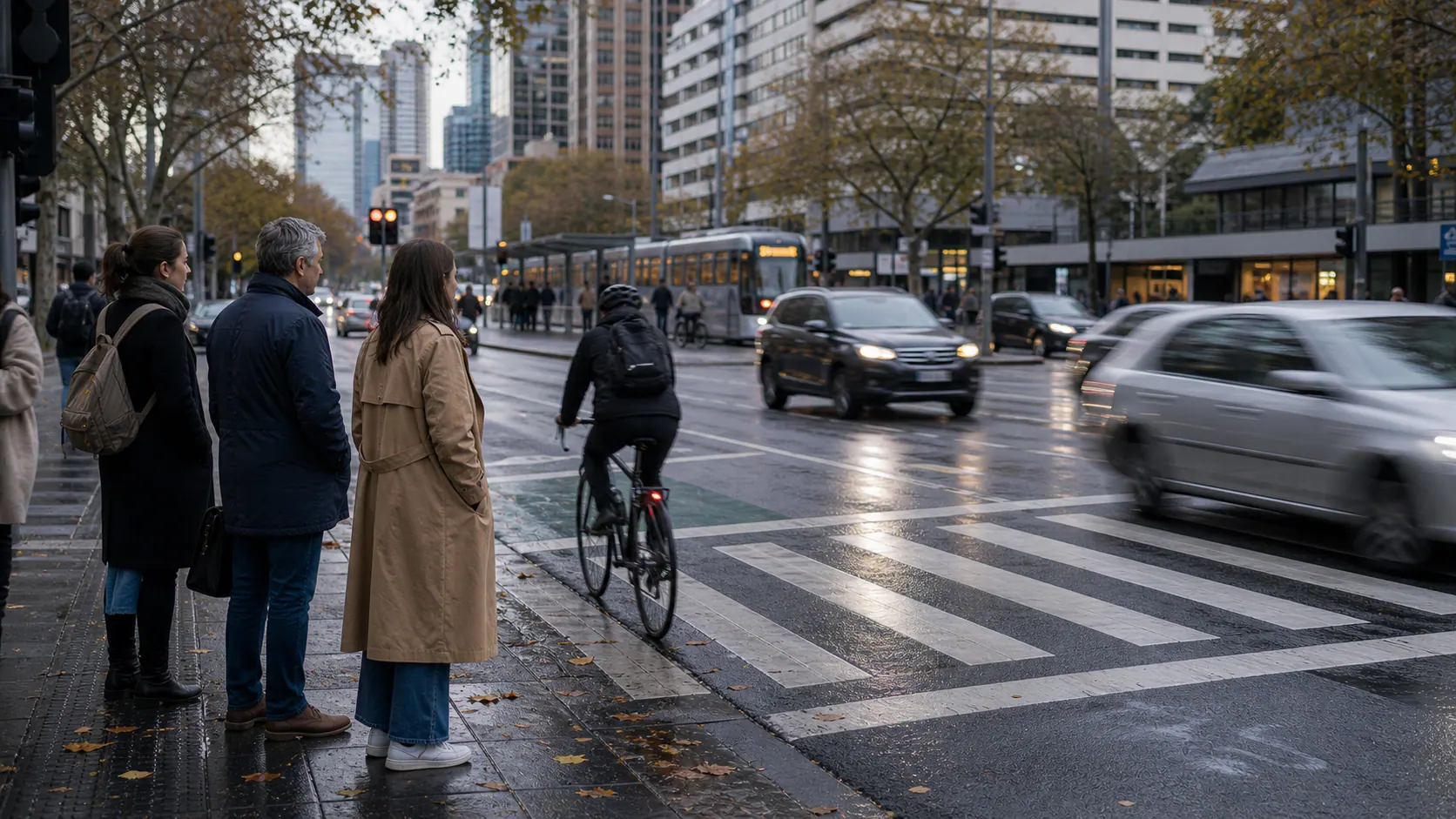
Reducing a speed limit sounds minor until it touches the everyday politics of streets. A few kilometres per hour becomes an argument about commute times, delivery schedules, local business, school safety, police enforcement and whether public space belongs mainly to cars or to people moving through a neighbourhood.
The Guardian’s Australian reporting has renewed attention on a familiar road-safety question: if lower urban speed limits can reduce harm to pedestrians and cyclists, why are many cities still reluctant to adopt them widely? This is not only an Australian issue. It is a global urban-policy problem, because the same conflict appears in cities from Auckland to London, Melbourne to Toronto.
The evidence problem is not the problem
The basic physics is straightforward. Higher impact speeds increase the chance that a crash kills or seriously injures a person outside a vehicle. Lower speeds give drivers more time to react and reduce stopping distance. They also make streets feel safer for walking and cycling, which can change how people move through local neighbourhoods.
International road-safety bodies and public-health agencies have long argued that speed management is central to a safe-system approach. The point is not that every street should move at the same speed. It is that roads used heavily by pedestrians, children, older people, cyclists and local shoppers should not be treated like miniature highways.
Why governments hesitate
The resistance is partly political. Speed-limit reductions are highly visible, easy to attack and often experienced by drivers before the safety benefits become obvious. A fatal crash avoided is not a dramatic public event. A slower commute is. That imbalance makes prevention hard to sell.
There is also a trust problem. If a lower limit is introduced without clear design changes, some drivers see it as revenue raising rather than safety policy. If enforcement appears selective, support falls. If local councils cannot explain which streets are changing and why, the measure becomes a symbol of bureaucracy rather than care.
Design matters as much as the sign
A lower number on a pole is rarely enough. Streets have to be designed so the safe speed feels natural. Narrower lanes, raised crossings, better lighting, protected cycle lanes, kerb extensions, tree cover and clearer intersections can all help drivers behave differently without constant enforcement. Speed policy works best when it is built into the street, not simply announced to it.
This is where many cities underdeliver. They change rules faster than they change environments. The result can be frustration for drivers, continued fear for pedestrians and limited political durability. A serious lower-speed policy should be paired with street redesign and public explanation.
Who benefits is broader than campaigners
Lower speeds are often framed as a cyclist or pedestrian demand. But the beneficiaries include children walking to school, older people crossing near shops, wheelchair users, parents with prams, delivery workers, bus passengers walking to stops and drivers themselves. Serious injuries carry social costs far beyond the crash scene, including hospital demand, rehabilitation, family care, insurance and lost work.
Small businesses may also benefit when streets become easier to cross and more pleasant to linger in. The choice is not always between economic activity and slower speeds. In many local centres, the more relevant question is whether a street is a place people want to spend time, not only a pipe for moving vehicles through.
The best counterargument
There is a real concern that blanket changes can be poorly targeted. Freight routes, emergency access and outer arterial roads have different functions from school streets and shopping strips. If governments fail to distinguish between them, they invite backlash and weaken the case for safety where it matters most.
That counterargument should lead to better design, not paralysis. Cities can be precise. They can start with schools, local centres, high-injury corridors and areas with heavy walking and cycling. They can publish data, measure travel-time impacts and adjust design where necessary. The lesson is not to avoid speed reductions. It is to make them credible.
What to watch
The next stage in Australia and elsewhere will be whether governments can turn road-safety evidence into politically resilient street policy. That requires more than safety slogans. It requires data, design funding, honest communication and the courage to admit that familiar roads can be dangerous precisely because they feel ordinary.
The takeaway is that lower urban speed limits are not an anti-driver gesture. They are a public-health tool. The real test is whether cities can implement them carefully enough that people experience not only slower streets, but safer, more useful ones.
Sources: The Guardian Australia on urban speed limits, WHO road-traffic injury fact sheet.