The ocean moderates climate, supports food and livelihoods, and covers most of the planet’s living space. Yet many regions remain sparsely observed, while research vessels, sensors, laboratories and data expertise are concentrated in a relatively small number of countries.
The IOC of UNESCO released the executive summary of the third Global Ocean Science Report in June 2026, describing the most complete picture of capacity, investment and collaboration assembled for the field. The report should be read as an infrastructure audit, not a celebration of individual discoveries.
Observation requires continuity
A short expedition can reveal a process but not a trend. Moorings, floats, coastal stations and repeat sampling need maintenance, calibration and long-term budgets. Funding only novelty creates impressive launches and broken time series.
Capacity is more than equipment
A donated instrument is useful only with technicians, consumables, connectivity, data management and career paths. Training should create local authority to set questions, not permanent dependence on visiting institutions.
Data sharing must be reciprocal
Open standards and timely access improve forecasting and research. But communities and countries providing access should receive usable products, attribution and decision power. Indigenous and local knowledge requires governance, not extraction into a global database.
Coasts need finer resolution
Global models may miss bays, reefs, estuaries and small-island conditions where decisions occur. Local monitoring connects climate trends to fisheries, hazards, pollution and restoration.
Ships and satellites are complements
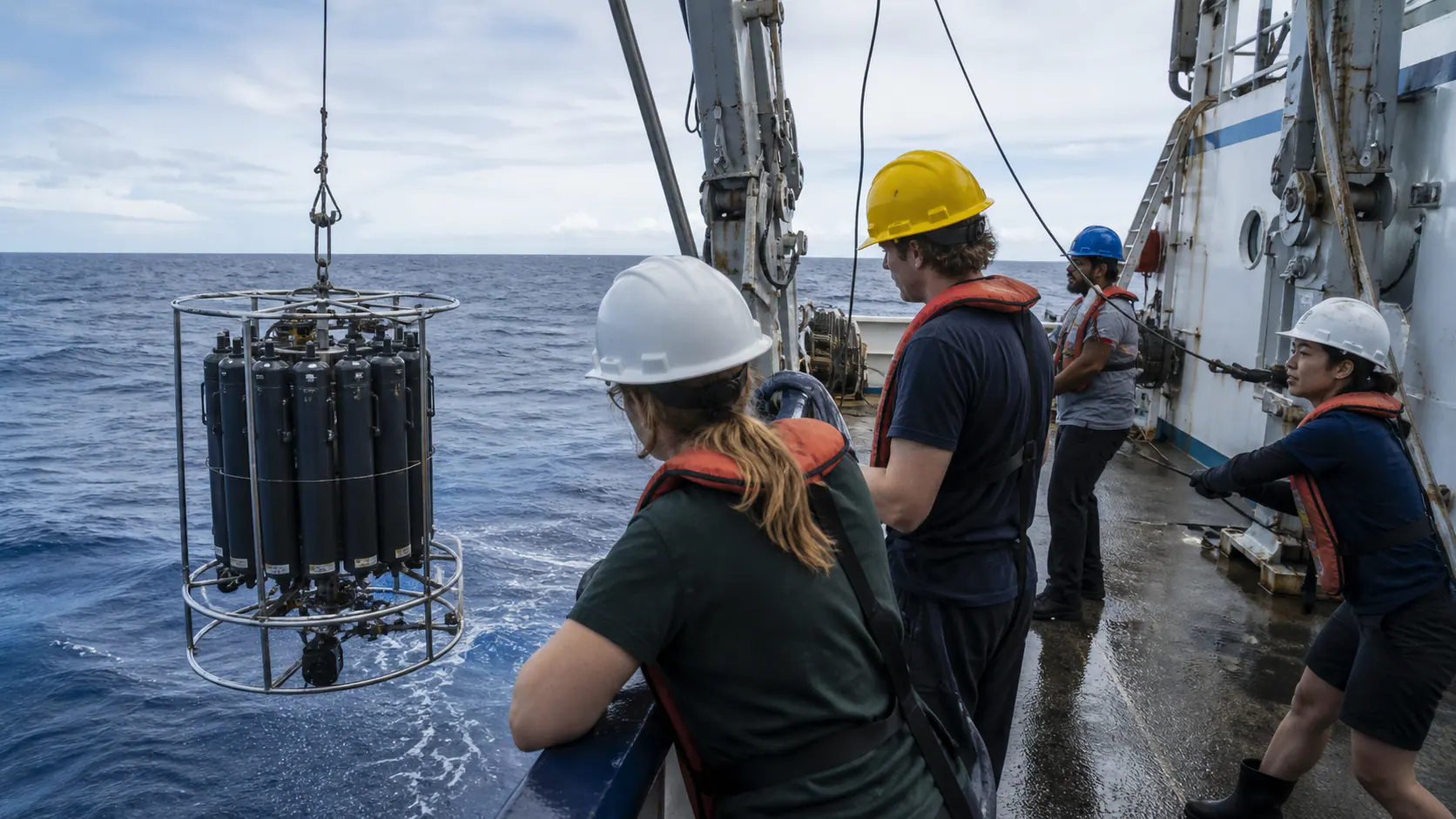
Satellites provide broad repeated views; in-water measurements explain depth and calibrate signals. Autonomous instruments expand reach but do not remove the need for vessels and skilled people.
Science must reach decisions without false certainty
Reports should express uncertainty while identifying robust action. Waiting for perfect knowledge can be as political as exaggerating confidence.
A world that depends on the ocean needs observations treated like weather services: sustained, interoperable and public-serving. The largest blind spots are not merely scientific gaps; they are unequal capacity to anticipate change.
Maintenance is a scientific output
Research systems often reward papers and new instruments while treating calibration, vessel time, data curation and repair as background cost. Yet a sensor that drifts unnoticed can contaminate a time series, and a platform without replacement parts can turn an ambitious network into scattered gaps. Funders should evaluate uptime, data quality and local technical capacity alongside publications.
Career structures matter just as much. Early-career researchers in under-resourced regions may be trained abroad and then find no funded post, laboratory or ship access at home. Fellowships should connect to institutional investment and long-term positions, or capacity-building will continue to move expertise toward already strong centres.
Who sets the research question
Global priorities such as carbon uptake and sea-level rise are essential, but coastal communities may need answers about harmful blooms, groundwater salinity, erosion or a local fishery. Shared programmes should reserve decision-making power and budgets for locally defined questions, then connect those observations to global standards.
The report can become a baseline for accountability if future editions show not only where science increased, but which gaps persisted and why. Ocean knowledge is a global public good, yet producing it relies on ports, crews, permits and communities in particular places. Fair collaboration must recognise that labour and authority.