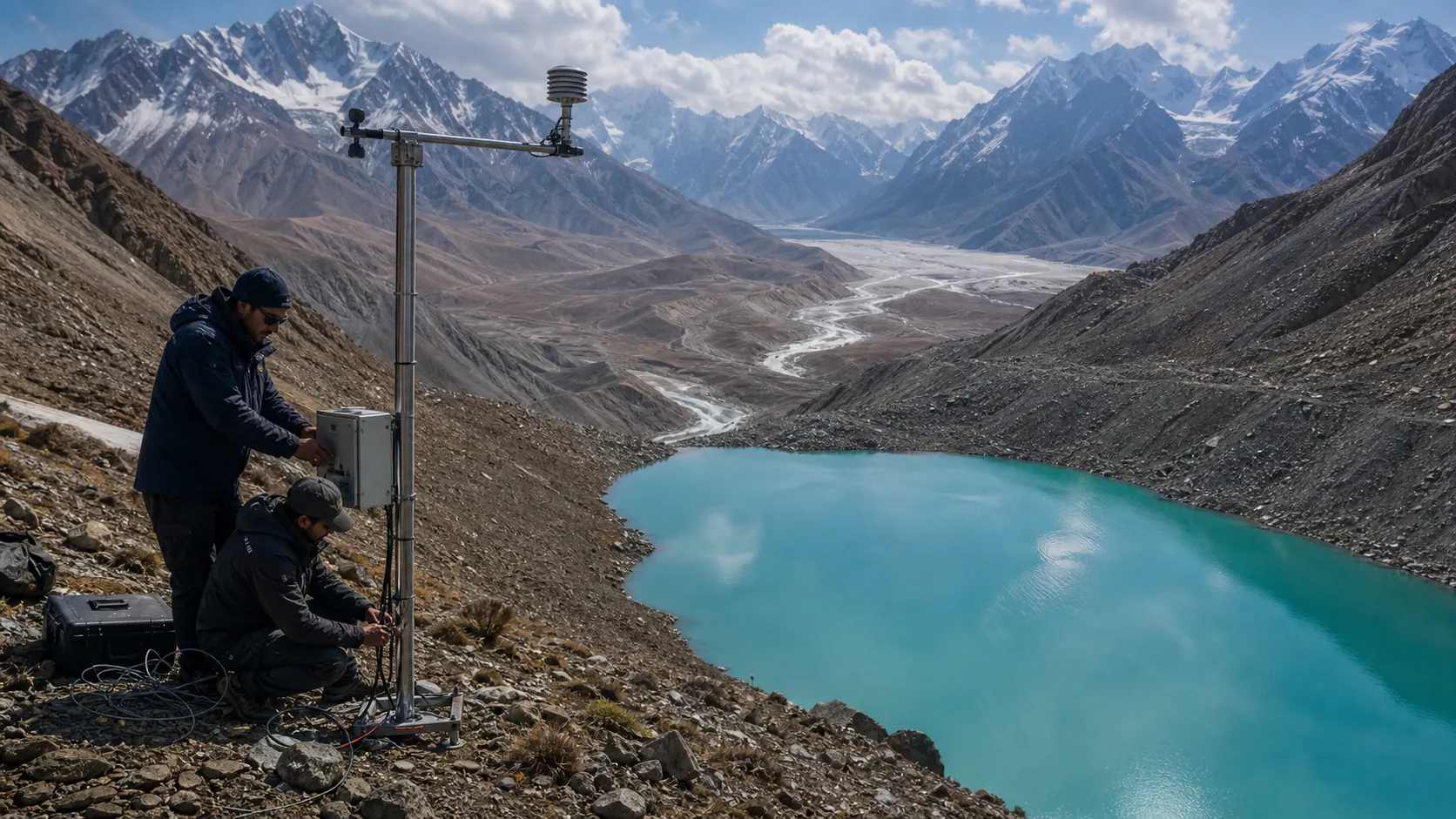
A glacial lake can look calm while storing a moving disaster. Ice retreat leaves water behind natural dams of moraine or ice. A rockfall, avalanche, rapid melt or structural failure can release a flood carrying water, sediment and debris down a narrow valley.
UNESCO’s Central Asian GLOFCA project combines monitoring, institutional capacity and community preparedness across Kazakhstan, Kyrgyzstan, Tajikistan and Uzbekistan. That regional approach reflects a physical fact: mountain water does not stop at administrative boundaries.
Risk begins with an inventory
Satellite images can identify new and expanding lakes, but field surveys are needed to understand dams, slopes and drainage. Inventories must be updated as glaciers change.
A stable lake last decade may not be stable now.
Sensors are only one link
Water levels, weather stations and cameras can detect change. Equipment must survive harsh conditions and transmit despite power or network failure.
Maintenance and data review need named institutions and budgets.
Warnings must be understandable
A technically accurate alert fails if residents do not receive it, trust it or know what action to take. Sirens, phones, radio and local messengers provide redundancy.
Messages should specify routes, timing and safe areas.
Practise evacuation
Maps made in an office may overlook bridges, livestock, older residents or tourists. Community drills reveal bottlenecks and allow people to act without waiting for perfect information.
Plans need night-time and winter scenarios.
Manage what can be managed
Some lakes can be lowered or drained, while others require land-use controls and protection of critical infrastructure. Intervention carries its own environmental and engineering risks.
Transparent risk assessment should guide priorities.
Think across the watershed
Flood waves can cross districts and borders. Shared data, common thresholds and coordinated communication reduce dangerous delay.
A warning system is not a sensor beside a lake. It is a promise that information will travel faster than the hazard, all the way to the last household downstream.