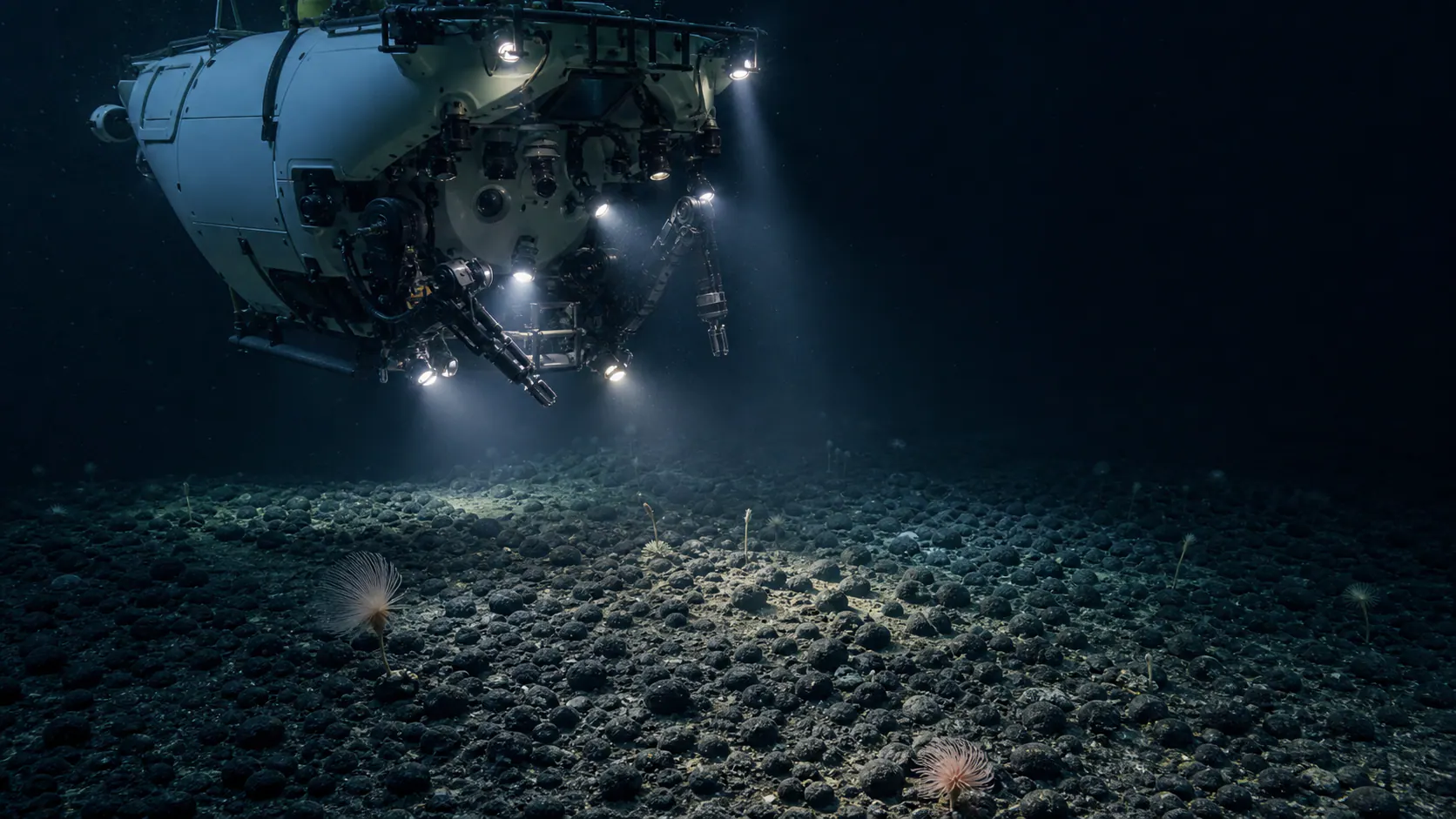
The abyssal plain looks empty until lights reach it. Then the seafloor reveals tracks, sediments, sponges, corals and small organisms adapted to darkness, pressure and extremely slow change. Polymetallic nodules scattered across some regions contain nickel, cobalt, copper and manganese, attracting interest as demand for energy-transition minerals grows.
The governance problem is stark: commercial decisions could arrive before science has described baseline ecosystems, regional connectivity or realistic recovery times.
Nodules are habitat as well as ore
Nodules form over millions of years and provide hard surfaces in otherwise soft sediment. Removing them removes habitat, not merely loose stones.
Collector vehicles would also disturb sediment. Plumes could spread beyond mined tracks, with effects depending on particle size, currents and organism sensitivity.
Climate benefits require comparison
Mining advocates argue seabed minerals could support batteries with less land disruption. That claim must be tested against improved terrestrial mining, recycling, changing battery chemistry and demand reduction.
A fair lifecycle comparison includes ships, processing, waste, ecosystem loss and uncertainty, not only ore grade.
The regulator faces a structural tension
The International Seabed Authority is expected to organise resource activity while protecting the marine environment. It must resist pressure to treat the absence of evidence as evidence of safety.
Rules need independent science, public data, transparent contracts, enforceable liability and monitoring that continues after operations stop.
A pause can be active governance
A precautionary pause is not a refusal to learn. It can fund baseline mapping, standardise sampling and establish protected reference areas before irreversible disturbance.
Time also allows recycling and alternative technologies to change the economic case. A rush based on today’s mineral forecast could lock in damage for a demand profile that shifts.
The inheritance question
The deep ocean lies beyond most people’s sight, but that does not make it empty or ownerless. Decisions made now could alter habitats formed over geological time.
The burden of proof should rest with those proposing extraction. Humanity should not discover the ecological function of the nodules only after the machines have removed them.
Sources and further reading: International Seabed Authority; IUCN deep-sea mining issues brief.