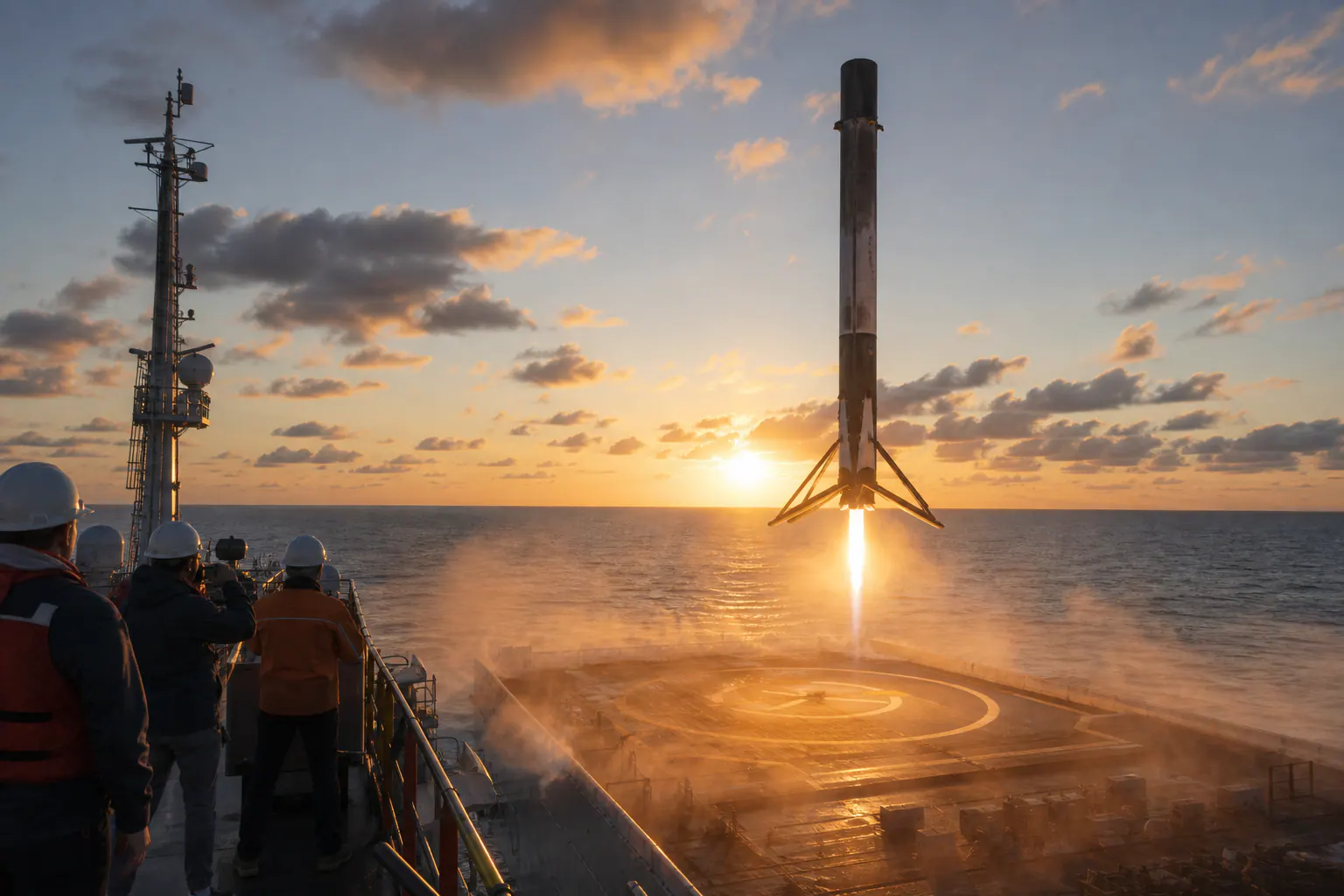
A rocket stage falling back toward Earth can look like a spectacular engineering image, but the real story is economic. If a launch system can recover and reuse major hardware reliably, the cost structure of space changes. Missions can become more frequent, industrial supply chains can mature faster, and space activity can move from rare national demonstration to routine infrastructure.
AP reported that China recaptured the first stage of a space rocket for reuse, an important step in the country’s push toward reusable launch capability. The details matter, but the larger signal is even more important: China is not treating reusability as a novelty. It is treating it as part of the industrial foundation for a larger space economy.
Why recovery matters
Traditional expendable rockets throw away expensive hardware after each launch. That model worked for decades because launch cadence was limited and national prestige or strategic necessity justified high cost. Reusable systems aim to change the equation. Recover the first stage, refurbish it quickly enough, fly again, and the marginal cost of reaching orbit can fall.
The phrase ‘can fall’ is important. Reusability is not magic. It requires durable engines, precise guidance, recovery infrastructure, inspection processes, refurbishment discipline, manufacturing consistency and enough launch demand to make reuse worthwhile. A recovered stage is a milestone, not the finish line. The economic prize depends on whether recovery becomes routine.
The SpaceX shadow
Any discussion of reusable rockets now happens in the shadow of SpaceX. The American company changed expectations by making booster landings familiar and by linking reuse to high launch cadence, satellite deployment and commercial contracts. That success created a new benchmark for every major space power and private launch company.
China’s effort should not be read as a simple copy. It sits inside a different system: state-backed aerospace institutes, emerging commercial launch firms, civil-military industrial overlap, national science goals, satellite internet ambitions and a strategic desire to avoid dependence on foreign launch services. Reusability is part of a wider capacity-building programme.
Launch cost is strategic infrastructure
Lower-cost, higher-frequency launch has consequences beyond space enthusiasts. It affects Earth observation, disaster monitoring, navigation resilience, communications networks, climate data, remote sensing for agriculture, defence awareness, scientific missions and commercial experimentation. A country that can launch more often and more cheaply can test more, fail faster, replace satellites sooner and build denser orbital systems.
That is why reusable launch should be understood as infrastructure. Railways, ports, data centres and power grids shape what industries can grow. Launch systems do the same for space. If access to orbit becomes more predictable, a larger ecosystem of satellite manufacturers, software companies, ground-station providers, data users and component suppliers can develop around it.
There are still hard constraints
Reusability does not solve every space problem. Rockets still face safety risks, regulatory limits, debris concerns, range constraints, propellant logistics and environmental questions around launch operations. More frequent launches can increase the burden of space-traffic management. Satellite constellations can create astronomy, collision and spectrum issues. A cheaper route to orbit is powerful, but it must be governed.
China also has to prove reliability over time. A single recovery can show technical progress. A reusable launch economy requires repeated flights, transparent performance data, customer confidence and a maintenance culture that treats boring reliability as the main achievement. The gap between demonstration and dependable service is where many aerospace ambitions become difficult.
Why the rest of the world watches
For New Zealand, Australia and the wider Asia-Pacific, China’s launch advances are not distant. The region already lives with space-enabled services: weather forecasting, navigation, maritime tracking, emergency communications, agricultural monitoring and broadband. Competition in launch capability can lower costs and expand services, but it can also deepen strategic rivalry and raise questions about data, dependencies and orbital congestion.
New Zealand has its own launch sector through Rocket Lab and a regulatory environment that places it inside the global space conversation. China’s progress therefore belongs in the same mental map as American private launch, European launch difficulties, Indian space ambitions and growing regional demand for satellite services.
The signal to read
The most important point is not that China has completed one dramatic recovery. It is that reusable launch is becoming a normal benchmark for serious space powers. The countries and companies that master it will have an advantage not only in spectacular missions, but in the quieter business of putting useful machines into orbit again and again.
That is the space-economy signal. The next era of space will be shaped less by who can occasionally reach orbit and more by who can make access frequent, reliable and affordable. China’s rocket recovery is one step on that path. The question now is how quickly it can turn a technical success into a repeatable industrial system.
Source: AP on China recapturing a rocket first stage for reuse.