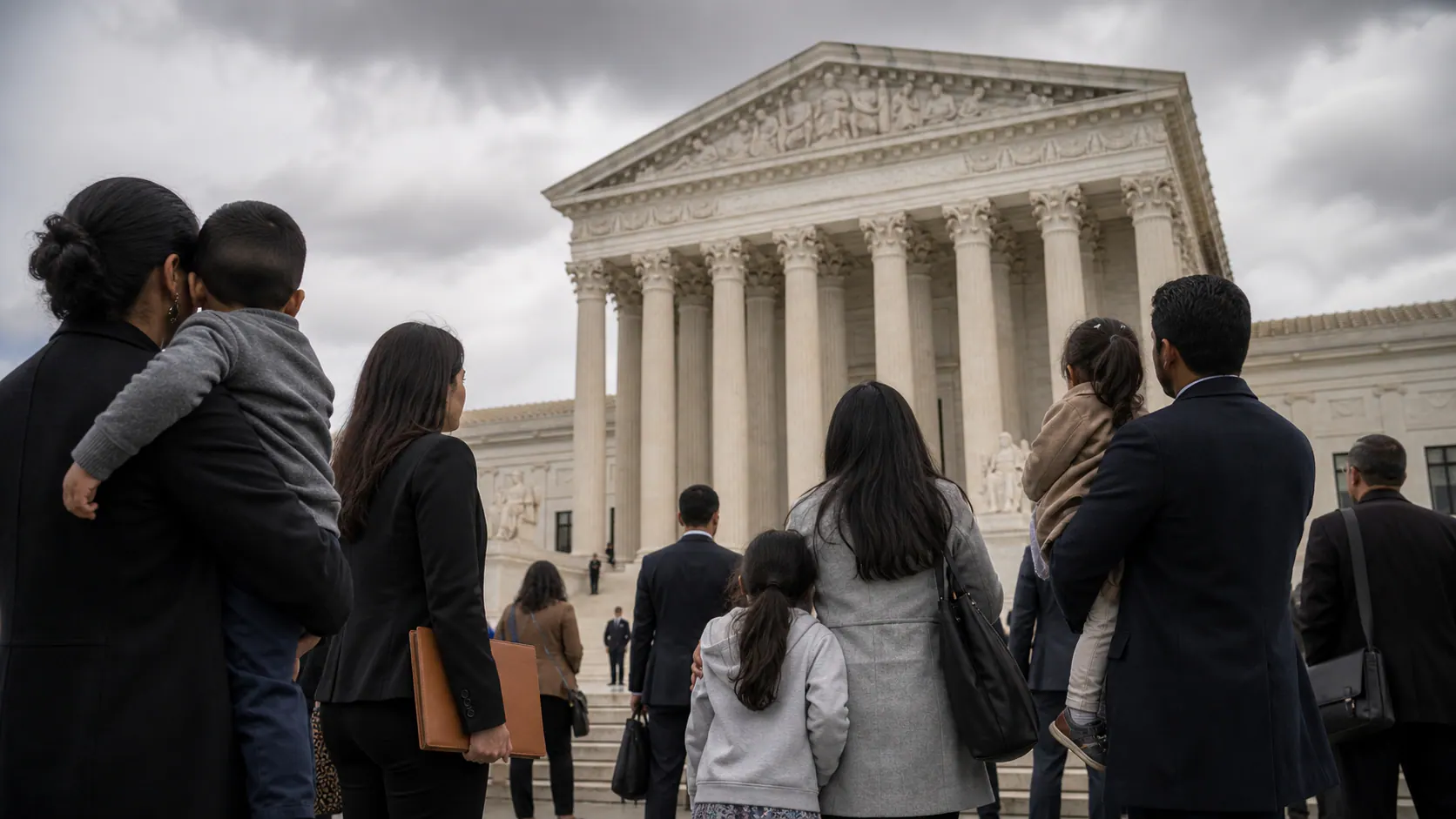
Citizenship is most powerful when it is boring. A child is born, documents are issued, rights attach, and a family can plan life without wondering whether the state will later question the child’s belonging. The U.S. fight over birthright citizenship threatens that boring certainty.
AP and other U.S. outlets have reported on court battles surrounding efforts to limit birthright citizenship and the Supreme Court’s handling of related nationwide injunction questions. The constitutional issue is large, but the human issue is immediate: who gets to leave the hospital with legal certainty, and who is forced into doubt?
What birthright citizenship does
The Fourteenth Amendment has long been understood to grant citizenship to people born in the United States and subject to its jurisdiction. That rule has made citizenship administration relatively clear. It does not require a newborn’s legal status to depend on a parent’s visa, paperwork, mistake, immigration case or bureaucratic delay.
That clarity matters because citizenship is not symbolic. It affects passports, Social Security numbers, healthcare, schooling, travel, family stability and protection from removal. A rule that appears abstract in constitutional argument becomes very concrete at a hospital registration desk.
Why uncertainty is the point
Even before a final legal answer, attempts to narrow birthright citizenship can produce uncertainty. Hospitals, state registrars, immigration lawyers, families, schools and agencies may not know how to treat future births. Some parents may fear seeking services. Others may rush to file documents. Legal aid systems may be overwhelmed.
That is why the practical harm is not limited to people eventually denied citizenship. It includes people forced to prove what used to be automatic. When a right becomes administratively contestable, the burden falls hardest on families with less money, less legal knowledge and less ability to wait.
The court question and the family question
Much of the legal debate has focused on judicial power: whether lower courts can issue nationwide injunctions blocking federal policy across the country. That is an important separation-of-powers issue. But families experience it differently. If an injunction applies in one place but not another, or if rules shift while litigation continues, a newborn’s legal treatment may depend on geography and timing.
The result can be a patchwork of uncertainty. A constitutional right should not feel like a postcode lottery. Yet that is exactly what can happen when high-stakes rights are filtered through emergency litigation.
Immigration politics and constitutional stability
Supporters of limits argue that birthright citizenship encourages unlawful migration or birth tourism. Those concerns deserve policy discussion. But changing the citizenship rule by executive action or unstable litigation carries enormous institutional cost.
Citizenship is the legal foundation beneath the rest of civic life. If governments can destabilise it through aggressive reinterpretation, the precedent reaches beyond immigration politics. It teaches families that even the status of a child born on U.S. soil may become a contested administrative fact.
Who is most affected
The affected families are not only undocumented migrants. Mixed-status families, temporary workers, students, asylum seekers, people with pending cases, and children of parents caught in bureaucratic delay may all face fear or confusion. Hospitals and local officials would also face pressure to interpret complex federal policy in emotionally charged settings.
The richer a family is, the easier it is to hire lawyers, gather records and wait out uncertainty. The poorer a family is, the more a delayed document can disrupt basic life. That inequality is central to the story.
What to watch next
Watch how lower courts apply Supreme Court guidance on injunctions. Watch whether federal agencies issue implementation instructions. Watch state registrars and hospitals. Watch legal aid organisations, because they will see the confusion early. Watch whether Congress engages seriously or leaves the issue to executive orders and litigation.
The birthright citizenship fight is often described as a clash over borders. It is also a clash over legal certainty. A stable citizenship rule lets families begin life with a clear answer. A contested rule turns newborn status into a legal question mark. That is a profound change in the relationship between the state and the child.
Sources: AP coverage of U.S. Supreme Court and citizenship litigation, U.S. Supreme Court and U.S. Constitution Annotated on the Fourteenth Amendment.