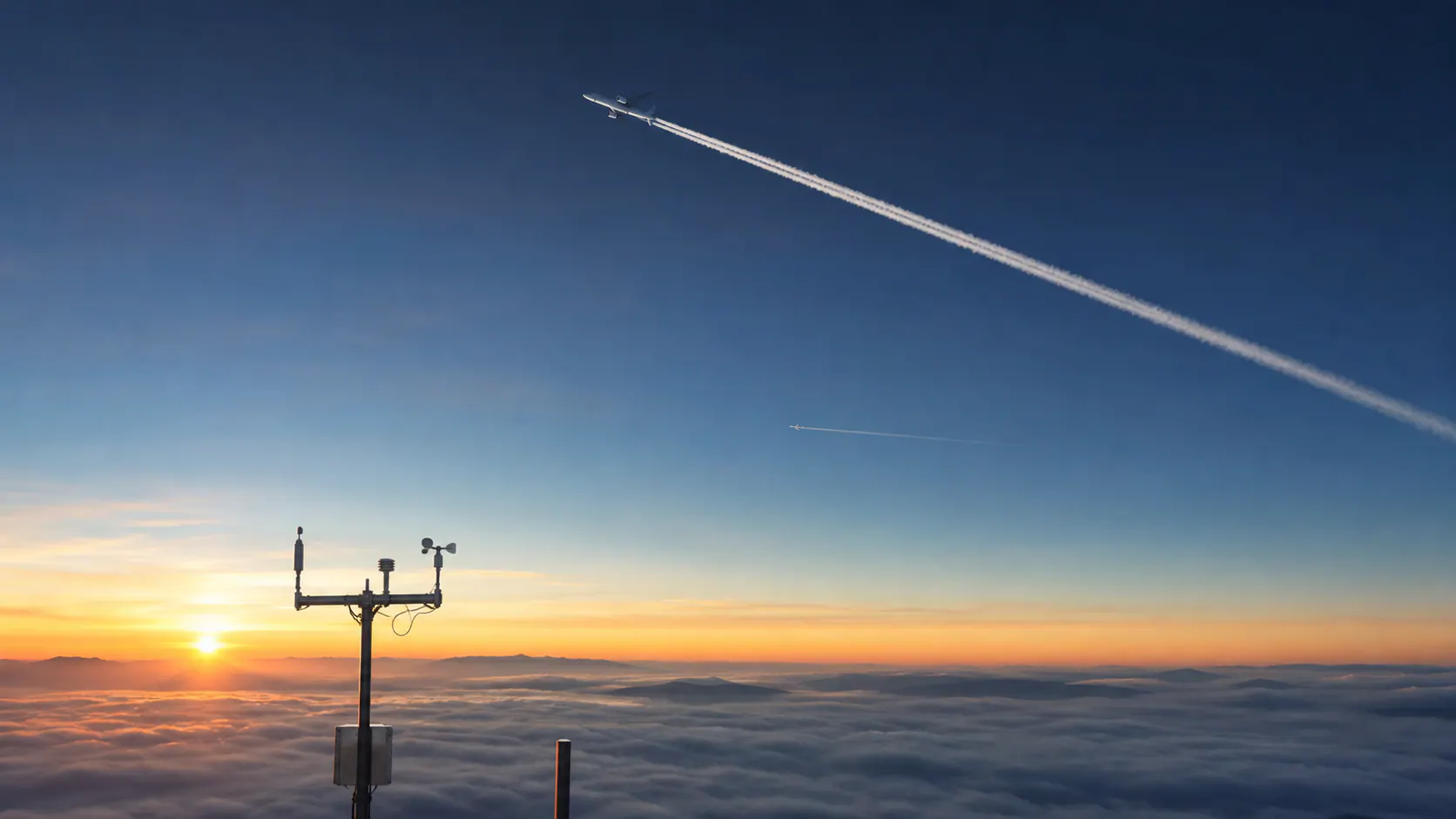
The white line behind an aircraft can vanish quickly or spread into a thin cloud that persists. Contrails form when hot, moist exhaust meets very cold air at altitude. Under ice-supersaturated conditions, they can influence Earth’s radiation balance, trapping heat as well as reflecting sunlight.
Research suggests a relatively small share of flights may account for a large portion of persistent contrail warming. That concentration creates an unusual policy opportunity: targeted altitude or route changes could reduce impact without redesigning every aircraft.
Prediction is the central challenge
Weather models must identify narrow atmospheric layers hours in advance. Humidity at cruise altitude is difficult to measure and forecast, so a route change may avoid a predicted region that was harmless or enter another.
Trials need verification from satellites and aircraft observations, not model claims alone.
Not every avoidance is beneficial
Changing altitude can burn more fuel and increase carbon dioxide. The climate trade-off depends on contrail duration, time of day, season and extra fuel.
Decision tools should compare total effect and set limits on operational penalties.
Safety and airspace come first
Pilots and controllers manage weather, turbulence, traffic and restricted airspace. Contrail avoidance must fit existing procedures and never become an informal pressure that competes with safety.
Automation may help, but accountability must remain clear.
Airlines need common methods
If each company uses a different climate metric, reported reductions will not be comparable. Shared baselines, independent evaluation and disclosure of additional fuel are needed.
Credits based on uncertain avoided warming could easily outrun the science.
It is not a substitute for cleaner energy
Contrail management addresses a non-CO2 effect and may deliver near-term benefits. Aviation’s accumulated carbon emissions still require efficiency, sustainable fuels, demand choices and eventually new propulsion.
An operational intervention should complement, not distract from, those harder changes.
Test the opportunity honestly
Large-scale trials across seasons and regions can identify where forecasts are reliable and route changes practical. Results should include failures and uncertainty.
Contrails are a rare climate problem where avoiding particular places at particular times may matter. The opportunity is real enough to test rigorously and uncertain enough to resist easy promises.