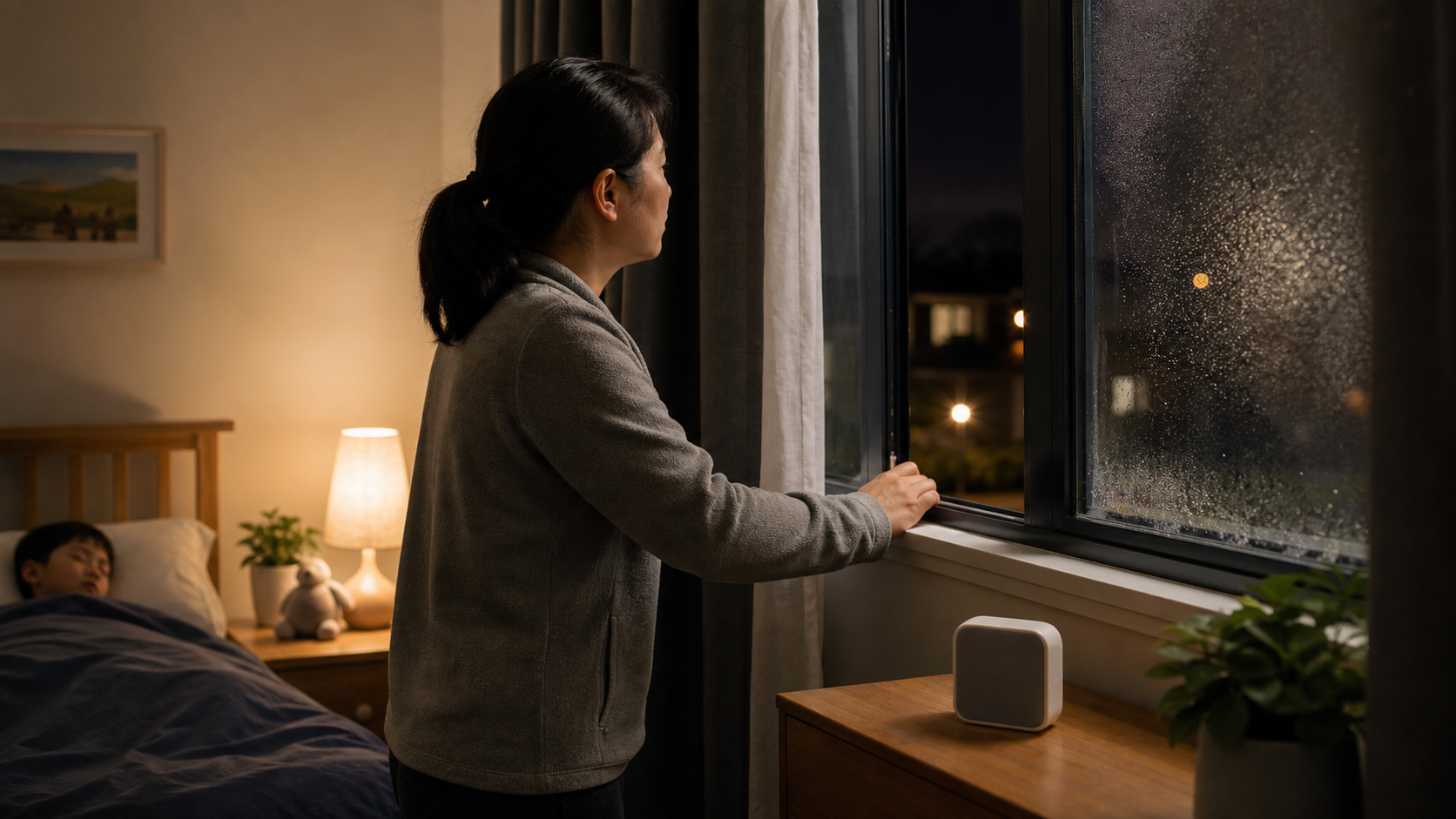
A New Zealand bedroom can look perfectly ordinary and still be doing a poor job of protecting sleep. A study reported by 1News and published in the New Zealand Medical Journal looked at 20 Wellington homes and found that many bedrooms exceeded a carbon dioxide target of 800 parts per million overnight. Half of the bedrooms recorded peaks above 2000ppm, and one was reported at more than 8000ppm. The numbers are striking, but the more important point is not that one room was bad. It is that the conditions that create stuffy nights are common: closed windows, cold weather, small rooms, dampness, poor ventilation and houses that make people choose between fresh air and warmth.
Carbon dioxide is often misunderstood in this conversation. The issue is not that a bedroom with high CO2 automatically becomes a poisonous chamber in the way a carbon monoxide leak would. CO2 is a marker. When it rises overnight, it suggests that exhaled air is not being replaced quickly enough. That can come with humidity, warmth, odours and other indoor pollutants building up. In plain terms, the room is not breathing well while the people inside it are trying to sleep.
Why the finding matters
Sleep is not a soft lifestyle topic. It is part of health, education, work safety, mental wellbeing and daily functioning. A child who sleeps badly is less ready to learn. A shift worker who wakes tired is more vulnerable to mistakes. A driver who never quite feels rested is a risk to themselves and others. When indoor air quality is poor, the consequences may not appear as a dramatic event; they accumulate as fatigue, headaches, damp-related illness, poorer concentration and household stress.
New Zealand often talks about housing in terms of price, rent, supply and ownership. Those debates matter, but they can crowd out the physical experience of living in a home. Is the room dry? Can it be warmed affordably? Can windows be opened safely? Is there cross-ventilation? Does the house trap moisture? Is there an extractor fan that actually works? Does a tenant feel able to ask for repairs? These questions decide whether housing is only shelter or genuinely healthy shelter.
The cold-weather trap
The obvious response to high bedroom CO2 is to open a window. That advice is simple and sometimes helpful, but it is not enough. In winter, opening a window can make a room cold, increase heating costs, bring in outdoor noise or feel unsafe at ground level. For renters, children, older people and households already struggling with power bills, “just ventilate more” can become another way of pushing the problem back onto the people with the least control.
A good home should not require a nightly trade-off between fresh air and warmth. Mechanical ventilation, passive design, insulation, draught control, heating, window security and moisture management all matter together. If a home is insulated but not ventilated, it can become warmer and still stale. If it is ventilated but not warm, people will close it up. Housing quality is a system, not a checklist.
Why small studies can still be useful
Twenty homes is not the whole country. It should not be treated as a national census of bedroom air. But small studies are valuable when they reveal a plausible hidden pattern. Most families do not measure overnight CO2. They know only that a room feels stuffy, windows fog, mould appears, or people wake tired. Data turns that vague discomfort into something policy can discuss.
The next step should be broader measurement across different regions, building ages, rental types and household sizes. Wellington houses have their own climate and design quirks, but the underlying issue is not confined to the capital. Auckland apartments, damp rentals in provincial towns, crowded family homes and older villas can all face versions of the same problem.
What renters and owners can do now
At the household level, there are practical moves: ventilate bedrooms when weather allows, use extractor fans while cooking and showering, dry clothes outside or in vented spaces where possible, keep beds away from cold damp walls, check that vents and fans are actually operating, and address mould early. A simple CO2 monitor can also help some households understand what happens overnight, though monitors should not become another cost burden imposed on tenants.
For landlords, the responsibility is broader than meeting the bare minimum on paper. If a house cannot be kept warm, dry and ventilated in normal use, the people living there inherit the health risk. For government and councils, the question is whether building standards, rental enforcement and public-health messaging are aligned. New Zealand has already learned, painfully, that cold and damp homes are not just private matters. Ventilation belongs in that same conversation.
The deeper lesson
The bedroom CO2 story is easy to dismiss as a niche indoor-air issue. It is not. It is a reminder that housing quality is lived most intensely at night, when people close doors, turn off lights and trust the room to look after them until morning. If that room quietly fills with stale air, the failure is not only personal habit. It is design, regulation, affordability and public health meeting in the most private space of the home.
Sources: 1News reporting on bedroom carbon dioxide levels and the New Zealand Medical Journal study.