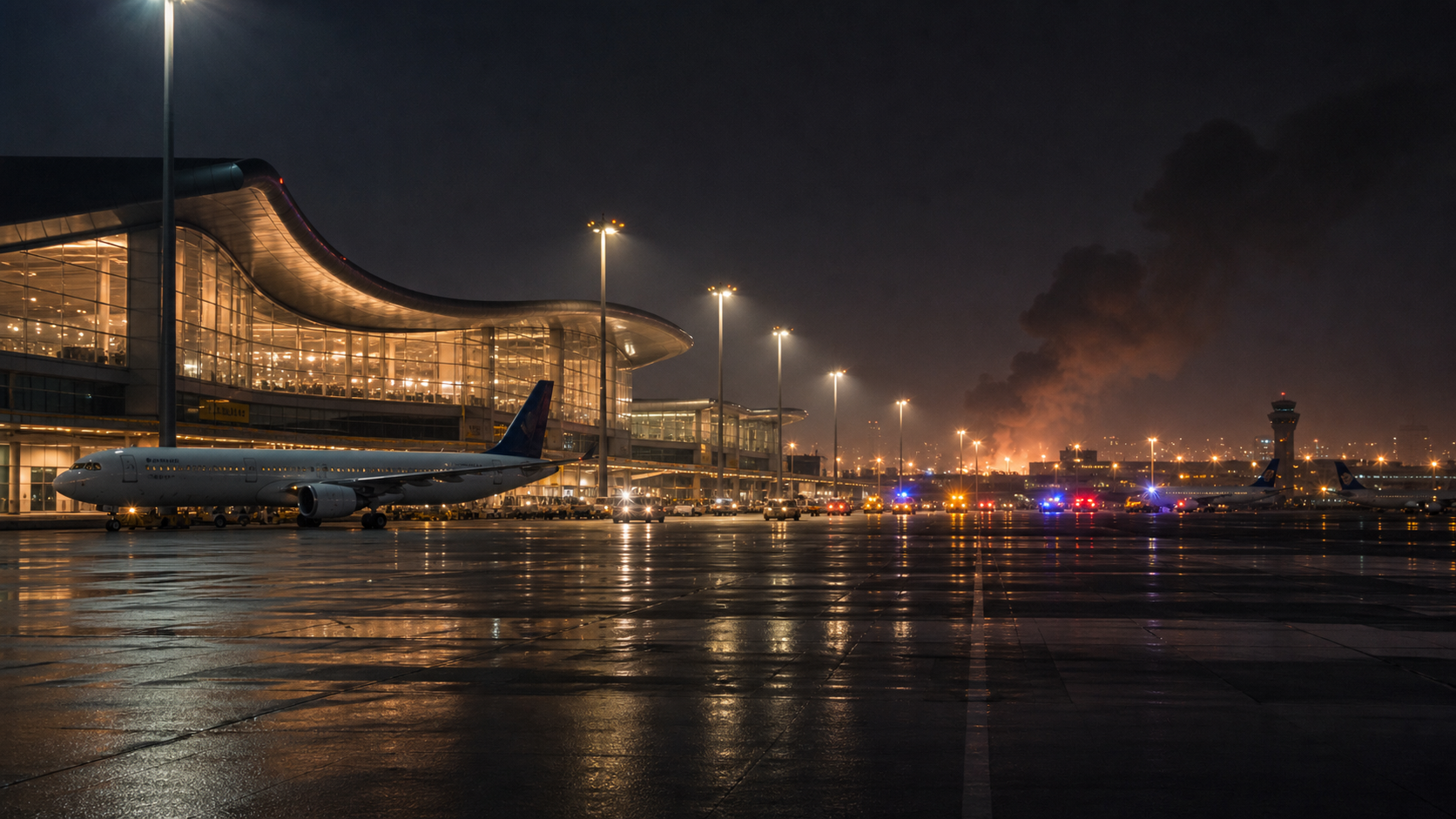
Airports are not just transport hubs. In moments of conflict, they become symbols of state capacity, economic confidence and civilian vulnerability. That is why reports of Iranian drones hitting Kuwait’s main airport matter far beyond the immediate casualty count.
AP reported that Kuwait said Iranian drones hit the airport and killed one person as a ceasefire was tested again. BBC also reported one killed and dozens injured in Iranian drone strikes on Kuwait airport. (AP; BBC)
Why Kuwait changes the map
Kuwait is not simply another location on a conflict map. It sits inside a Gulf security system built around oil infrastructure, US military presence, regional trade and aviation connectivity. A strike there raises the possibility that retaliation is no longer limited to the most direct combatants.
That matters because the Gulf is dense with strategic targets: airports, refineries, ports, desalination plants, bases and shipping lanes. Even limited attacks can create outsized economic and psychological effects.
The ceasefire problem
Ceasefires are often described as agreements, but in practice they are systems of restraint. They require commanders, proxies, political leaders and foreign backers to believe that not responding is less costly than responding. One strike can shift that calculation.
If a ceasefire is already fragile, an airport attack creates three pressures at once: domestic pressure on Kuwait to show control, pressure on Iran’s rivals to respond, and pressure on outside powers to protect aviation and energy flows.
Aviation as a confidence system
Commercial aviation depends on predictable risk. Airlines can reroute, insurers can reprice, passengers can delay travel, and airports can increase security. None of those steps requires a full regional war. The market reacts to uncertainty before governments declare a crisis.
That is why a single airport incident can ripple through routes, cargo and tourism. Gulf airports are not local facilities; they are global connectors.
Energy risk without a tanker crisis
The Strait of Hormuz usually dominates Gulf risk analysis. But energy security is not only about tankers. It is also about the broader confidence that Gulf infrastructure can operate under pressure. If airports, ports and oil-adjacent infrastructure are seen as vulnerable, prices can move even before supply is physically disrupted.
What to watch next
- Attribution: whether governments agree on who ordered, enabled or tolerated the strike.
- Retaliation: whether responses stay symbolic or target infrastructure.
- Airline decisions: rerouting and insurance costs can reveal risk faster than diplomatic statements.
- US posture: Washington’s protection commitments will shape regional confidence.
The Kuwait strike is a warning about the geography of modern conflict. The front line is not always where soldiers stand. Sometimes it is where civilians board planes, where supply chains pause, and where a ceasefire discovers how little trust it really contains.