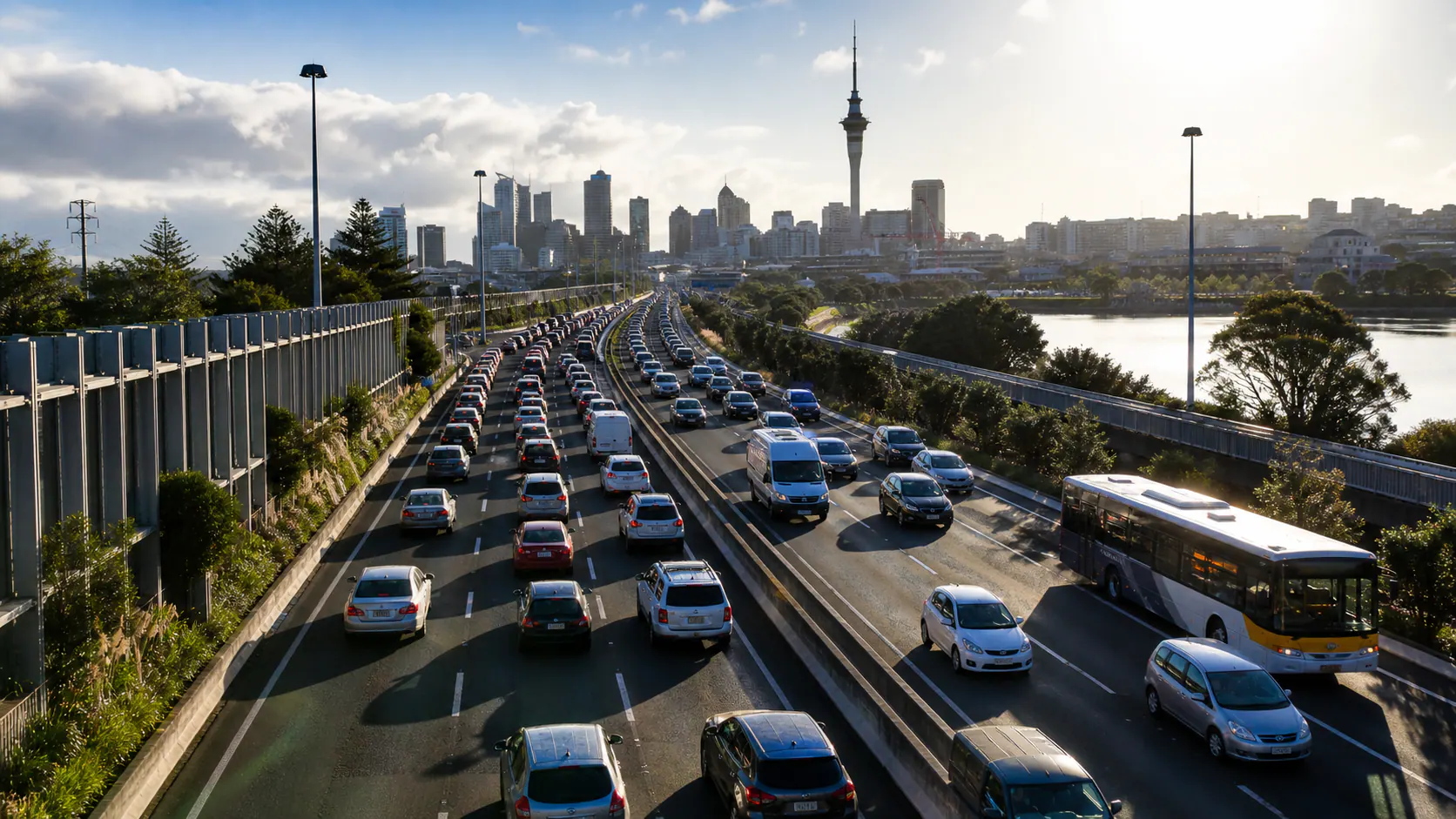
Auckland’s traffic problem is visible every weekday, but visibility does not make the solution simple. Time-of-use charging can reduce peak demand by asking some drivers to travel at a different time, take another route or use another mode. The economic logic is sound. The social contract is harder.
New Zealand’s enabling law comes into force in November 2026. Local schemes will require consultation and ministerial approval. That creates a useful window to decide not only where and when to charge, but what must exist before the first invoice is sent.
Pricing can change a small but decisive share of trips
A road network near capacity can improve markedly when only a modest number of trips move away from the peak. Ministry work on Auckland has estimated meaningful congestion reductions under a mature scheme. Reliability, rather than dramatic speed, is the real prize: buses keep timetables, freight arrives predictably and families can plan pick-ups.
But averages conceal who changes. Office workers with flexible hours may shift easily. Nurses, cleaners, construction crews, tradespeople and parents doing fixed school runs may have little room. A charge that is optional for one household can be unavoidable for another.
Alternatives must come first
Public transport does not need to replace every car trip, but it must be credible on the corridors being charged. That means frequency, safe access, early and late services, integrated fares and enough capacity when people switch. A theoretical bus on a map is not a practical alternative if it adds two transfers and forty minutes.
The same principle applies to exemptions and rebates. They should be simple enough to use, narrow enough to preserve the scheme’s purpose, and designed around circumstances rather than political favourites. Complexity can punish people who have the least time to navigate forms.
Where the money goes will decide trust
Road pricing is easier to accept when revenue is visibly returned to the transport system that gives people options. If drivers perceive the charge as a general tax, support will erode. Transparent reporting should show revenue, operating costs, travel-time changes and investment by corridor.
Privacy also deserves more than a footnote. A location-based charging system creates movement data. Rules for collection, retention, access and deletion should be established before deployment, not improvised after public concern.
A pilot should test equity, not only traffic
Technical success is not enough. A pilot should measure effects by income, occupation, disability, caregiving responsibility and suburb. It should track whether buses become crowded, whether traffic diverts through residential streets and whether small businesses face changed delivery costs.
The scheme should have published thresholds for adjustment. If a corridor lacks alternatives or diversion harms local streets, planners need the ability and obligation to respond.
The honest case
Auckland cannot endlessly build enough peak-hour road space for every possible trip. Demand management belongs in the toolkit. Yet a fair scheme cannot tell people to choose differently when years of housing and transport decisions have left them without choices.
Time-of-use charging should therefore be judged as a package: price, public transport, street safety, privacy, exemptions and transparent reinvestment. Get that package right and a charge can buy reliability. Get it wrong and it will feel like a toll on people who already pay for Auckland’s geography with their time.
Sources and further reading: Ministry of Transport time-of-use charging guidance; Auckland Transport project page.