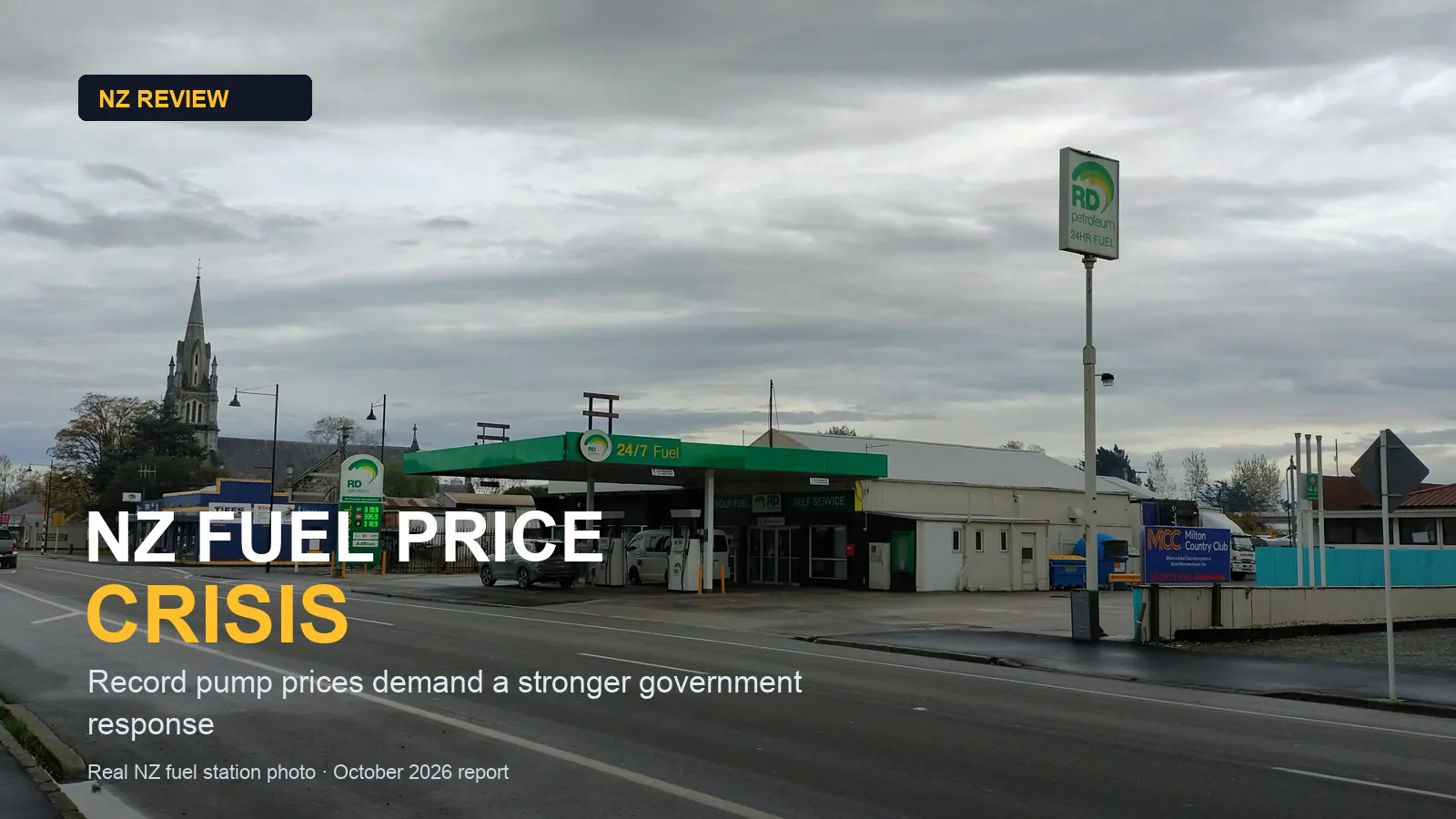
New Zealand’s fuel price shock has crossed from inconvenience into a cost-of-living emergency. By early October 2026, live market data reported through Gaspy and local industry coverage put the national average price of 91 petrol at about $3.53 a litre, with 95 petrol around $3.72 and diesel around $3.23. MBIE’s official fuel-response benchmark, which runs on a weekly lag, had already placed regular 91 at $3.38 a litre for the week ending 27 September.
For many households, that difference is not academic. A 50-litre fill at $3.53 costs about $176. A family, contractor, student, care worker or rural commuter who cannot simply stop driving is watching one of the most basic costs of participation in daily life move beyond normal budgeting.
The cause is global, but the pain is local
The immediate cause is not mysterious. New Zealand imports refined fuel, which means local pump prices are exposed to international refined product markets, shipping, insurance, foreign exchange movements and supply disruption. The 2026 Middle East conflict has made those channels unusually volatile.
MBIE says the conflict has produced larger, faster and more uneven movements in importer costs and margins than several previous shocks, including the Global Financial Crisis, Covid-19 and the Russia-Ukraine conflict. The Commerce Commission’s latest fuel monitoring also shows retail prices moving with refined import costs, while warning that the spread between retail prices and refined costs includes logistics, storage, terminal costs, service-station costs, discounting and timing effects – not simply profit.
That distinction matters. It would be too easy to blame only oil companies, or only the Government, or only an overseas war. The truth is more uncomfortable: New Zealand has built an economy where a shock in imported fuel very quickly becomes a shock to ordinary life.
Fuel inflation does not stay at the pump
Fuel is not just another consumer product. It is an input into food distribution, freight, farming, trades, construction, emergency services, public transport, healthcare travel, school runs and commuting. When petrol and diesel rise, they push costs through the whole economy.
Stats NZ’s June 2026 CPI release made this plain. Petrol rose 20.1 percent in the quarter and 27.5 percent over the year, becoming one of the main contributors to inflation. The transport group contributed heavily to the quarterly CPI rise. The Reserve Bank has also warned that higher fuel prices feed indirectly into food, domestic airfares, road transport and construction. Treasury has described the same transmission problem: fuel costs raise input costs for businesses, which then pass them through to other goods and services over time.
This is why the Government should stop treating fuel as a narrow petrol-station issue. It is a supermarket issue. It is a rent and services issue. It is a small-business issue. It is a regional equity issue. If fuel remains elevated, food and living expenses will keep absorbing the pressure.
The Government has acted – but not enough
The Government can fairly say it has not ignored the crisis. Budget 2026 included fuel-response measures, including funding for strategic fuel reserves and a temporary $50 per week increase to the In-Work Tax Credit for eligible working families. Inland Revenue says that boost runs from 1 April 2026 to 31 March 2027, or until 91 petrol stays below $3 a litre for four consecutive weeks. The Government also cancelled the 12-cent fuel excise increase that had been scheduled for 1 January 2027, delaying future fuel tax increases until 2028.
Those moves are real. But they are not enough for the moment New Zealand is now in.
The first problem is coverage. A fuel shock does not only hit working families with children. It hits single workers, beneficiaries trying to attend interviews or medical appointments, students, pensioners, rural households, small businesses, tradies, carers, delivery drivers and people living in suburbs where public transport is weak. Many of these people receive little or no direct help.
The second problem is timing. Cancelling a future tax rise may reduce future pressure, but it does not reduce today’s record pump price. Families are not filling up in January 2028; they are filling up now.
The third problem is design. The current response helps selected households after prices have already caused damage. It does not create a clear automatic stabiliser for future spikes. New Zealand is still responding to each shock as if it were temporary, surprising and isolated. In 2026, that assumption is no longer good enough.
What a stronger response should look like
First, New Zealand needs an automatic fuel-shock trigger. If national average 91 petrol remains above a clear threshold – for example $3.20 or $3.40 a litre – for several consecutive weeks, temporary support should activate without political delay. The trigger should be based on MBIE’s published fuel-response price and updated transparently.
Second, support should be broader and more targeted at actual exposure. Eligibility should not depend only on having children or receiving one specific tax credit. A rural household driving long distances, a low-income worker commuting across Auckland, or a beneficiary needing to travel to appointments can be just as exposed as a working family that receives Working for Families.
Third, the Government should consider a temporary fuel excise or GST rebate during crisis-level prices. This should not be an open-ended subsidy. It should be temporary, threshold-based and paired with Commerce Commission monitoring to ensure the benefit is passed through to consumers rather than absorbed into margins.
Fourth, food and essential freight need protection. A time-limited diesel or freight credit for essential food distribution could reduce the pass-through into grocery prices. But it must come with disclosure and pass-through requirements. If taxpayers support the freight chain, consumers should see some of that support in lower pressure on food prices.
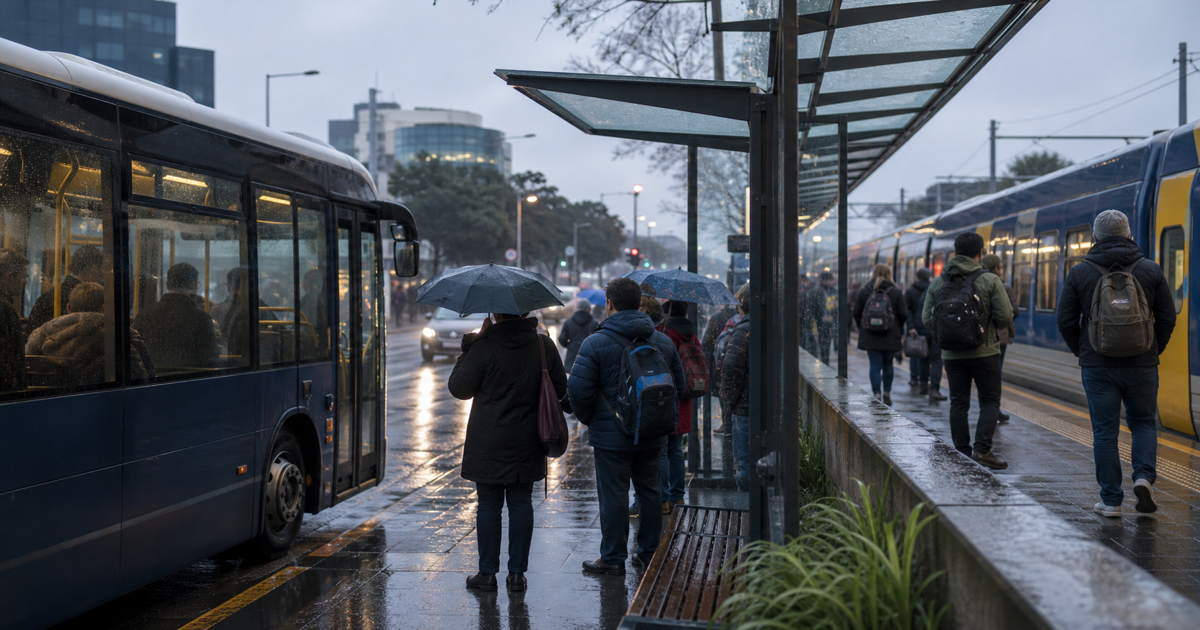
Fifth, public transport relief should be part of fuel policy, not treated as a separate debate. During fuel spikes, half-price public transport, stronger off-peak services, park-and-ride support and encouragement for work-from-home where practical can reduce demand and protect household budgets. The best fuel-price policy is not always making petrol cheaper; sometimes it is helping people need less of it.
Finally, New Zealand must accelerate the long-term escape route. More charging infrastructure, better regional transport, support for efficient vehicles, resilient fuel stocks and genuine competition in local fuel markets are not climate luxuries. They are cost-of-living infrastructure.
The political risk of doing too little
The Government is right to worry about inflation and debt. A broad, permanent petrol subsidy would be expensive and could encourage more consumption. But doing too little has costs too. If businesses face higher freight bills, they raise prices. If workers cannot afford to commute, labour shortages worsen. If households spend more at the pump, they spend less in local businesses. If food distribution costs rise, supermarket bills rise again.
That is the danger now. Fuel inflation can become general inflation. A petrol crisis can become a food crisis. A household budget problem can become a business confidence problem.
The Government cannot control the Middle East, the Singapore refined-fuel market, or the New Zealand dollar. But it can control how exposed ordinary New Zealanders are to the shock. The record price at the pump is a warning. If Wellington treats it as a temporary irritation, the next bill will arrive at the supermarket, the building site, the doctor’s appointment and the family kitchen table.
Sources
- MBIE: Price for fuel response support
- MBIE: Weekly fuel price monitoring
- MBIE: Impacts of the 2026 Middle East conflict on fuel monitoring
- Commerce Commission: Fuel monitoring reports
- Stats NZ: Consumers price index – June 2026 quarter
- Reserve Bank: Monetary Policy Statement September 2026
- Budget 2026: Fuel Response
- Beehive: Government cancels fuel tax hike
- Inland Revenue: In-work tax credit increase
- Autotalk: Petrol demand down as fuel prices hit new highs