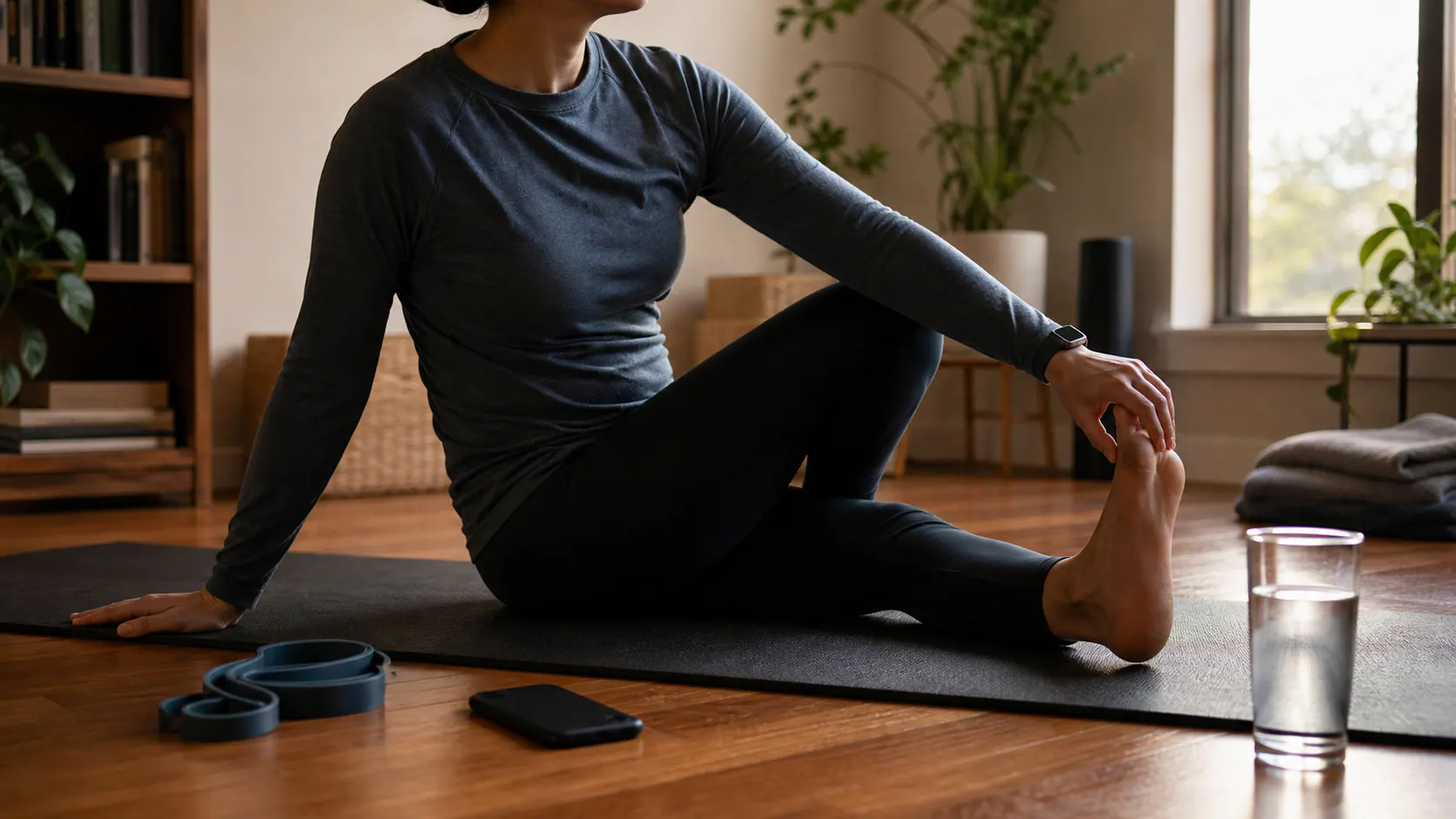
Movement advice often becomes either too shallow or too extreme. Walk more, stretch more, train harder, optimise everything. Huberman Lab’s episode with Ido Portal, Movement Practice to Strengthen Your Mind-Body Connection, is useful because it treats movement as a way of relating to the nervous system, attention and daily life, not only as exercise output.
Listen on Huberman Lab: Movement Practice to Strengthen Your Mind-Body Connection | Ido Portal
What this is
Andrew Huberman’s podcast often sits at the intersection of neuroscience, behaviour and health. This episode brings in Ido Portal, whose work is associated with movement practice rather than conventional gym categories. The conversation is not simply about flexibility or strength. It is about how a person uses the body to learn, regulate attention, explore capacity and stay connected to physical reality.
That might sound abstract, but the practical idea is simple: movement is not a chore you complete after a day of sitting. It can be a daily language for noticing how you are doing.
Why it is worth your time
Many New Zealand Review readers live in bodies that are either overworked or underused. Desk workers sit too long. Parents carry children and stress. Tradies repeat hard movements. Migrants may work long shifts while losing time for sport and community. Winter makes all of this worse by shrinking daylight and making comfort more sedentary.
This episode is valuable because it widens the idea of movement. You do not have to treat the body only as a project to improve. You can treat it as a source of feedback. Balance, mobility, breath, floor work, walking, play and coordination all become ways to return attention to the present.
What to notice while listening
- The difference between training and practice.Training often aims at measurable output. Practice also develops awareness, curiosity and control.
- The nervous-system frame.Movement can change mood and attention, not only muscle condition.
- The humility.Many adults lose basic movement confidence slowly. Rebuilding it does not need to be dramatic.
- The transfer.Better movement can affect how you sit, breathe, work, recover and handle stress.
Who will benefit most
This is a good episode for people bored by standard fitness advice, people returning after injury, desk workers who feel physically stale, and anyone who wants movement to feel less like punishment. It will also suit listeners interested in martial arts, dance, climbing, mobility work or nervous-system regulation.
It is not a quick hack episode. That is part of the appeal. Some topics deserve time because the point is not a single tip; it is a changed relationship to the body.
A caveat
Listeners should adapt any movement ideas to their own health, injury history and capacity. This is not personalised medical advice. If pain, dizziness, pregnancy, disability or a medical condition is involved, get appropriate professional guidance.
Final recommendation: listen while walking, stretching or sitting on the floor rather than while doing email. Let the episode be an invitation to move a little differently, not another thing to consume passively.
Sources: Huberman Lab official episode page and Apple Podcasts episode page.