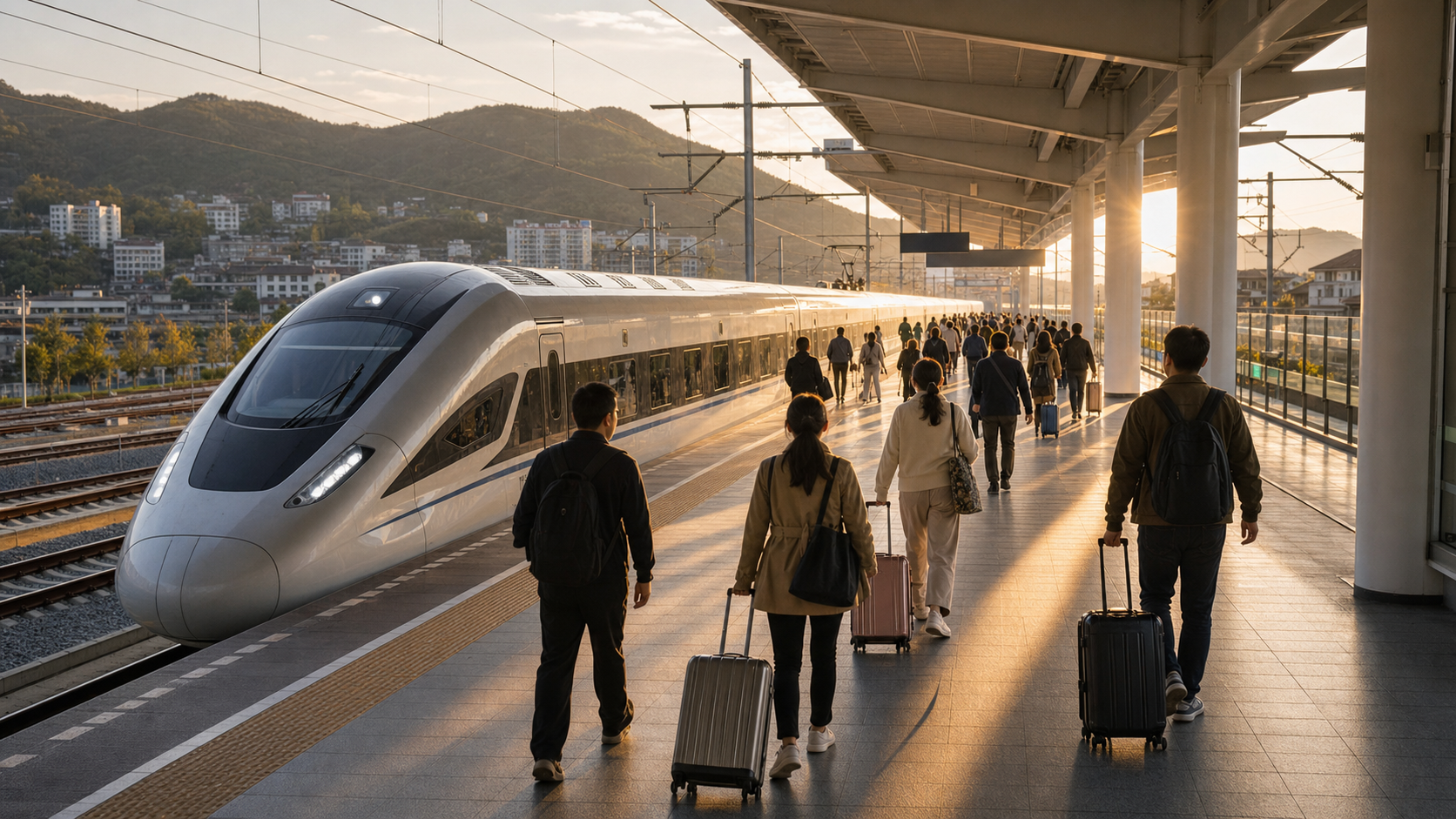
A high-speed railway milestone can look like a simple passenger number. In China, it is often more revealing than that. The Hangzhou-Taizhou railway, described by Xinhua as China’s first privately controlled high-speed railway, has passed 100 million passenger trips less than four and a half years after opening. The line is 266.9 kilometres long, designed for speeds up to 350 kilometres per hour, and connects Hangzhou, Shaoxing and Taizhou while cutting the Hangzhou-Taizhou journey to about 74 minutes.
Those facts are impressive, but the deeper story is about infrastructure finance. China has built the world’s largest high-speed rail network largely through state-led planning, public financing and railway-sector institutions. A privately controlled high-speed railway asks a different question: where can private capital fit into a system where the public value is large, the upfront cost is heavy and the payoff is slow?
Why this line matters
High-speed rail is often discussed as a national achievement. The more important effects are frequently local. A line can change a county’s sense of distance from a provincial capital. It can make a smaller city more attractive for business trips, education, medical visits, tourism and family movement. It can also alter land values, station-area development and commuting patterns.
Xinhua reported that the Hangzhou-Taizhou line ended the absence of rail access for places such as Shengzhou, Tiantai and Xinchang. That detail matters. For a county or smaller city, being added to the rail map is not only a transport upgrade; it is a change in economic identity. Investors, students, workers and tourists can imagine the place differently once travel time shrinks.
The 100 million passenger mark therefore says something about demand. It suggests the railway is not a symbolic project waiting for use. People are using it at scale, and that gives the private-capital model a practical test case.
The promise and tension of PPP infrastructure
Public-private partnerships are attractive because they promise more capital, more discipline and less direct burden on government budgets. In theory, private investors bring efficiency and commercial pressure while the public side ensures social value.
In practice, transport PPPs are hard. Railways require enormous upfront spending, long asset lives and complicated coordination with land, stations, timetables, safety systems and wider networks. A profitable route may be easier to finance, but many socially valuable routes are not immediately commercial. If the risk sits too heavily on investors, they may avoid projects. If the state absorbs too much risk, the partnership can become private upside with public downside.
That is why the Hangzhou-Taizhou milestone is useful but not simple proof. It shows that a privately controlled high-speed line can attract heavy passenger use in a prosperous region. It does not automatically mean the same model can be copied everywhere. Zhejiang has dense cities, strong private enterprise, high travel demand and a regional economy that can support frequent movement. A less developed region may face a very different equation.
Passenger numbers are only one measure
One hundred million passenger trips is a strong headline. But infrastructure success should also be measured by broader outcomes. Did the line reduce travel inequality between cities? Did smaller places gain more than station-adjacent property developers? Did tourism income spread beyond the largest nodes? Did the railway shift trips from cars or buses? Did it create sustainable revenue for maintenance and upgrades?
These questions matter because China’s high-speed rail expansion has entered a more mature stage. The country is no longer proving that it can build fast trains. It is deciding where new lines still make economic and social sense, how debt should be managed, and which forms of financing are appropriate.
What private capital can and cannot solve
Private capital can help infrastructure delivery, but it cannot replace public planning. A railway is not a shopping mall. It has network effects, safety obligations, land-use consequences and social objectives. The value created by a line may appear in local business growth, saved time, tourism, labour mobility and reduced road pressure, not only ticket revenue.
That is why the public side still has to define the purpose of the project clearly. If the goal is regional integration, then fares, stopping patterns and station access matter. If the goal is fiscal discipline, then risk allocation matters. If the goal is industrial upgrading, then procurement and maintenance ecosystems matter. A private-controlled line does not remove these choices; it makes them more visible.
The regional development angle
The Hangzhou-Taizhou line sits in one of China’s most commercially dynamic provinces. Zhejiang’s private economy is strong, and many of its smaller cities have deep manufacturing, e-commerce and tourism links. Better rail can help those places connect more tightly to Hangzhou and the Yangtze River Delta.
But connection can cut both ways. Improved rail may bring visitors and investment into smaller cities; it may also allow talent and spending to flow more easily toward the larger centre. Local governments often hope rail will automatically create growth, but the station is only a platform. The real test is whether local industry, housing, public services and urban design are ready to use the connection.
What to watch next
Three indicators will matter. First, whether the railway’s passenger growth remains durable beyond the novelty period. Second, whether the financial model is judged replicable by investors and local governments. Third, whether smaller cities along the line can show measurable gains in tourism, business activity and resident mobility.
The milestone is important because it shows demand. But the real lesson is more careful: China may be entering a phase where infrastructure finance has to become more selective, more transparent and more regionally tailored. A successful private high-speed railway is not just a faster train. It is a test of whether capital, public purpose and regional development can run on the same track.
Sources: Xinhua on the Hangzhou-Taizhou railway milestone and World Bank PPP resource centre.