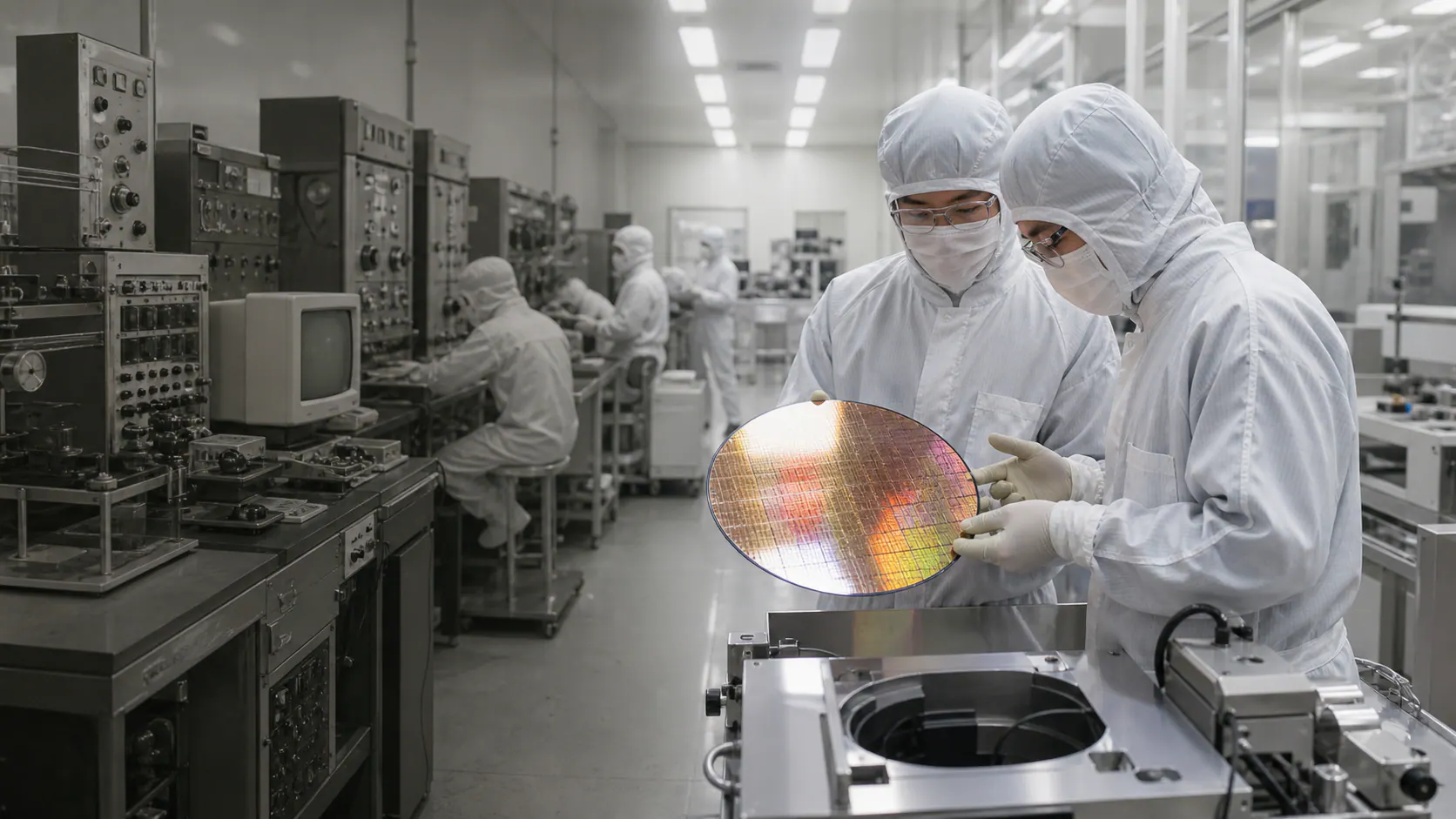
Semiconductor news is usually written in the future tense: a country will build a fab, a company will reach a new process node, a subsidy will create strategic autonomy. Asianometry’s video How Japan Learned Semiconductors is valuable because it looks backward and asks a harder question: how does a country actually accumulate the ability to make a complex technology?
The video follows Japan’s post-war semiconductor development from early learning and licensing through industrial expansion and global leadership. It is not a complete history of Japanese electronics, but it gives viewers a strong framework for separating a factory from an ecosystem.
What this video is
Asianometry is a video-essay channel focused on business, technology and history, often in Asia. Its semiconductor work is unusually good at connecting engineering constraints with company strategy, capital expenditure, supply chains and historical institutions.
This episode runs for roughly 17 minutes and traces about three decades. The pacing is calm, the visual material supports the chronology, and the narration assumes curiosity rather than prior engineering knowledge.
Why it is worth watching now
Governments across the world are spending heavily to attract chip production. The video offers a useful antidote to announcement-driven thinking. Japan did not acquire capability through one heroic project. Firms learned through production, improved yields, built supplier relationships, trained engineers and served markets that generated further demand.
That history does not provide a simple policy recipe for 2026. Semiconductor technology, trade rules and corporate structure have changed. It does show why money is necessary but insufficient: manufacturing competence is embodied in teams, routines and feedback accumulated over time.
What to notice while watching
First, notice the role of technology transfer. Learning from abroad is not portrayed as passive copying; imported knowledge becomes useful only when firms and institutions can absorb, adapt and improve it. Second, watch how consumer electronics and industrial demand create a domestic market for capability.
Third, pay attention to the distinction between invention and manufacturing. A country can contribute research without dominating volume production, or become excellent at production without owning every upstream idea. Semiconductor power is distributed across design, materials, tools, fabrication, packaging and customers.
The channel’s strongest habit
Asianometry treats industrial history as a chain of constraints rather than a parade of famous executives. That approach makes technical subjects legible. A change in wafer size, process control or capital intensity becomes a business story because it alters who can compete and how quickly they can learn.
The result is not flashy. There is no presenter face, dramatic studio or constant on-screen joke. Viewers who enjoy dense, source-minded explanation may find that restraint refreshing.
A useful follow-up exercise
After watching, draw a simple chain from research to chip design, materials, production tools, fabrication, packaging and final markets. Then mark which capabilities can be imported and which require repeated domestic practice. The exercise makes current “chip independence” claims easier to interrogate.
It also reveals why mature-node production remains important. The public conversation gravitates toward the smallest geometries, while vehicles, industrial equipment and power systems depend on a wider range of chips and manufacturing capabilities.
One caveat
A 17-minute national industry history necessarily compresses labour, trade conflict, corporate rivalry and the experiences of individual firms. Viewers should treat it as an orientation, then follow specific questions into longer histories. Japan’s later loss of market share also deserves its own analysis rather than being read as an inevitable sequel.
The video is strongest on industrial development, not as a complete account of the social and political costs surrounding post-war growth. That boundary is worth keeping visible.
Who should watch it
It suits viewers who follow AI and chip geopolitics but want firmer historical ground, students of economic development, engineers curious about the institutions around their work, and anyone who wonders why semiconductor factories cannot simply be purchased like ordinary equipment.
Our recommendation is to watch once for the chronology, then return to the parts about learning and markets. The enduring lesson is that technological independence is rarely a moment. It is a long accumulation of dependence, practice and increasingly difficult competence.