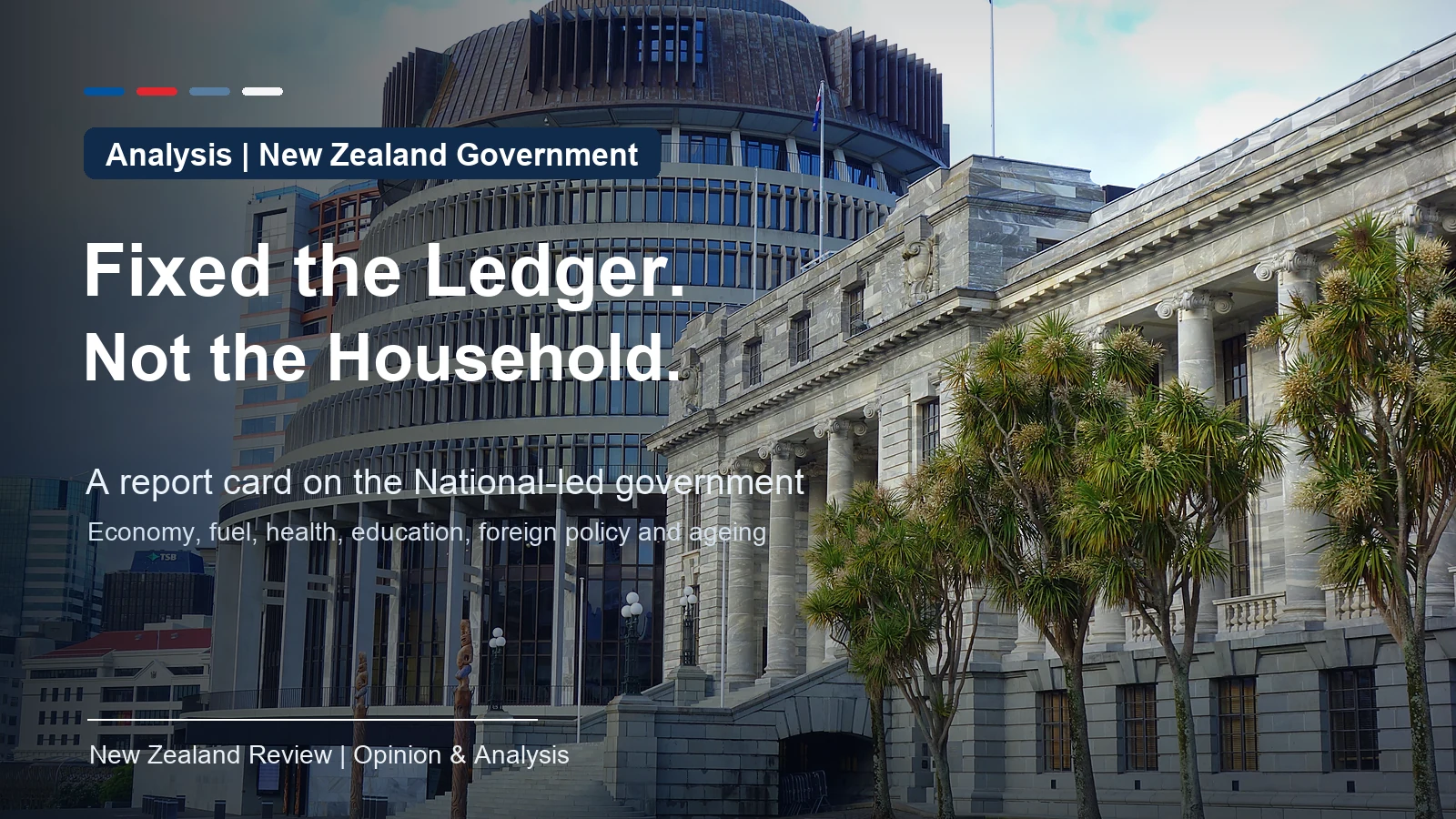
If New Zealand were a listed company, the National-led coalition would have something to show investors. The deficit track has improved. Debt is projected to peak and then decline. Management has reintroduced targets, quarterly reporting and a sharper language of accountability.
But countries are not companies. Voters do not live inside a Treasury forecast. They live in petrol stations, emergency departments, classrooms, rental homes and supermarkets. On those measures, the government’s record is far less flattering.
The verdict, as of October 2026, is this: Christopher Luxon’s government has earned a narrow pass on fiscal management and some operational targets. It has not earned a clean pass on living standards, health access, education outcomes, employment or the deeper structural questions facing an ageing, low-productivity economy. On a conventional scorecard, it is a C-minus government: disciplined, often serious, occasionally effective, but not yet transformative.
The Economy: A Better Fiscal Story, Not Yet a Growth Story
The coalition’s strongest claim is fiscal repair.
Treasury’s 2026 Pre-election Economic and Fiscal Update projects the OBEGALx deficit narrowing to NZ$6.8 billion in 2026/27, shrinking to NZ$0.8 billion in 2027/28, and returning to a NZ$4.0 billion surplus in 2028/29. Net core Crown debt is expected to peak at 43.9% of GDP in 2027/28 before declining to 39.5% by the end of the forecast period.
That matters. A small, externally exposed economy cannot ignore debt, interest costs or investor confidence. Finance Minister Nicola Willis can credibly argue that the government has restored some discipline to the public books after several years of fiscal expansion.
Yet the broader economy remains unimpressive. Stats NZ reported that GDP rose just 0.2% in the June 2026 quarter after a 0.9% gain in March. GDP per capita rose only 0.1% in the June quarter. The economy is no longer in its worst post-pandemic slump, but neither is it roaring.
The government delivered income-tax relief in 2024 and has pursued a growth agenda built around infrastructure, investment, resource-management reform and tighter public spending. The logic is coherent. But the political problem is equally clear: tax cuts did not feel large enough to offset higher rents, rates, insurance, fuel, food and health costs, while public-sector restraint has often felt like service deterioration.
The economic grade is a narrow pass. The balance sheet looks better. The income statement for households does not.
Fuel and the Cost of Living: Not the Government’s Crisis, Still the Government’s Problem
The most visible economic shock of 2026 has been fuel.
Stats NZ’s June-quarter economic snapshot showed petrol prices up 20.1% over the quarter and diesel up 47.7%. Petrol prices were 27.5% higher than a year earlier. The Reserve Bank said annual CPI inflation rose to 4.1% in the June quarter, largely because of higher fuel and related prices driven by the Middle East conflict.
The government cannot control global oil markets. It can decide how much pain households absorb.
Its response was targeted and fiscally restrained: a temporary NZ$50-a-week increase to the In-Work Tax Credit, NZ$150 million for additional strategic fuel reserves, a Fuel Response Plan, and later the cancellation of a planned fuel-excise increase. Economically, that approach is defensible. Broad fuel-tax cuts are expensive and poorly targeted.
Politically, it was too narrow. Many people hit by fuel costs did not fit neatly into the government’s preferred support channel: retirees, single workers, rural commuters, contractors, students, low-income people without dependent children, and many squeezed middle-income households. For them, the message sounded like this: the government understood the macroeconomics better than it understood their weekly budget.
On cost of living, the government does not deserve all the blame. It does deserve criticism for overpromising relief and underdelivering the lived experience.
Jobs and Welfare: The Weakest Line on the Scorecard
The government’s welfare target is now a political liability.
DPMC’s June 2026 Government Targets report shows the goal: 50,000 fewer people on Jobseeker Support, taking the number down from about 190,000 in December 2023 to 140,000. Instead, the number had risen to 218,500 by June 2026, and the target was marked “At Risk.” Stats NZ also recorded unemployment at 5.6% in the June 2026 quarter.
The government can point to weaker economic conditions and the fuel shock. That is fair. The Reserve Bank itself expects unemployment to remain elevated around the end of 2026.
But a government that campaigned on getting people into work cannot treat the labour market as someone else’s responsibility. Its welfare reforms have focused heavily on obligations, sanctions, reapplications and job matching. Those tools may improve compliance. They do not create jobs when firms are cautious, consumers are stretched and construction and retail are uneven.
This is a fail. Not because there is no policy effort, but because the central indicator is moving in the wrong direction.
Health: Better Metrics, Still a Sick System
Health is the most complicated part of the government’s record.
The government has made measurable progress. DPMC reports that the share of emergency-department patients admitted, discharged or transferred within six hours rose from 68.0% in September 2023 to 74.4% in March 2026. The share of people waiting less than four months for elective treatment rose from 62.0% to 64.9%. In the March quarter, 51,089 people were treated from the elective waitlist, up 5.5% from the same quarter a year earlier.
Budget 2026 also committed substantial new health funding, including support for emergency departments, specialist assessments, elective surgery, cancer treatment and GP visits.
The trouble is that health systems are judged not only by marginal improvements but by public experience. A 74.4% emergency-department result is better than 68%. It is still a long way from the 95% target. GP access remains uneven. Workforce shortages, hospital capacity, rural access, mental health and aged-care bottlenecks are still structural constraints.
The government’s health approach is managerial: targets, throughput, outsourcing, winter planning, flow managers, additional beds and priority lists. That can help. But without a deeper workforce and primary-care strategy, it risks producing better dashboard results before it produces a better patient experience.
Health gets a partial pass, with a warning attached.
Education: Attendance Is Up. Achievement Is Not.
Education is one area where the coalition has moved quickly and clearly.
The government has pushed school attendance, phone restrictions, structured literacy, a refreshed curriculum, new assessment tools and a more explicit focus on reading, writing and maths. DPMC reports that regular attendance rose from 47.0% in Term 2, 2023 to 64.3% in Term 2, 2026. That is a real gain.
But attendance is the doorway, not the destination.
The government’s target is for 80% of Year 8 students to be at or above the expected curriculum level in reading, writing and maths by 2030. The latest reported results remain grim: reading fell from 47% to 45%; writing rose from 24% to 28%; maths rose from 22% to 24%. The target is marked “At Risk.”
The government deserves credit for treating attendance and foundational learning as serious issues. It does not yet deserve credit for turning around achievement. The real test is whether curriculum reform, teacher training and assessment changes translate into learning gains rather than administrative activity.
Education gets a split grade: pass on attendance, fail for now on achievement.
Foreign Policy: More Active, More Western, More Exposed
The coalition’s foreign policy has been more assertive than its predecessor’s.
Under Winston Peters and Christopher Luxon, New Zealand has leaned harder into traditional partnerships, the Pacific, Five Eyes, trade diplomacy and strategic coordination with Australia, the United States, Britain and Canada. The government has also tried to maintain a pragmatic relationship with China, New Zealand’s indispensable trading partner, while taking a more guarded view of Beijing’s regional ambitions.
This is broadly realistic. The Indo-Pacific is no longer a benign backdrop to New Zealand prosperity. The country cannot sell dairy and meat into the world while pretending strategic rivalry does not exist.
The risk is that alignment becomes drift. New Zealand’s independent foreign policy has always depended on careful public consent. AUKUS Pillar II discussions, defence spending pressures, China tensions, Pacific competition and a more unpredictable United States require a clearer explanation of what New Zealand is signing up for, what it is not signing up for, and what it is willing to pay.
Foreign policy earns a pass. It is active and serious. It is not yet fully explained to the public.
Crisis Management: Competent, but Cold
The 2026 fuel shock was the government’s clearest crisis-management test.
Its response was not chaotic. The Fuel Response Plan, strategic diesel reserve, cross-agency monitoring and targeted support show a government trying to avoid panic while preserving fiscal discipline. Compared with universal subsidies, the government’s approach was cheaper and more defensible.
But crisis management is not only logistics. It is confidence. A government must make people believe it sees their pain. Here the coalition struggled. It explained why broad relief was expensive more effectively than it explained why the selected relief was fair.
The crisis grade is a technical pass and a political near-fail.
Housing and Emergency Housing: One Clear Win, with Caveats
Emergency housing is one of the coalition’s strongest indicators.
DPMC reports that households in emergency housing fell from 3,141 in December 2023 to 459 in June 2026, an 85% reduction from baseline. More than 1,100 Priority One households with children had moved into social-housing tenancies by June 2026.
That is a substantial achievement. It should not be dismissed.
The caveat is that reducing motel use is not the same as solving housing affordability. The government’s long-term housing agenda still depends on planning reform, infrastructure financing, supply delivery and rental-market conditions. Some households have moved into better arrangements; others remain under pressure from rents, insecurity and eligibility rules.
Emergency housing gets a pass. Housing affordability remains unfinished business.
Superannuation and Aged Care: The Bill Nobody Wants to Open
The government talks about fiscal discipline. It has been far less willing to confront the largest long-term fiscal pressure: ageing.
Budget 2026 materials note that the annual cost of New Zealand Superannuation is rising from less than NZ$20 billion in 2023 to more than NZ$30 billion by 2030. In the next year alone, the cost is expected to rise by about NZ$1.8 billion. Meanwhile, living costs for superannuitant households rose 4.5% in the year to the June 2026 quarter, above the average household increase.
Aged care is under strain as well. Health-sector documents point to shortages in residential-care beds and workforce capacity. The government has provided a 4% funding uplift for aged residential care providers and is reviewing aged-care funding and service models.
That is not nothing. But it is not a long-term settlement. New Zealand still has not had an honest political conversation about the age of eligibility, universality, KiwiSaver adequacy, aged-care co-payments, workforce supply and intergenerational fairness.
On ageing, the grade is incomplete leaning fail. The government sees the fiscal problem. It has not yet shown the political courage to solve it.
The Final Grade
The National-led government is not an incompetent government. It is not a government without achievements. Its fiscal discipline has improved the outlook. Its public-service targets have created accountability. It has delivered progress on emergency housing, student attendance, parts of health delivery, law-and-order indicators and foreign-policy engagement.
But its central promise was larger than competent management. It promised to get New Zealand back on track.
For many households, the track still feels rough. Inflation is back above target. Fuel costs have hit hard. Unemployment has risen. Jobseeker numbers are moving the wrong way. Health and education remain fragile. Superannuation and aged care remain unresolved. The government’s managerial strengths are real, but they do not yet add up to a restored social contract.
So the fair verdict is this: the coalition has passed the fiscal test, partially passed the administrative test, and failed to deliver a convincing improvement in everyday life. It deserves credit for discipline. It has not yet earned a victory lap.
The question for voters is not whether the government has done anything. It has. The question is whether doing some things right is enough when the promise was to fix the basics.
Key Sources
- Treasury: Pre-election Economic and Fiscal Update 2026
- Stats NZ: GDP increases 0.2 percent in the June 2026 quarter
- Stats NZ: Economic snapshot, June 2026 quarter
- RBNZ: Monetary Policy Statement, September 2026
- DPMC: Government Targets, June 2026
- Budget 2026: Fuel Response
- Beehive: Government cancels fuel tax hike
- Ministry of Health: Health targets
- Ministry of Education: Attendance Action Plan
- Health NZ: Aged care funding and services model review