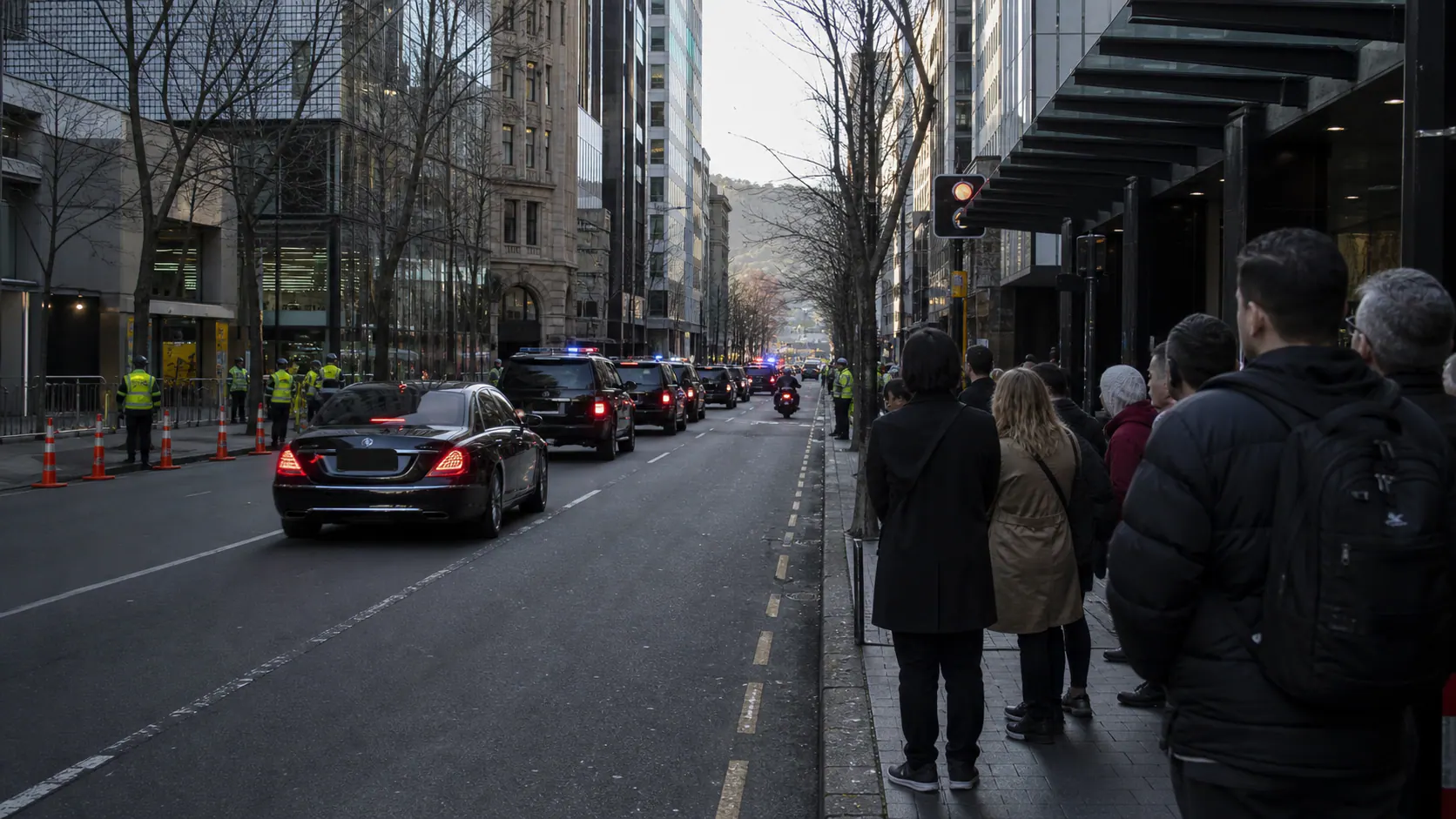
A diplomatic motorcade is meant to project order. Clean route, controlled timing, visible security, protected guests, a city briefly rearranged around national protocol. But for the person trying to get to work, the parent navigating a detour, the small business losing foot traffic, or the commuter who simply did not know why a street was suddenly difficult, it can feel less like order and more like being pushed aside by a decision made somewhere else.
RNZ reported a large security presence in Auckland as Indian Prime Minister Narendra Modi met political and community leaders. 1News reported that motorcades, cordons and closures would disrupt parts of the city. The visit is diplomatically important, especially given New Zealand’s relationships with India across trade, migration, education and regional politics. But the local disruption also raises a civic question: how does a city host high-stakes diplomacy without eroding trust among the people who have to live around it?
Security is not optional
It is easy to complain about motorcades, but security planning exists for a reason. Visiting leaders face threats. Host governments have obligations. Police and security services cannot improvise protection after a crowd forms or a route becomes exposed. In an age of polarised politics, online mobilisation and unpredictable lone actors, some disruption is the price of hosting major international events.
Auckland should be capable of hosting them. New Zealand cannot be globally connected only when nothing inconveniences anyone. Diplomacy happens in real cities, not abstract conference rooms. Communities want to welcome leaders. Governments want to show seriousness. Trade and security relationships are built partly through these visible rituals.
But disruption needs a social licence
The problem is not that security measures exist. The problem is whether they are communicated and managed in a way that respects the city. People are more willing to tolerate disruption when they understand its timing, route, purpose and likely duration. They are less willing when information arrives late, detours are unclear, footpaths feel blocked, buses are delayed without explanation, or police presence appears disproportionate to the public information provided.
Social licence is a useful phrase here. It does not mean every resident gets a veto over security planning. It means public agencies recognise that inconvenience draws from a limited account of trust. If that account is already low because of transport frustrations, construction delays, cost-of-living pressure and public-service fatigue, even a justified cordon can become a symbol of distance between decision-makers and ordinary city life.
Auckland is already a stressed city
Auckland does not experience road closures in a vacuum. The city already deals with congestion, unreliable travel times, public transport frustrations, major events, weather disruptions and a central city still trying to rebuild its everyday rhythm. A motorcade may be temporary, but it lands on people whose patience has been used up by many other systems.
This is why officials should avoid treating diplomatic disruption as merely operational. It is also emotional. A city that feels listened to will absorb inconvenience. A city that feels managed from above will resent it. The difference is often communication: early maps, clear time windows, accessible public-transport advice, disability access information, business liaison and honest updates when plans change.
The diaspora dimension matters
Visits by foreign leaders are not only state-to-state events. They can be meaningful for diaspora communities who see language, culture, family ties and identity recognised in public. Auckland’s Indian communities are large and diverse. For many people, a visit by India’s prime minister is not an abstract diplomatic story but a moment connected to heritage, politics, pride, disagreement or concern.
That makes careful city management even more important. Security settings should protect both visiting dignitaries and the rights of local communities to gather, celebrate, protest or simply move through the city. A mature democracy can host diplomatic ceremony without making public space feel unavailable to everyone else.
What better hosting looks like
Good hosting has two audiences: the visiting delegation and the city. The delegation needs safety, dignity and efficient movement. The city needs predictability, respect and alternatives. Those needs are not opposites. In fact, poor public communication can create more friction and uncertainty, which makes security harder.
Before major visits, agencies should publish plain-language guidance early, update it in real time, coordinate with public transport, give businesses practical advice, and explain why some details cannot be released. After the event, they should review what worked and what did not. Public trust improves when people can see that disruption is not treated as invisible collateral.
The opinion
Auckland should keep hosting important diplomatic visits. New Zealand benefits when it is seen as a serious, connected country. But seriousness is not measured only by how smoothly a motorcade moves. It is also measured by how well the host city carries the burden.
The lesson from this week’s closures and cordons is not that diplomacy should retreat from public streets. It is that diplomacy needs city trust. When ordinary people are asked to wait, detour or adapt, they deserve clear information and visible respect. A motorcade can pass in minutes. The feeling it leaves behind can last longer.
Sources: RNZ on security presence during the Modi visit and 1News on motorcades, cordons and closures.