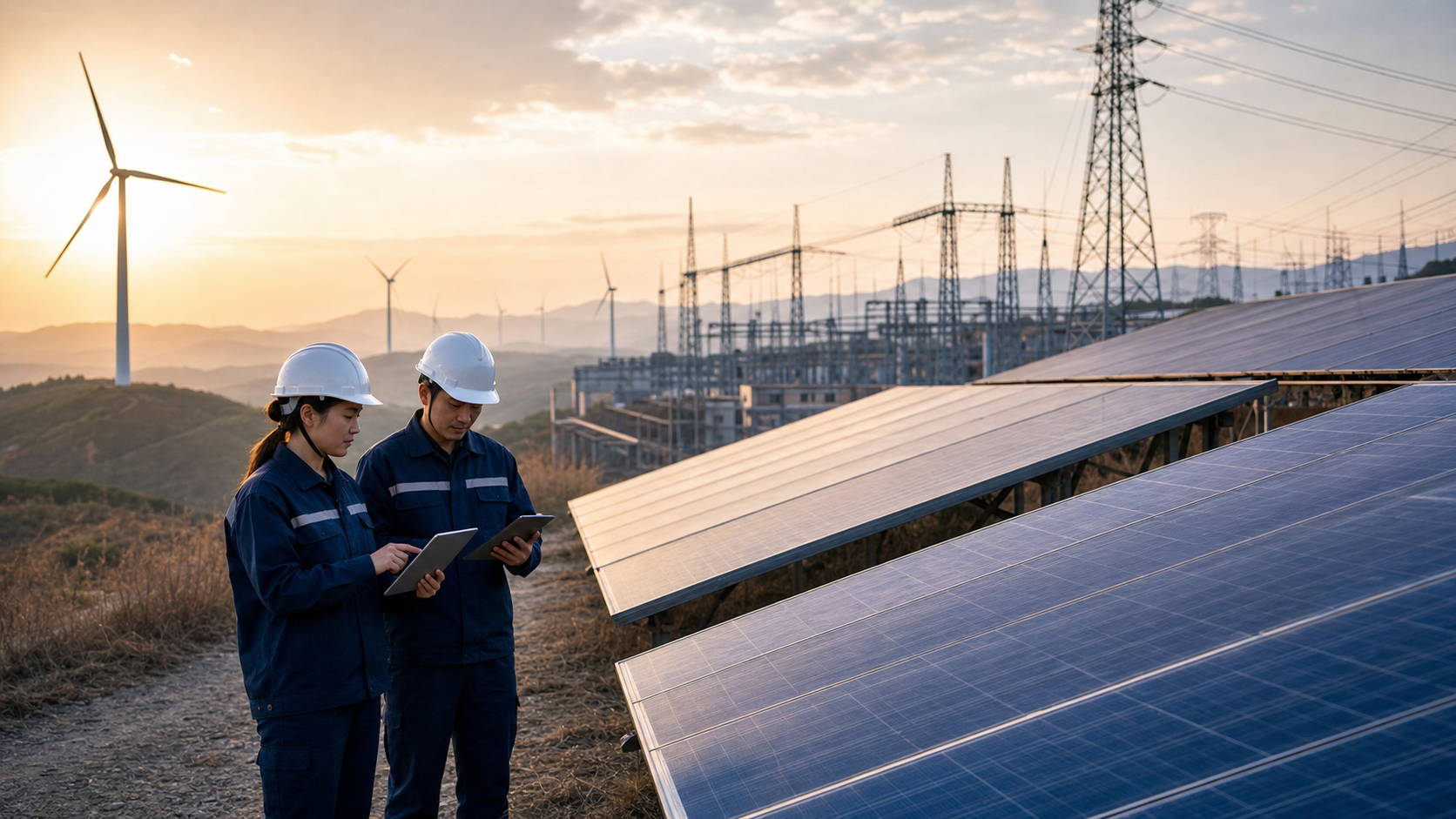
China’s power system has crossed a symbolic threshold. Xinhua reported that total installed power generation capacity reached 4.01 billion kilowatts by the end of May 2026, with non-fossil energy accounting for 62 percent of installed capacity. A separate official plan points toward a new energy system by 2030, including non-fossil energy reaching 25 percent of total energy consumption and wind and solar making up more than half of installed power generation capacity.
Those numbers are impressive, but they also mark a shift in the debate. Building clean power capacity is no longer the only challenge. China has already shown it can build solar farms, wind bases, hydro projects, transmission lines and manufacturing supply chains at enormous scale. The harder question now is whether the grid, markets, storage, dispatch rules and local incentives can absorb that power efficiently.
Installed capacity is not the same as useful electricity
Capacity tells us how much equipment exists. It does not tell us when that equipment produces, where the electricity is needed, whether transmission is available, or whether demand can adjust. Solar generation is strongest in daylight; wind output can rise and fall; industrial demand has its own rhythm; cities and factories may be far from the best renewable resources. A power system has to balance all of this second by second.
That distinction matters because clean-power politics often celebrates construction. New panels and turbines are visible, countable and easy to announce. Flexibility is less photogenic. It lives in grid codes, storage contracts, demand response, ancillary services, forecasting, inter-provincial trading and pricing rules. But without flexibility, clean capacity can become underused capacity.
The old system was built around controllable supply
For decades, electricity systems were built around large generators that could be dispatched to meet demand. Coal plants, gas plants, hydro stations and nuclear plants all have different operating characteristics, but they are more controllable than weather-dependent renewables. A system with rising wind and solar needs a different kind of coordination: more forecasting, faster balancing, stronger transmission, smarter distribution grids, and consumers who can shift some demand.
China’s challenge is intensified by geography. Major renewable resources are often in northern and western regions, while demand is concentrated in coastal and industrial provinces. Ultra-high-voltage lines help, but transmission alone cannot solve every mismatch. Local consumption, storage, flexible industrial load and regional market design all become important.
Coal’s changing role
The clean-power boom does not mean coal disappears quickly. In many systems, coal plants are being pushed toward a more flexible backup role, even as policymakers still worry about energy security, extreme weather, industrial demand and peak load. The risk is that coal capacity remains financially and politically protected even when its operating hours should fall. The other risk is moving too fast without enough reliability tools and creating shortages that damage public confidence in the transition.
The 2030 plan language about resilience and complementary support is important because it acknowledges this tension. A greener system has to be reliable, or the politics will turn against it. Reliability does not have to mean slowing renewables; it means building the boring but essential capabilities that let renewables do more of the work.
Storage is necessary, but not magic
Batteries, pumped hydro, thermal storage, hydrogen pilots and electric vehicles all have roles to play. But storage cannot be treated as a single magic answer. Short-duration batteries are useful for smoothing and shifting; pumped hydro can provide longer balancing where geography allows; industrial demand response can sometimes be cheaper than building more supply. The correct mix depends on local demand, weather patterns, market rules and cost.
The same applies to distributed solar. Rooftop and local generation can reduce pressure on transmission, but only if distribution networks, metering, tariffs and local storage are ready. Otherwise, communities can experience voltage problems, curtailment or investment that does not deliver its full value.
The market question
China’s energy transition is often described through planning targets, but pricing and incentives will decide much of the outcome. If provinces are rewarded mainly for building capacity, they will build. If grid companies and local governments are rewarded for absorbing clean electricity efficiently, investing in flexibility and reducing curtailment, behaviour changes. Market design is not an ideological detail; it is how a huge technical system learns what to value.
Clearer spot markets, better ancillary-service payments, time-of-use pricing and inter-provincial settlement mechanisms can all help. So can stronger data transparency about curtailment, grid congestion and renewable output. Without that transparency, it is hard to know whether capacity is translating into decarbonisation.
What to watch next
The key indicators are no longer only headline capacity additions. Watch renewable generation share, curtailment rates, storage utilisation, transmission bottlenecks, coal-plant operating hours, demand-response participation and whether regional markets become more integrated. Also watch industrial electrification. If heavy industry, transport and heating electrify faster, clean power has more useful demand to serve.
China’s clean-power expansion is one of the largest infrastructure stories in the world. Its success will not be measured only by the number of panels, turbines and lines installed. It will be measured by whether a huge power system can become cleaner, smarter and more flexible at the same time. The construction boom has shown what scale can do. The next phase will show what coordination can do.
Sources: Xinhua on China’s installed power generation capacity and Xinhua on China’s 2030 new energy system plan.