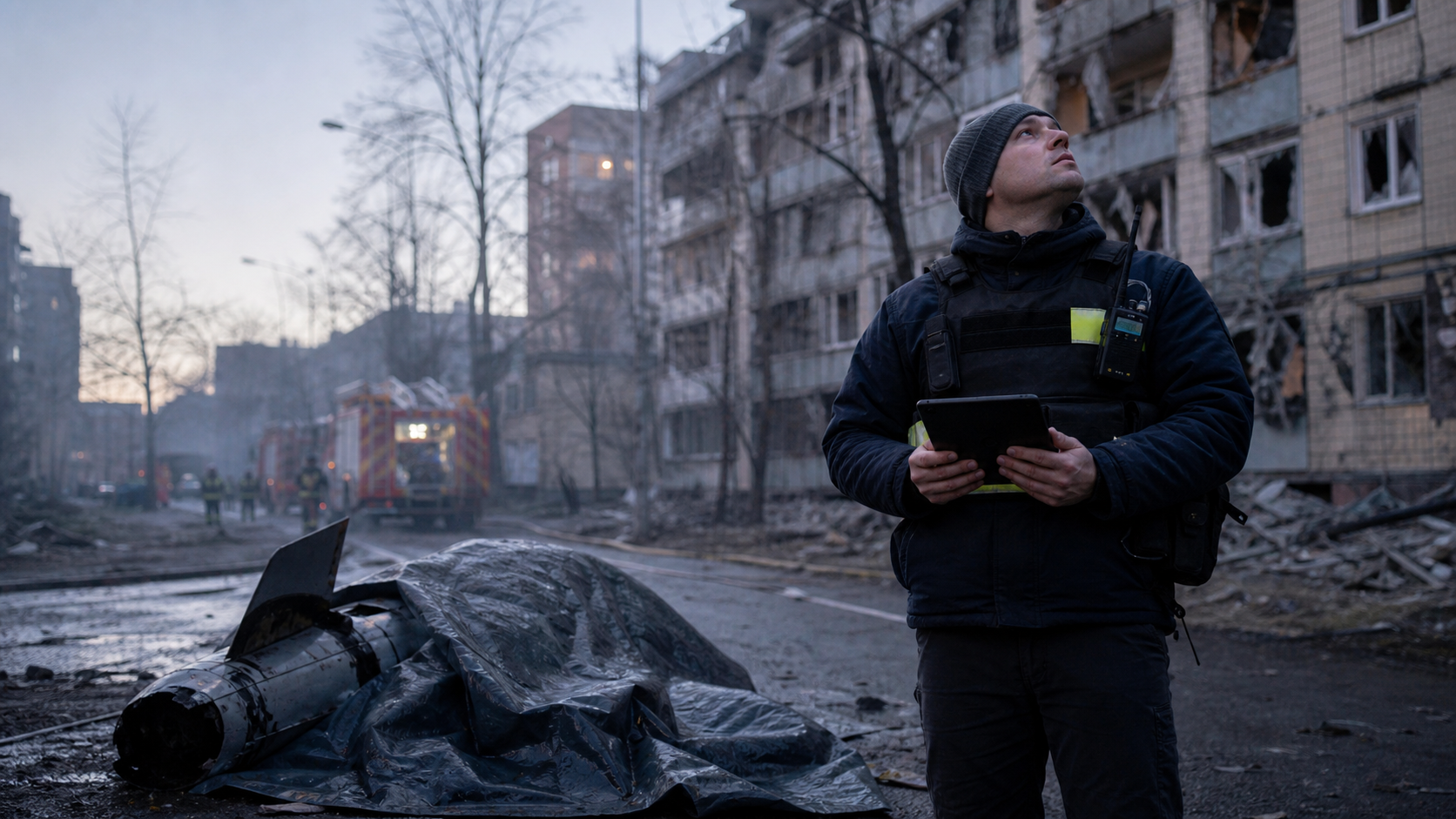
The latest Russian assault on Kyiv was a military attack, a political signal and a stress test for European security all at once. It showed again that Ukraine’s war is no longer only about front lines on a map. It is about whether cities can be protected when missiles, drones and decoys arrive in waves designed to exhaust the defenders before the most dangerous weapons hit.
Reuters reported that Russia hit Ukraine with an Oreshnik missile in one of the war’s biggest attacks on Kyiv. Other Reuters reporting said the Kremlin was still demanding that Ukraine cede all of Donbas in talks, according to TASS, while European and U.S. positions over Ukraine’s future security guarantees continue to show strain. AP reported from a Swedish military exercise that Ukrainian drone pilots turned NATO training into a warning about what modern battlefield air threats now look like.
Put those stories together and a larger picture emerges: Ukraine’s air defence shortage is not a temporary procurement problem. It is a preview of the defence challenge facing Europe.
The strike was designed to overwhelm, not only to destroy
Modern long-range attacks are built around saturation. Drones may be cheap compared with ballistic missiles, but they force defenders to detect, track and intercept many objects at once. Cruise missiles complicate the picture by flying low and using terrain. Ballistic missiles compress decision time. Decoys and mixed salvos make every radar contact a question: is this the weapon that must be intercepted, or a cheaper object meant to drain a limited missile stock?
That is why the word ‘interception’ can be misleading. Success is not simply shooting something down. Success is having enough sensors, crews, missiles, mobile units, command systems and repair capacity to repeat the process night after night without collapsing the defensive network.
Russia has learned that Ukraine’s Western-supplied air defence systems can be highly effective but finite. Every Patriot interceptor used to stop a ballistic missile is a precious asset. Every radar that emits can become a target. Every night of attack imposes cost even when most incoming weapons are defeated.
Oreshnik changes the political signal
The Oreshnik missile matters partly because of what it can do and partly because of what Moscow wants it to symbolise. Russia presents such weapons as evidence that it can escalate technologically and strategically. Whether every technical claim is accepted or not, the political message is clear: Moscow wants Ukraine and its backers to believe that time and escalation advantage sit with Russia.
That message lands in a tense diplomatic environment. If the Kremlin maintains maximalist demands over Donbas while continuing large-scale strikes, any negotiation becomes less a peace process than a contest over leverage. Kyiv must show it can survive. Europe must decide whether it can supply enough air defence and ammunition to keep that survival credible. Washington’s role remains decisive but less predictable, especially when U.S. attention and military resources are also pulled toward the Middle East.
Europe is learning the wrong lesson slowly
European governments have spent much of the war debating tanks, artillery shells, fighter jets and long-range missiles. Those debates matter. But Ukraine’s cities have made a different lesson impossible to ignore: air defence is not a luxury system for occasional crises. It is daily infrastructure in a missile age.
The AP report from Sweden is revealing because it shows Ukrainian battlefield experience moving into NATO training. Drone pilots who learned under Russian fire can expose gaps in Western assumptions: how fast small drones appear, how hard they are to classify, how quickly electronic warfare changes the operating environment, and how vulnerable expensive platforms can be to cheap systems used in large numbers.
For NATO, the warning is uncomfortable. If a non-NATO Ukraine can be hit with such intensity, then European countries must ask how many cities, ports, air bases, power stations and logistics hubs they could protect in a wider crisis. The answer is unlikely to be reassuring.
The industrial base is now part of the battlefield
Air defence is not only a military doctrine. It is a factory problem. Interceptors, radar components, guidance systems, mobile launchers and replacement parts must be produced at wartime scale. Training pipelines must expand. Stockpiles must be rebuilt even while weapons are being sent to Ukraine.
This is where the war has changed Europe most profoundly. Security is no longer only a matter of alliance declarations. It is the ability to manufacture the boring, expensive, essential things quickly enough. A missile defence system that exists in small numbers can protect a capital or a base. It cannot by itself defend a continent against sustained saturation attacks.
That industrial reality also affects diplomacy. If Russia believes Europe cannot sustain Ukraine’s defences, Moscow has an incentive to keep striking. If Europe can expand production and integrate Ukrainian lessons quickly, the incentive changes. Negotiations become more plausible when one side cannot bomb its way to a better bargaining position.
What to watch next
The next indicators are practical. Watch whether Ukraine receives more Patriot, SAMP/T, NASAMS, IRIS-T and short-range counter-drone systems. Watch whether European governments sign multi-year air defence production contracts rather than one-off announcements. Watch whether NATO training absorbs Ukrainian lessons about drones and electronic warfare into ordinary doctrine. Watch whether Russia continues to combine drones, cruise missiles, ballistic missiles and experimental systems in ways designed to overwhelm rather than merely strike.
Most of all, watch the gap between political language and physical capacity. Europe can say that Ukraine’s security is Europe’s security. The harder test is whether it can produce, deploy and sustain the defensive network that sentence requires.
The latest Kyiv assault was another night of fear for Ukrainians. It was also a message to Europe: in the next phase of security, air defence is not the shield at the edge of the system. It is the system.