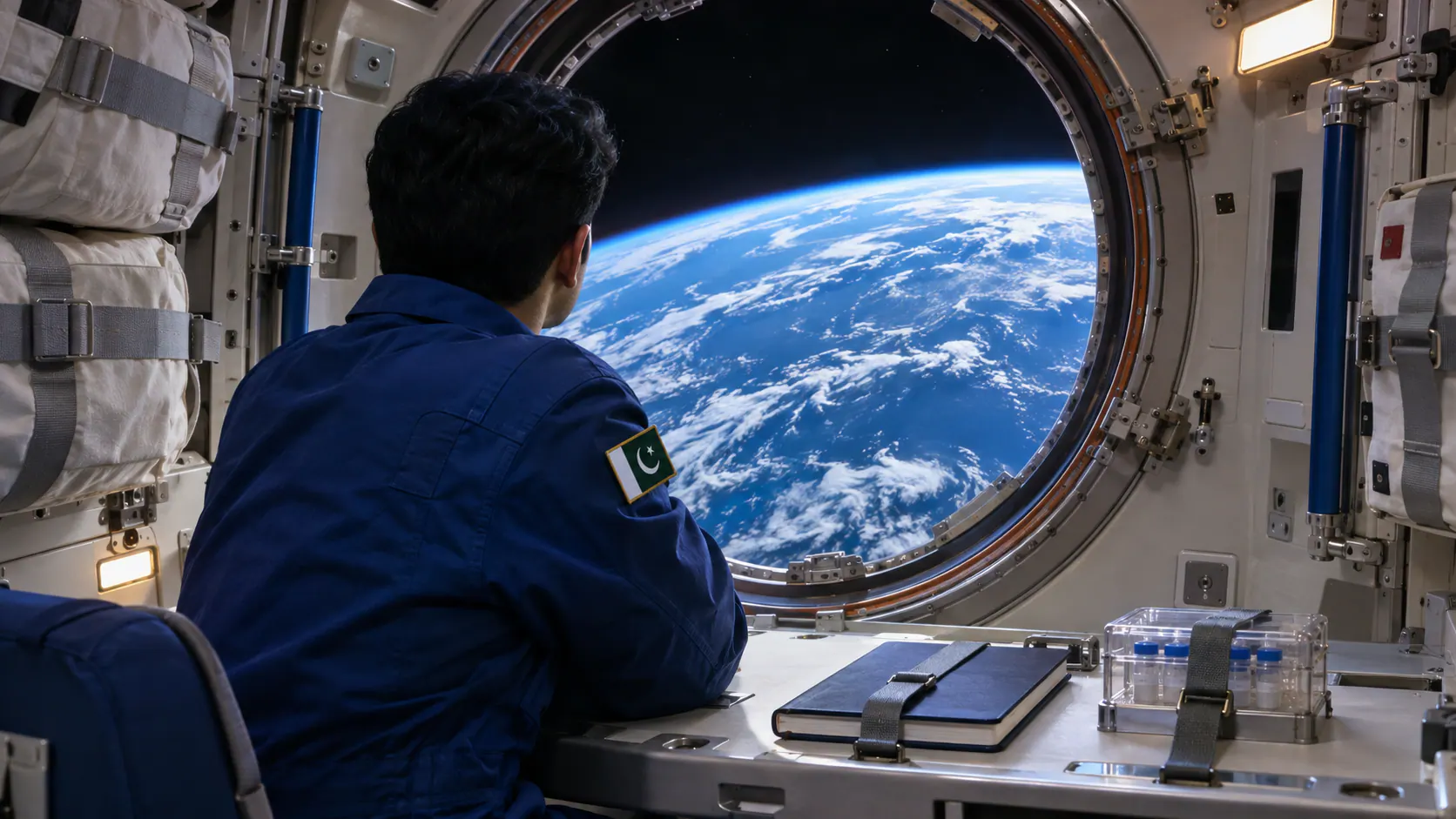
Pakistan’s first astronaut reached orbit on 25 November aboard a Chinese spacecraft, turning a long-standing diplomatic relationship into a human journey beyond Earth.
Muhammad Zeeshan Ali launched from Jiuquan in northwestern China on Shenzhou-24, alongside Chinese astronauts Tang Hongbo and Wu Yi. His flight marks Pakistan’s first human spaceflight and the first foreign crew member carried on a mission to China’s Tiangong space station. Associated Press launch report
The milestone is easy to understand as a story of national pride. Its wider significance lies in what happens around the flight: scientific access, astronaut training and the ability of a country without its own crewed launch system to participate in orbital research.
The BBC report that prompted this article captures the excitement in Pakistan and the diplomatic importance for China. The mission also raises a longer-term question: can a highly visible first flight produce durable scientific capacity after the astronaut returns?
A short visit with a longer institutional purpose
Ali’s visit is a short-duration assignment, rather than the roughly six-month stay associated with Chinese station rotations. China’s mission briefing says he is scheduled to return aboard Shenzhou-23 after completing the joint flight. These are mission plans, not confirmation that his return has already happened. China Manned Space Agency briefing
The distinction matters. A country can acquire experience in human spaceflight without independently operating the rocket, capsule or station. Pakistan’s participation depends on Chinese infrastructure and operational arrangements, while creating an opportunity for Pakistani personnel to learn from the process.
Preparing experiments, qualifying equipment, training a crew member and coordinating with mission control are all technical activities. Their value can extend beyond the person who flies, provided the knowledge reaches researchers, engineers and institutions at home.
Pakistan’s government has presented the launch as a national milestone and a further step in cooperation with China. That is an understandable political message. Its practical success will be easier to judge through follow-on research, skills and opportunities than through the number of congratulatory statements. Pakistan government announcement
What the science involves
Chinese officials have identified four China-Pakistan cooperative projects in biotechnology and materials, and an experiment involving photosynthetic cyanobacteria. The broader mission’s research programme should not be confused with the tasks assigned specifically to Pakistan’s visiting astronaut. Official mission overview
Orbital laboratories offer conditions difficult to reproduce for long periods on Earth. In microgravity, familiar processes such as the movement of fluids and the behaviour of biological systems can change. Scientists can compare those changes with ground-based controls to investigate underlying mechanisms.
Such work is valuable because it can answer specific questions, not because every space experiment immediately becomes a medicine or commercial product. Results need analysis, validation and, often, further investigation. Any claim of economic or health benefits should follow evidence rather than precede it.
For Pakistan, a useful outcome would include scientists gaining meaningful roles in experimental design and interpretation, not merely receiving a ceremonial association with research conducted elsewhere. Public information about the teams, methods and eventual findings would help demonstrate that contribution.
China is offering access as well as displaying capability
Space stations are infrastructure, but they are also institutions. Their operators decide how research is selected, who receives training and which partnerships can develop into further missions.
Inviting a foreign astronaut demonstrates that China’s programme can accommodate international participants. It also places China in a position to shape the procedures and relationships through which that access is delivered.
This is diplomacy with an engineering foundation. Pakistan gains a route into human spaceflight; China gains a visible example of international cooperation on its own orbital platform. Those interests can coexist with genuine scientific work.
International research participation in Tiangong predates this crewed visit. In 2019, China and the United Nations Office for Outer Space Affairs selected nine projects involving 23 institutions from 17 countries under a separate research cooperation initiative. Selection did not mean that every participant would send an astronaut or that every project had already been completed. UNOOSA selection results
The distinction helps explain the new milestone: sending an experiment and sending a trained person are different forms of access. Ali’s flight adds a human dimension to China’s international station partnerships.
A changing market for orbital research
The launch comes while the future of low Earth orbit is being reorganised. NASA plans to move from the International Space Station towards commercially operated destinations as the ISS approaches its planned retirement around 2030. That transition is a programme under development, not a guaranteed timetable for every replacement station. NASA’s commercial station programme
The US Government Accountability Office has highlighted decisions NASA faces over whether commercial stations will be ready and what alternatives may be needed. GAO assessment
It would be premature to turn those uncertainties into a prediction that Tiangong will become the world’s only operating station. Several programmes and commercial projects are evolving. It would also be misleading to describe the ISS as simply an American facility: its history is one of international partnership.
For countries seeking research opportunities, the important questions will include cost, available equipment, scientific independence, data access and reliable transport. Political relationships will influence those choices, but laboratory capability and workable agreements will matter too.
Pakistan’s real test begins on the ground
A first astronaut can inspire students and give a space programme greater public visibility. Inspiration becomes more durable when students can see a path into laboratories, engineering jobs and funded research.
That requires decisions less dramatic than a launch: maintaining technical teams, supporting universities and making room for scientists to propose future work. It also requires clarity over how results will be shared and who can build on them.
Pakistan’s dependence on a partner for transport does not make participation meaningless. International science routinely relies on shared facilities. The more useful test is whether the partnership creates knowledge and capability that Pakistani institutions can retain.
Public accountability belongs in that assessment. The sources reviewed for this article do not establish a complete, independently verified cost for Pakistan’s participation. Claims that the flight is either an obvious financial bargain or an irresponsible diversion from domestic needs would therefore outrun the available evidence.
The government can make the debate more useful by publishing costs, research responsibilities and follow-on objectives. Citizens should be able to distinguish the price of a symbolic achievement from investment in a continuing programme—and understand where the two overlap.
The achievement will be measured after the celebration
Ali’s journey has already changed Pakistan’s human spaceflight history. It also gives China a prominent example of what participation in its station programme can look like.
The lasting outcome remains open. More research partnerships, accessible findings and stronger scientific teams would give the mission a life beyond its images. A celebration without sustained support would leave much of its potential unrealised.
The launch has delivered a national first. What Pakistan builds from the experience will determine how far that first carries it.
Reporting and analysis based on sources checked on 25 November 2026. Planned research and return arrangements are identified as plans; scientific benefits and future station availability are not guaranteed outcomes. Cover: an original concept of a Pakistani participant in an orbital laboratory, not a photograph of the actual astronaut or mission.