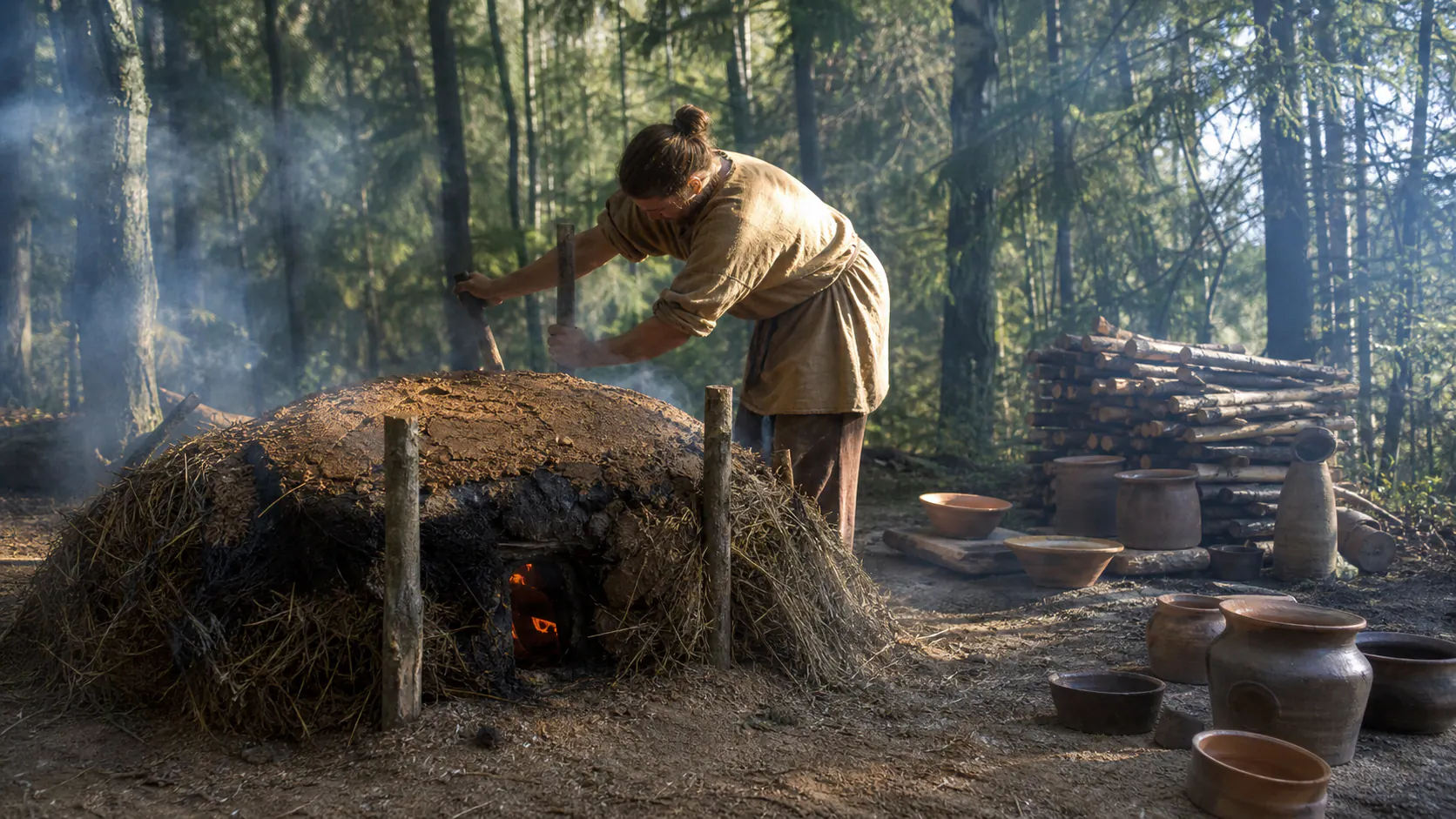
Most online making videos compress labour into a reveal. Primitive Technology does the opposite. In the selected charcoal episode, the interest lies in the sequence: gather material, control air, watch heat, wait, inspect the result and improve the method. There is no spoken narration competing for attention.
The official channel is made by John Plant and uses optional subtitles to explain decisions. That matters because the apparent simplicity is highly constructed: a modern practitioner, working in a controlled setting, has accumulated skill through repetition. The video is compelling precisely because it leaves that labour on screen.
Why it is worth your time
The camera stays close to material consequences. Soil that is too loose, wood that burns too quickly or airflow that is poorly controlled changes the outcome. Viewers can infer a small experimental method without being given a motivational speech.
The silence also restores scale. A task that would occupy seconds in a montage is allowed to take time, making effort and uncertainty part of the subject.
What the subtitles add
Turning on captions reveals concise notes about materials and choices. They are explanations rather than a second personality track, so viewers can first observe and then revisit a step with context.
This makes the video useful for thinking about how procedural knowledge is communicated: show the action, name the decision, and let the result provide evidence.
What not to conclude
The channel does not prove that a particular historical community used exactly the same method, and it should not be treated as survival certification. Experimental craft is informed by research and trial, but it remains a contemporary reconstruction.
Charcoal production and enclosed fires create burn, smoke and carbon-monoxide hazards. Do not reproduce the process without suitable land, fire rules, ventilation, tools and experienced supervision.
The deeper appeal
The video offers relief from the fiction of frictionless production. Every finished object contains time, fuel, waste, judgment and maintenance, even when industrial supply chains hide them.
Watching a person make one material slowly can sharpen attention to the systems that make modern materials seem instant. That is more interesting than nostalgia. It is a lesson in process.