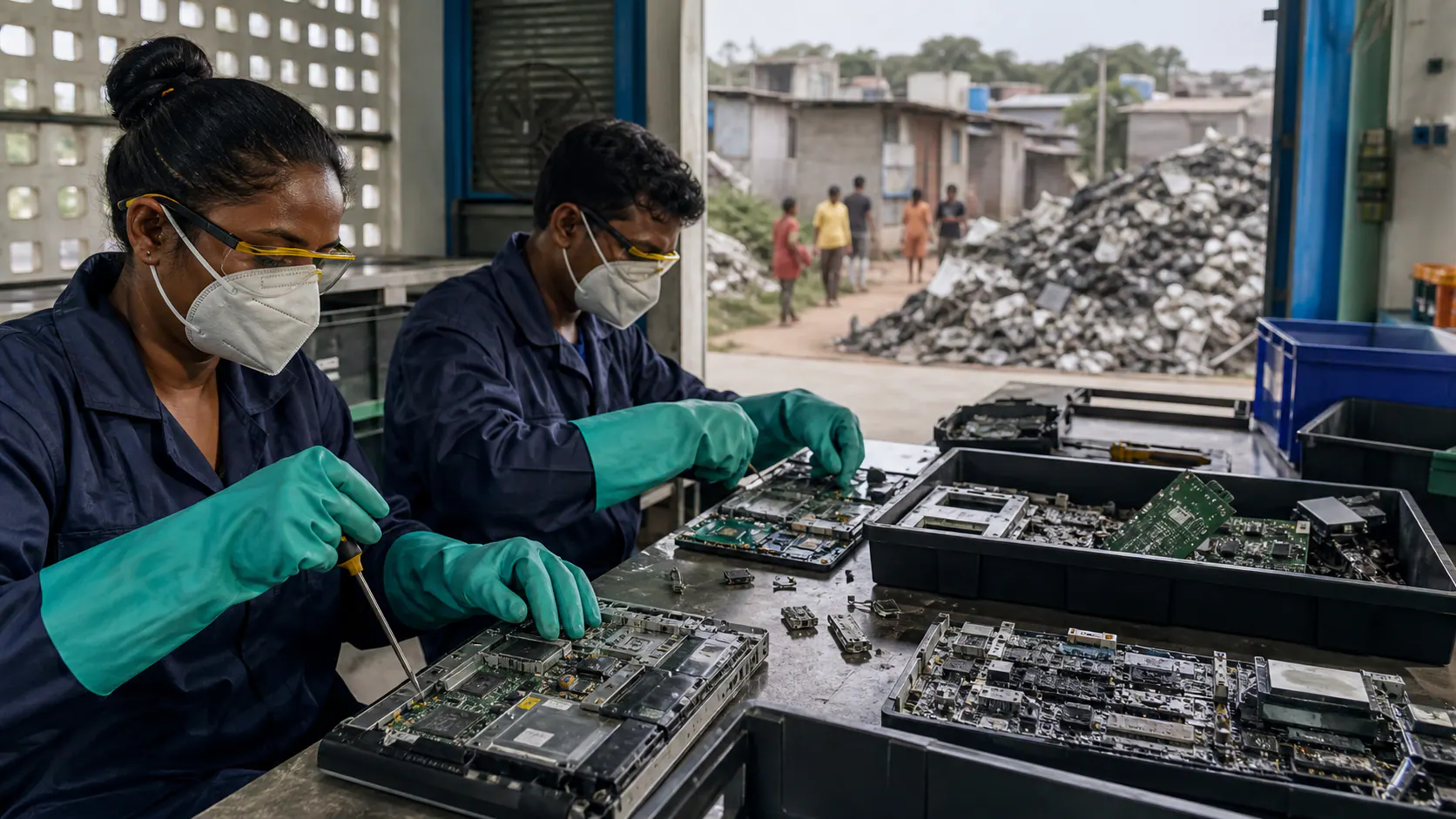
A discarded phone is not one material. It is a compact mixture of copper, gold, cobalt, glass, plastics, flame retardants, lead and other substances whose value and danger emerge when the device is broken apart. In a well-equipped facility, that process can recover resources with ventilation, containment and worker protection. In an informal yard, the same phone may be burned, smashed or treated with acid beside homes and children.
The World Health Organization, drawing on the Global E-waste Monitor, reports that 62 million tonnes of electronic waste were generated in 2022 and only 22.3 percent was documented as formally collected and recycled. Annual generation is projected to reach 82 million tonnes by 2030. The gap is often described as a lost resource opportunity. It is also a transfer of toxic exposure to workers, families and communities with the least power in the global electronics chain.
Why informal recycling persists
Discarded electronics contain materials with real market value. Where formal jobs and waste services are scarce, collecting, repairing and dismantling devices can support households. Informal workers also provide a service that formal systems often fail to reach: they collect from doorsteps, identify reusable components and extract value from products designed with little thought for disassembly.
Policy that simply bans informal activity can remove income without removing waste. Material may move to more hidden and dangerous sites. A safer transition must recognise workers’ knowledge, organise collection, provide training and equipment, and create routes into formal cooperatives or enterprises with decent conditions.
Children face exposure before they can choose it
WHO identifies more than 1,000 harmful substances associated with e-waste or unsafe processing. Open burning and heating can release metals and industrial chemicals into air and dust; acid leaching contaminates water and soil. Exposure occurs through inhalation, food, water and frequent hand-to-mouth contact.
Developing respiratory, immune and nervous systems make children especially vulnerable. Prenatal and childhood exposure has been associated with adverse birth outcomes, impaired neurodevelopment, poorer lung function and longer-term health risks. Children may work directly, accompany parents or simply live beside processing sites. Removing them from the work area is necessary but insufficient if contamination remains in homes and soil.
Export rules fail when “reuse” becomes a loophole
International trade can extend the life of functioning equipment. It can also relabel near-useless devices as second-hand goods, shifting disposal costs across borders. Distinguishing legitimate reuse from waste requires testing, documentation, repairability and responsibility when imported products fail quickly.
The Basel Convention provides a framework for controlling hazardous waste movements, but enforcement depends on ports, customs data and cooperation between exporting and receiving countries. Producers and retailers should not be able to claim circularity while the final unusable fraction becomes another community’s problem.
Design determines the danger at end of life
Products sealed with adhesive, paired to proprietary software or lacking spare parts become waste sooner and are harder to dismantle safely. Batteries create fire risks. Mixed plastics and chemical additives reduce recycling options. A circular electronics policy must reach upstream into durability, repair, modular design and material disclosure.
Right-to-repair rules and longer software support can slow the waste stream, but repairers also need safety information and access to parts. Extending product life is usually preferable to shredding it for raw materials, provided old equipment remains energy-efficient and safe.
Formal recycling must be accessible, not ceremonial
A national collection target means little if rural households travel hours to a depot or must pay more than an informal buyer offers. Convenient take-back, deposit systems and producer financing can increase return rates. Public procurement can require traceable downstream processing instead of relying on the first contractor in a chain.
Facilities need air controls, fire prevention, wastewater treatment, protective equipment, exposure monitoring and safe handling of residual waste. Certification should include independent audits and worker voice. A clean front room cannot compensate for hazardous subcontracting elsewhere.
Health services have a role beyond treating symptoms
Clinicians in affected areas can ask about household recycling work when respiratory, developmental or pregnancy concerns arise, while avoiding stigma. Public-health agencies can monitor lead and other exposures, map contaminated sites and coordinate environmental remediation.
Medical surveillance must be linked to prevention. Testing a child without changing the source creates anxiety rather than protection. Families need clear results, treatment where appropriate, safer income options and cleanup.
The climate benefit depends on safe recovery
Recovering metals from discarded electronics can require far less energy and disturbance than extracting virgin ores. WHO notes that secondary material production avoided an estimated 52 billion kilograms of carbon-dioxide equivalent in 2022. That is a real environmental benefit, but it cannot justify unsafe recovery methods.
Climate and health accounting should be joined. A recycler that reports recovered copper while ignoring open burning has not delivered a clean material. Procurement and producer-responsibility schemes should trace both material yield and environmental controls.
The residual fraction also matters. Even advanced facilities cannot recover everything. Plastics, glass, contaminated dust and damaged batteries need safe destinations. A high recovery percentage should never become permission to dump the most hazardous remainder.
A just measure of circularity
Recycling rates should be accompanied by worker injury, child exposure, export, repair and material-recovery indicators. Economic value is not fully recovered if health costs are externalised. WHO estimates that improving collection and recycling could produce major net benefits, but only if safety is built into the system.
The electronics economy likes the image of a perfect loop. Real loops have people standing at every stage. A system is not circular when valuable metals return to production while toxins remain in a child’s body or neighbourhood.