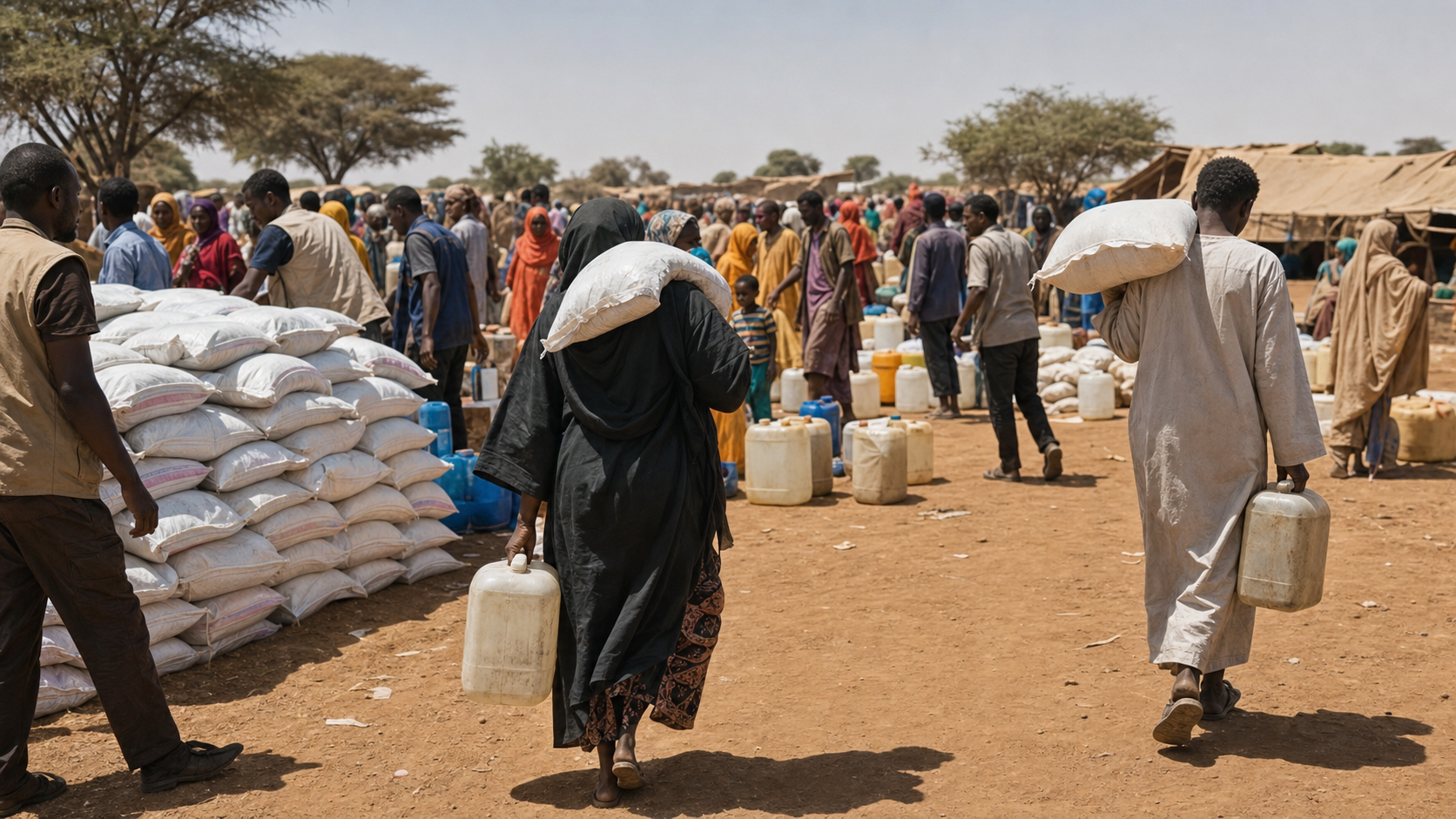
Sudan’s humanitarian crisis is difficult to absorb because the scale has become almost too large for ordinary language. Millions of people have been displaced, food insecurity is severe, health services are strained, and aid agencies warn about famine risk in areas where conflict and access restrictions make relief work dangerous. The World Food Programme describes Sudan as a major hunger emergency; the International Organization for Migration continues to track mass displacement across and beyond the country.
But the central problem is not only whether the world has enough food, money or sympathy. It is whether help can actually reach people. Humanitarian response depends on roads, security guarantees, local permissions, fuel, warehouses, staff safety, telecommunications, border crossings and trust. In a fragmented war, each of those can break.
Why access is the heart of the crisis
When conflict splinters territory, aid agencies cannot simply drive to the places of greatest need. Convoys may be delayed, looted, blocked or forced to negotiate with multiple armed actors. Fighting can cut off towns. Checkpoints can turn lifesaving supplies into bargaining chips. Even when food is available in regional warehouses, the last kilometres may be the most dangerous.
Access is also political. Allowing aid into a community can change local power, reduce displacement pressure or expose atrocities. Blocking aid can punish populations, pressure opponents or maintain control. That is why humanitarian access cannot be treated as a logistical inconvenience. It is part of the war’s structure.
Displacement changes everything
Large-scale displacement does not only mean people have moved. It means households have lost fields, wages, schools, documents, clinics, social networks and protection. A family that was self-sufficient before the war may become dependent on aid within weeks. A host community that was already poor may suddenly carry thousands of extra people. Rents rise, water systems strain, disease spreads more easily, and children miss months or years of education.
Sudan’s displacement also spills across borders, putting pressure on neighbouring countries that may already face their own economic and political challenges. Refugee response then becomes a regional stability issue, not only a humanitarian one. If funding is thin, camps and host communities can become sites of long-term neglect.
Hunger is not only a crop problem
Food insecurity in Sudan is shaped by violence, market disruption, looting, inflation, destroyed livelihoods and blocked movement. Farmers may be unable to plant or harvest. Traders may avoid roads. Families may sell assets to buy food until there is nothing left to sell. Hospitals may see malnutrition as one symptom among many: trauma, infection, pregnancy complications, untreated chronic disease and lack of clean water.
This is why famine warnings are not just about rainfall or harvests. They are about systems collapsing at the same time. When conflict, displacement, disease and market failure overlap, hunger accelerates. Once severe malnutrition spreads widely, catching up becomes harder, especially for children.
The funding gap is real, but money must become movement
Donor fatigue is a serious risk. The world is crowded with crises: Ukraine, Gaza, climate disasters, debt distress, migration politics and domestic budget pressure. Sudan can disappear from headlines even while needs grow. More funding is essential for food, nutrition, shelter, health care, water and protection.
Yet money alone does not solve access. Donors and diplomats need to pressure parties to allow safe passage, protect aid workers, keep border routes open and respect humanitarian law. Regional governments also matter because cross-border aid, refugee protection and diplomatic leverage often depend on them. A well-funded operation that cannot move is still a failing operation.
What accountability should look like
Humanitarian language can become passive: people are “affected,” “displaced,” “food insecure.” But wars are made by decisions. Civilians are trapped because armed actors fight in cities, block routes, attack infrastructure, recruit, loot and use hunger as pressure. Accountability means documenting abuses, supporting local civil society, protecting witnesses and refusing to treat access obstruction as normal battlefield friction.
It also means listening to Sudanese responders. Local volunteers, doctors, women’s groups, community kitchens and neighbourhood networks often carry the first and most dangerous layer of response. International agencies need scale, but local actors have knowledge and trust that cannot be imported.
The question the world keeps failing
Sudan’s crisis asks a brutal question: can the international system act decisively when a war is catastrophic but geopolitically inconvenient, complex and under-covered? If the answer is no, famine risk becomes not only a tragedy but an indictment. The world will have had warnings, data and agencies ready to work. What it may lack is sustained political urgency.
The measure of response should be simple. Are hungry people receiving food regularly? Are children being treated before malnutrition becomes irreversible? Are displaced families protected? Are aid routes open and predictable? Are civilians able to move safely? If those answers are weak, then the crisis is not only Sudan’s. It is a failure of the world’s ability to keep attention where attention is hardest.
Sources: World Food Programme on Sudan and IOM displacement tracking for Sudan.