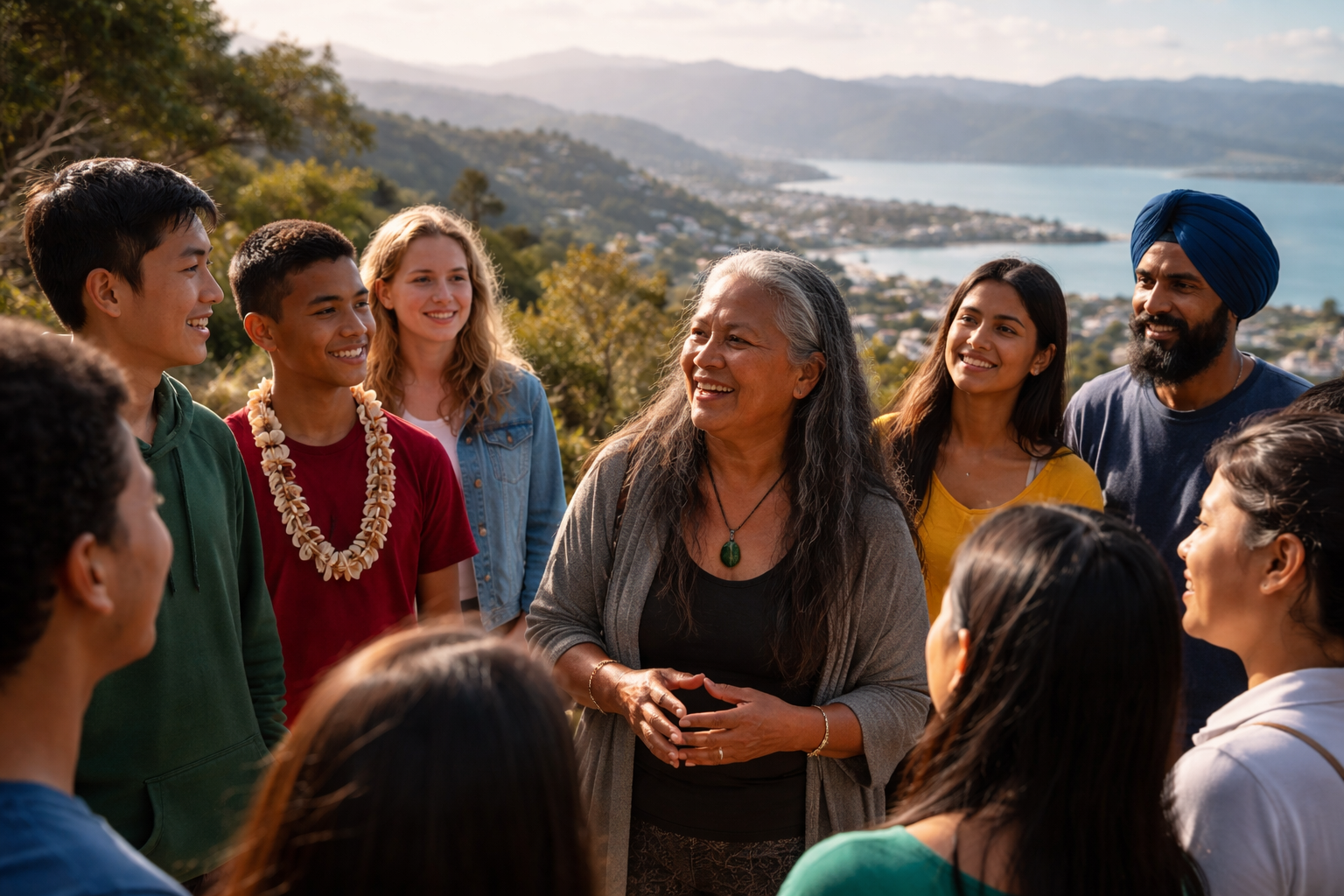
On a sunny day in Christchurch, a primary school parade turned into a living atlas. Children walked past in traditional clothing, waving flags and smiling for photos. The school community shared food, music and stories from around the world — and then the parade went through the university, as if to say: this is part of the fabric of the city. The Ministry of Education described Ilam School’s Cultural Day as representing 64 different cultures, from Afghanistan to Zimbabwe.
It’s a beautiful snapshot of modern Aotearoa New Zealand: multicultural by default, not by exception. Stats NZ says the 2023 Census recorded well over 200 birthplaces, and just under 30% of New Zealand’s usual residents were born overseas.
But the same moment also raises a harder question:
If so many of us carry different histories, passports, languages and identities — what does “we” mean in New Zealand?
A multicultural country can still feel temporary
In everyday life, New Zealand can be both welcoming and strangely provisional. People arrive for study or work, then keep one eye on “the next move”. Some New Zealand–born people do the same: Australia is close, wages are often higher, and the pathway is easy.
Stats NZ reported a provisional net migration loss to Australia in the June 2025 year, alongside wider migration movement. And over the past few years, the “Kiwi exodus” has become a recurring headline — not just because of the numbers, but because of what it signals: a growing sense that New Zealand is somewhere you pass through, not somewhere you invest your future.
Even high-profile moves can become symbolic. When former prime minister Jacinda Ardern confirmed her family is currently based in Australia, it landed as more than celebrity news — it touched a national nerve about opportunity, belonging and the pull of Australia.
None of this is a moral failure. Mobility is normal in a global economy. Migrants often maintain strong ties to their countries of origin — and many build deep, lifelong roots here too. But when “temporary thinking” becomes the default, it can weaken the everyday glue that holds a country together: trust, participation, and the feeling that “this place is ours”.
Belonging isn’t automatic — and schools can’t avoid it
We tend to treat national identity as something you either “have” or “don’t have”. In practice, identity is learned — through family, media, community and, crucially, education.
That matters because the social costs of weak belonging are not abstract. The Education Review Office (ERO) has found many learners from ethnic communities experience racist bullying, isolation, and a lack of cultural understanding in schools. In one ERO report, one in five ethnic learners said they experienced racist bullying in the last month, and many felt schools didn’t take it seriously.
If we want young people to feel that Aotearoa is home — not only safe, but theirs — then “belonging” can’t be left to cultural festivals alone. Cultural days are wonderful. But they are not a national identity strategy.
What I learned growing up elsewhere
I grew up in China, where schools and public life strongly reinforce a shared national identity. Whatever you think about the politics of it, the social effect is clear: people are constantly reminded they belong to the same national story, across regions and ethnic groups.
Other countries do similar things in different ways. Singapore’s Ministry of Education describes its “National Education” programme as helping students explore their identity as Singaporeans and fostering a strong sense of belonging that motivates them to contribute. Australia’s civics and citizenship curriculum explicitly aims to build belonging and engagement in civic life in a multicultural democracy.
New Zealand should not copy any model blindly — especially not the parts that slide into propaganda or forced conformity. Aotearoa’s context is unique: a Tiriti-based society, shaped by Māori as tangata whenua and by successive waves of tangata Tiriti. But the core lesson still applies:
Successful multicultural countries don’t leave shared identity to chance.
They teach it — not as “everyone must be the same”, but as: here is the civic home we share, here is how it works, and here is why you belong in it.
New Zealand already has the foundation — but it needs coherence
The good news is that New Zealand’s curriculum already points in the right direction. The New Zealand Curriculum’s social sciences learning area is designed to help students understand the bicultural nature of society derived from Te Tiriti o Waitangi, and how communities function. The refreshed social sciences content also places emphasis on rights, responsibilities, laws, Te Tiriti, and engaging respectfully with diverse perspectives.
And in 2023, teaching Aotearoa New Zealand histories became compulsory for Years 1–10. That was a major nation-building opportunity: to teach a shared story honestly — including the New Zealand Wars, colonisation, migration, and the ongoing meaning of Te Tiriti.
But ERO’s work on implementation suggests what many educators already know: rollout is uneven, resources vary, and schools need support to do this confidently and well.
So the challenge is less “invent something new” and more make what we already have real, consistent and effective.
What “teaching belonging” could look like (without assimilation)
If New Zealand wants a stronger shared identity — one that helps people stay, invest and build — education can do it in practical ways.
Here are five shifts that would make a difference:
1) Treat identity as civic infrastructure, not a side topic
Belonging shouldn’t depend on whether a student happens to get a passionate social sciences teacher. A coherent pathway should run through Years 1–13: Te Tiriti, local and national histories, how democracy works, and what respectful intercultural life looks like in practice.
2) Make Te Tiriti central — and usable, not symbolic
Many people support the Treaty “in principle” but don’t know what it means in everyday civic life. Schools can connect Te Tiriti to lived questions: language, land, institutions, rights and responsibilities, and what partnership requires from all of us.
3) Teach anti-racism as competence, not just values
ERO’s findings about racism in schools show this is not optional. Students need explicit skills: how to intervene in bullying, how bias works, how to discuss difference without humiliation, and how to disagree without dehumanising.
4) Make civics “hands-on”
It’s hard to feel ownership of a country you don’t know how to participate in. Students should learn by doing: attending a council meeting, writing a submission, running a classroom referendum, meeting local community leaders, or working on a real local issue. That is how “New Zealand” becomes something you help shape, not something done to you.
5) Support teachers properly
This is the make-or-break point. Identity education is emotionally and politically charged. Without training and resources, schools either avoid it or do it badly. If we want consistent national impact, we need practical teacher support — especially for the compulsory histories content.
The payoff: people who choose to belong
New Zealand’s future won’t be secured by slogans, and it won’t be saved by guilt-tripping people who leave for Australia. It will be secured when more people — whether they arrived last year, or their family has been here for generations — feel a deep, everyday sense that:
- this place is theirs,
- their voice matters,
- and their future is worth investing here.
Aotearoa is already diverse. The question is whether we can become unified without becoming uniform — and whether we can build a shared identity that makes “Kiwi” feel like a genuine home, not just a temporary label.
Cultural days show what New Zealand looks like. Education can help ensure more people decide to stay and build what it becomes.