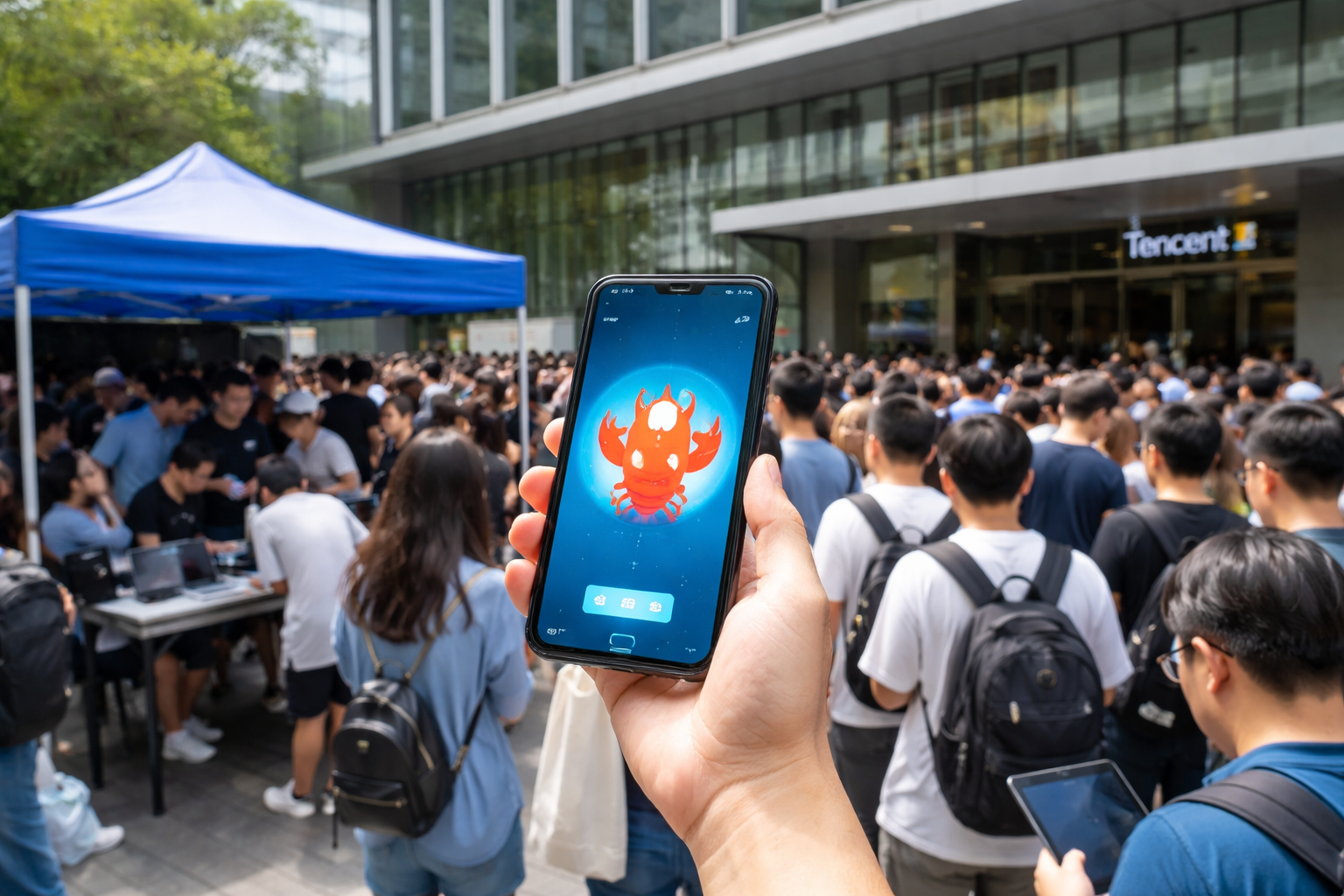
In China, one of the year’s most striking technology crazes has not been a new chatbot, but an AI agent called OpenClaw — a system users have nicknamed “the lobster” because of its logo.
Unlike conventional chatbots, which mainly answer questions, OpenClaw is designed to carry out tasks: browsing websites, managing files, handling email, calling tools and coordinating actions across apps. That distinction matters. It makes AI feel less like a conversational novelty and more like a digital worker. Reuters has reported that the tool spread rapidly in China, where developers, local governments and cloud providers began promoting it as part of a broader “AI plus” push. In Shenzhen, crowds reportedly lined up outside Tencent’s offices for help installing it, while several cities proposed subsidies and support for companies building around it.
The speed of the frenzy says something important about China’s contemporary tech culture. This is not simply a story about one piece of software going viral. It is also a story about social pressure, platform economics and the political value of technological momentum.
China is uniquely fertile ground for this kind of boom. By the end of 2025, the country had more than 1.12 billion internet users, according to official figures, giving any digital trend enormous room to scale. It also has the world’s largest software developer base; state-linked reporting in late 2024 put the number of software developers at more than 9.4 million. When a tool appears that promises to automate work, create a “one-person company” or offer first-mover advantage, it does not stay niche for long.
But the OpenClaw moment also reveals a deeper social logic: in fast-moving digital environments, people often adopt technologies not because they fully understand them, but because they fear the consequences of not adopting them. In that sense, AI agents are becoming a new site of status anxiety. If earlier internet eras encouraged people to chase platforms, side hustles or livestream traffic, the agent era encourages them to chase automation itself.
This helps explain why installation services became a business almost overnight. Chinese media reports described paid setup services advertised across social platforms, with some claims that installers made hundreds of thousands of yuan within days. Whether every such figure is reliable is less important than the social signal: people believed there was money to be made simply by helping others join the rush.
At the same time, the business logic behind the trend is not hard to see. AI agents consume more infrastructure than ordinary question-and-answer use because they do not just generate text; they loop through tasks, tools and interfaces. Chinese cities and firms have not merely tolerated the OpenClaw boom — many have actively tried to build around it. Reuters reported that districts in Shenzhen, Hefei and Wuxi proposed subsidies, free computing resources and discounted offices for OpenClaw-related ventures. That support reflects a wider industrial calculation: if AI agents become the next layer of digital production, then being early matters economically and politically.
Yet the frenzy has also exposed the limits of agentic AI. The same qualities that make these systems exciting — autonomy, permissions, persistent action — also make them risky. In February, Reuters reported that Chinese authorities had warned about OpenClaw deployments left in default or weak configurations, citing high security risks. This week Reuters also reported that government agencies and state-owned enterprises were warning staff against installing OpenClaw on work devices or even some personal devices because of concerns about data leaks, misuse and deletion.
This reversal is revealing. The same state and corporate actors that celebrated the productivity promise of AI agents have had to confront a basic truth: a tool that can act on your behalf can also make expensive, invasive or unsafe decisions at scale. That is especially important in a digital environment where users may grant broad permissions before they understand the consequences.
So the real issue is not whether OpenClaw is “good” or “bad”. AI agents are likely to improve and to become more common. The more useful question is why each new technical wave still produces the same social pattern: mass imitation, monetised anxiety and belated concern about governance.
From a media and communication perspective, the OpenClaw craze shows that technological adoption is never just about efficiency. It is also about symbolism. To install the tool is to signal that one is still current, still adaptable, still in the race. In that sense, the craze is less a break from older social habits than a new expression of them.
China’s AI-agent boom therefore tells us something broader about digital life today. In an age of cheap information, relentless virality and constant claims of disruption, the scarcest resource is no longer access to tools. It is the capacity to judge which tools deserve our trust, our data and our attention.