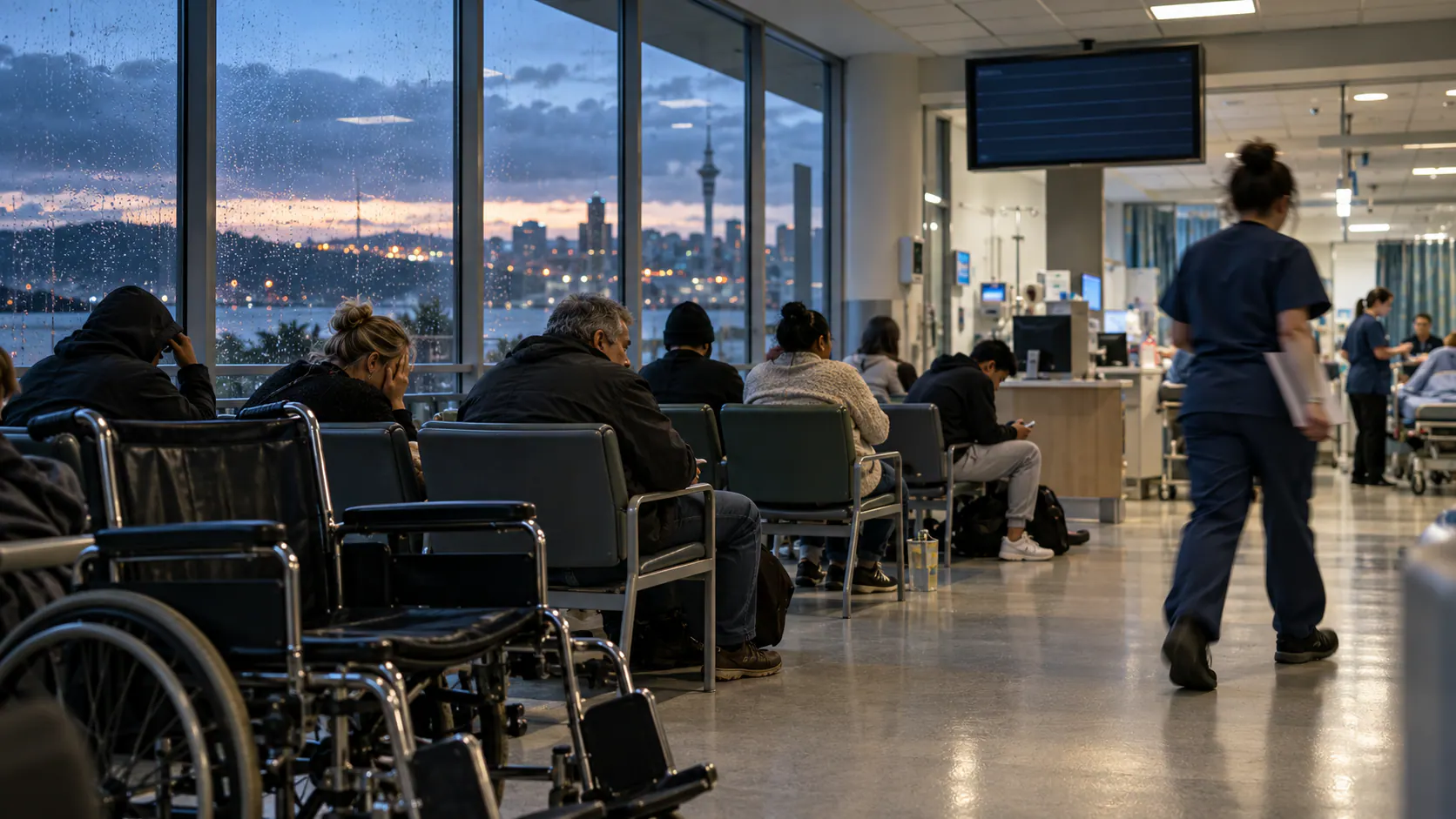
New Zealand still delivers strong health outcomes by many international measures. It also leaves too many patients waiting in emergency departments, too many adults priced out of dental care and too many cancer services constrained by geography and staffing. The 2026 election should turn on whether the next government can convert funding into capacity.
New Zealand’s public health system makes an attractive promise: serious illness should not become a financial catastrophe. Much hospital care is publicly funded, core services cover the population and a central purchasing agency negotiates medicines on behalf of a small country.
The promise is valuable. It is also incomplete.
For a patient who cannot get a general-practice appointment, waits through the night in an emergency department or postpones dental care because of the bill, nominal coverage is not the same as access. A service can be free at the point of treatment and still be functionally unavailable.
That gap between entitlement and delivery should be at the centre of New Zealand’s 2026 election.
This is not a failed health system. It is a system losing operational headroom
Claims that New Zealand’s healthcare is worse than that of “third-world countries” express genuine frustration but obscure the diagnosis.
Life expectancy is 82 years, 0.9 years above the OECD average. Thirty-day mortality following heart attack and stroke is below the OECD average. The whole population is covered for a core set of services, and most people report being treated with respect in hospital. These are not the results of a system without capability.OECD Health at a Glance 2025: New Zealand, Ministry of Health, Health and Independence Report 2025
The problem is that the system has too little spare capacity to absorb ordinary disruption. A winter surge, a staff vacancy, a delayed discharge or a broken scanner can propagate through a hospital because the next bed, appointment or worker is not readily available.
New Zealand has 2.5 hospital beds per 1,000 people, compared with an OECD average of 4.2. It has more nurses than the OECD average and a comparatively high number of major imaging machines, but slightly fewer practising doctors. This is a system with significant equipment and professional capability operating through a narrow physical and organisational channel.OECD country note
The distinction matters. If the problem were simply insufficient spending, the solution would be a larger cheque. If it were simply inefficient clinicians, the solution would be tighter management. The evidence points instead to a chain of constraints—primary care, hospital beds, workforce distribution, diagnostics, discharge services and capital delivery—that has to be repaired as a chain.
Emergency departments are reporting the condition of the whole system
There were almost 1.47 million emergency-department presentations in 2025, 5.3% more than a year earlier. More than 83,000 presentations ended with the patient leaving before being seen. Acute and unplanned care consumed 76.1% of hospital bed-days, up from 72.7% in 2020.Ministry of Health, Health and Independence Report 2025
Performance improved in the June 2026 quarter: 76.3% of emergency patients were admitted, discharged or transferred within six hours, up from 73.9% a year earlier. The improvement deserves recognition. It also means almost one patient in four remained in the department for more than six hours, against a long-term target of 95% within six hours.Health New Zealand 2025/26 results
The six-hour measure is not the same as time to first clinical contact, and it does not establish that every delayed patient waited eight or ten hours. It is a measure of flow. That is precisely why it is useful.
An emergency department cannot discharge a frail patient if community support is unavailable. It cannot admit a sick patient if wards are full. Wards cannot release beds if diagnostics are delayed or residential care has no place. Meanwhile, patients who cannot obtain primary care arrive with conditions that might have been treated earlier and more cheaply.
In 2024/25, one in four adults reported not seeing a general practitioner for a medical problem because the wait for an appointment was too long—about twice the level reported three years earlier.Ministry of Health report
The emergency queue is therefore not primarily an emergency-department management failure. It is the visible inventory of delays accumulated elsewhere.
Counting registered clinicians is not the same as staffing a service
New Zealand’s clinical workforce grew to roughly 130,000 in 2025. The number of doctors rose 2.6%, nurses 6.4% and nurse practitioners 14.4% over the year. That is meaningful progress.Ministry of Health workforce data
Yet aggregate growth can coexist with local shortages. A nurse on the register may work outside a hospital, part time or in a different region. A specialist cannot be replaced by an additional worker in another discipline. A hospital may have funded positions but fail to fill a night roster.
An independent analysis commissioned by the Ministry of Health estimated a shortage of about 1,810 full-time-equivalent doctors, potentially rising to 3,440 within a decade under existing patterns of demand and training. General practice, rural medicine and several specialist areas are particularly exposed.Medical education cost-benefit analysis
Immigration has helped New Zealand respond. It has also created a strategic dependency. The country relies heavily on internationally trained doctors and nurses at a time when Australia, Britain, Canada and ageing Asian and European economies are competing for the same people. Recruitment abroad will remain necessary, but a wealthy country cannot base its workforce plan on the permanent availability of clinicians trained at another society’s expense.
The next government needs a workforce balance sheet by region and specialty, not a national headcount. It should publish vacancies, roster gaps, training places, retention and projected retirements. It should expand domestic clinical placements as well as classroom seats, make rural service viable for families, and use nurse practitioners, pharmacists, paramedics and allied health professionals at the top of their scopes.
Workforce policy should be measured in staffed hours of care, not announcements about registrations.
Capital discipline is not the same as building hospitals cheaply
Stories from construction sites about money spent on finishes, consultants or redesigns are politically potent. Some may identify genuine waste. Others may misunderstand the demands of clinical construction, where surfaces, ventilation, lighting, acoustics, accessibility and infection control can affect safety and whole-of-life cost.
The test should not be whether a hospital looks austere. It should be whether every design choice has a defensible clinical or operating purpose.
Official reviews support concern about the broader investment system. Health New Zealand inherited fragmented asset-management practices, and the Ministry has said there was not yet a comprehensive national picture of asset condition. It also questioned whether improvement was moving quickly enough for an organisation managing an infrastructure-intensive estate.Ministry infrastructure review
Budget 2026 provided more than NZ$5.8 billion in new operating funding over the forecast period and more than NZ$680 million in capital. Health New Zealand also planned NZ$930 million of investment in equipment, facilities and technology, including regional hospital work and radiation-treatment capacity.Budget 2026 health package
The relevant question is not whether those numbers are “record” spending. It is what capacity they buy.
Every major project should disclose additional staffed beds, theatres, diagnostic throughput and annual operating requirements. Standard rooms and repeatable designs should be used where appropriate. Changes in scope should show the effect on clinical service, maintenance and patient flow. Capital costs should be published alongside lifetime costs.
Cutting a ward from a building may reduce the contract price while increasing waiting, outsourcing and staffing inefficiency for decades. Conversely, invoking clinical complexity should not give design teams an open account for repeated changes. Value for money is the relationship between lifetime cost and care delivered—not the lowest construction estimate and not the most impressive architectural rendering.
Cancer care needs a network, not merely a medicines budget
New Zealand’s pharmaceutical purchasing is a genuine strength. Generic medicines account for 76% of market volume, compared with an OECD average of 56%. Central bargaining allows the country to stretch a limited budget.OECD country note
But medicine procurement is only one component of treatment. A funded cancer drug still requires pathology, imaging, an oncologist, pharmacists, nurses, infusion capacity and monitoring. A modern weapon is of little use without logistics and trained personnel.
In the June 2026 quarter, 87% of patients began cancer management within 31 days of the decision to treat, meeting the annual milestone but remaining short of the 90% long-term target. The clock begins after a treatment decision, so it does not capture the whole journey from first suspicion through referral, diagnostics and pathology.Health New Zealand target results, Ministry monitoring report
The Cancer Control Agency expects annual diagnoses to rise from more than 30,000 in 2025 to more than 45,000 by 2044. It reports persistent workforce pressure across almost every cancer profession and significant variation in access. Canterbury patients, for example, faced periods in which radiation-treatment delays exceeded guidelines far more often than in several other regions.State of Cancer in New Zealand 2025
Some voters reasonably ask why New Zealand does not have the large stand-alone cancer hospitals seen in the United States or China. Scale complicates the comparison. A country of just over five million people spread across two main islands cannot replicate every specialised institution without fragmenting scarce expertise.
It can, however, build a more deliberate hub-and-spoke system: a small number of comprehensive centres for complex surgery, trials, genomics and rare cancers; regional radiation and infusion capacity; community sites for safe follow-up and selected treatments; and one national referral and data architecture. The patient should travel only when the treatment requires it, not because the system failed to organise care closer to home.
The unit of cancer policy should be the whole pathway, not the drug and not the building.
Dentistry exposes the largest hole in universal coverage
Publicly funded basic dental care largely ends at age 18. For most adults, the market takes over.
In the 2023/24 New Zealand Health Survey, 44.9% of adults—about 1.86 million people—reported an unmet need for dental care because of cost. The rates were higher for Māori, Pacific peoples, disabled adults and residents of the most deprived areas. In 2024, children and adolescents had 10,470 hospital admissions for dental treatment, 86% of them considered potentially preventable. More than 5,600 young people were waiting for dental surgery in March 2025.New Zealand Health Survey, Ministry oral-health briefing
Anger at dental bills is understandable. Describing dentists collectively as a cartel or a gang is not supported by evidence and misidentifies a financing failure as a moral defect among providers. Fees reflect labour, premises, equipment, sterilisation, regulation and business costs, though greater price transparency and competition are legitimate policy goals. Direct comparisons claiming that New Zealand treatment costs five times as much as China are also unreliable without matching procedures, quality, purchasing power and follow-up care.
The stronger indictment is structural: New Zealand treats oral health as essential for children and largely discretionary for adults, despite the effects of infection, pain and tooth loss on nutrition, employment and chronic disease.
Universal free adult dentistry could overwhelm the existing workforce and budget if introduced overnight. A staged settlement is more credible. Government could begin with preventive visits and basic restorative treatment for low-income adults, pregnant women, people with selected chronic conditions and younger adults leaving the free system. National fee schedules or capped co-payments could be combined with community clinics, mobile services, Māori and Pacific providers, expanded training and audited price disclosure.
Subsidy without additional supply could inflate fees and queues. Supply without subsidy would leave the poorest patients outside. Reform has to do both.
The four-year health test
The election debate should move beyond competing totals for “new health spending”. Voters need a delivery contract.
By the end of the next term, the government should be able to show fewer patients staying in emergency departments beyond six hours and fewer leaving unseen; shorter end-to-end waits from referral to diagnosis and treatment; a published pipeline of hospital projects tied to staffed clinical capacity; improved retention in hard-to-fill regions and specialties; less variation in cancer access by postcode; and a measurable reduction in adults avoiding dental care because of cost.
It should also publish what these gains cost. New Zealand already spends 10.1% of GDP on health on the OECD’s comparable measure, slightly above the organisation’s average. The long-term fiscal challenge will intensify: Treasury projects publicly funded health expenditure could rise from about 7.1% of GDP today to around 10% by 2065 under unchanged policy as the population ages.OECD country note, Treasury long-term fiscal statement
That makes efficiency indispensable, but it does not justify pretending that efficiency can substitute for every missing bed or clinician. The next government will need durable revenue, prevention, better procurement, digital infrastructure, disciplined capital planning and a frank conversation about what the public system will guarantee.
Healthcare is often described as a cost. It is also productive infrastructure. A worker waiting months for treatment is not fully participating in the economy. A parent who cannot secure primary care loses time and income. Untreated dental disease becomes more expensive disease. Delayed cancer diagnosis narrows treatment options.
New Zealand’s public system still has the foundations of a good service. The danger is not sudden collapse but gradual normalisation: the corridor becomes a ward, the eight-hour wait becomes expected, the dental bill becomes a reason not to seek care and the regional lottery becomes an accepted feature of cancer treatment.
The 2026 election should decide whether that normalisation continues. The winning parties should be those capable not merely of defending universal healthcare as an ideal, but of making it available in practice.
Sources and methodology: This is an original public-policy analysis based on information available through 29 October 2026. Data come primarily from the Ministry of Health, Health New Zealand, the Treasury, the OECD and Te Aho o Te Kahu. Reports of eight-to-ten-hour waits and spending on decorative design are treated as patient experiences or unverified project anecdotes, not national statistical facts. The article evaluates delivery standards and does not endorse a political party.