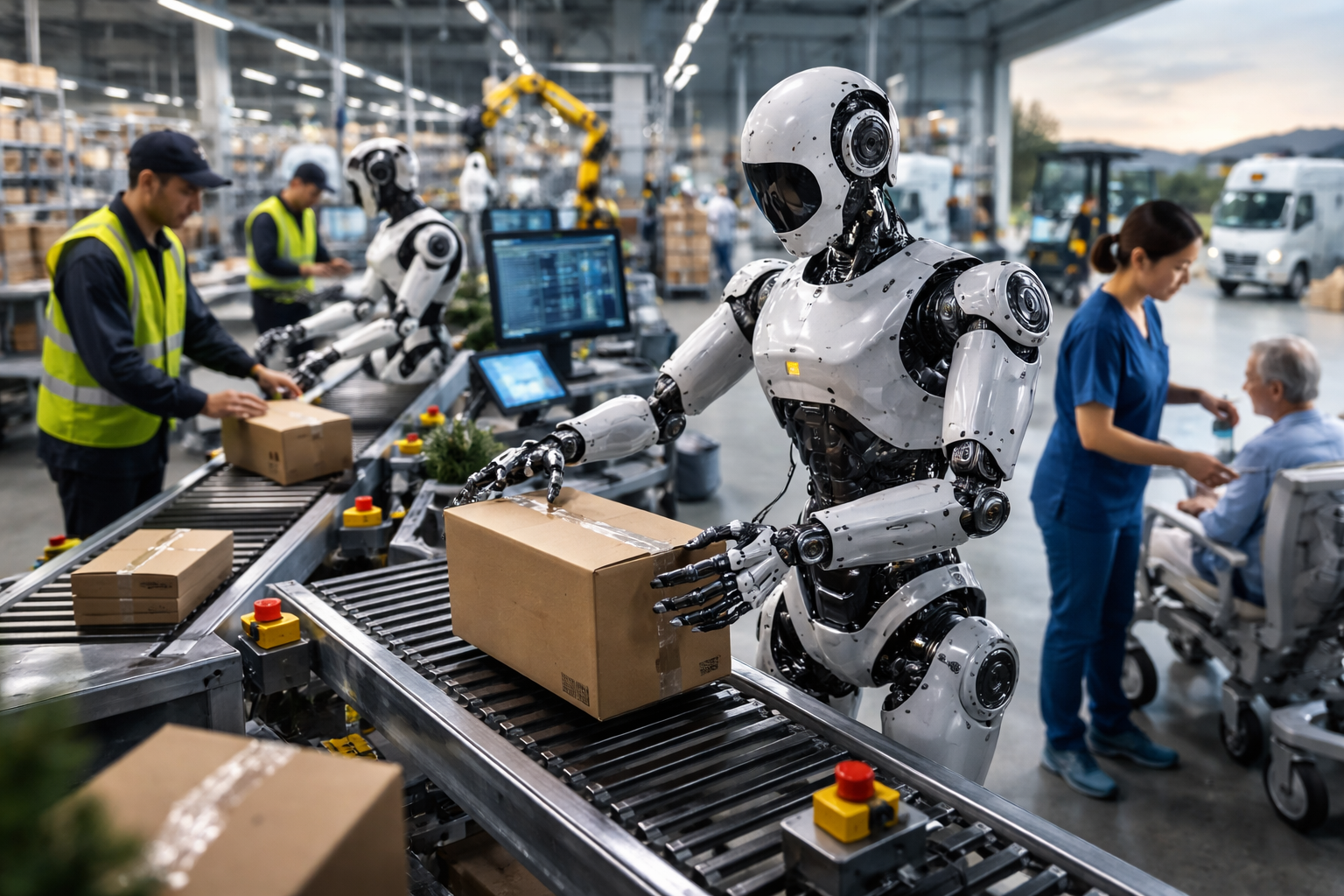
When humanoid robots appeared in China’s 2026 Spring Festival Gala – the country’s most-watched annual broadcast – it was easy to dismiss the performance as showmanship. But the bigger story isn’t that robots can do kung fu-style choreography. It’s what that prime-time moment signals: humanoid robots are moving from “research demo” to “scalable product category”, and the countries that shape the platform early will shape the economic spillovers later.
For New Zealand, this matters for a simple reason: we’re a small, trade-dependent economy facing persistent productivity challenges, regional labour shortages, and a fast-ageing population. If humanoid robots become as foundational as smartphones – a general-purpose device others build “apps” on top of – then whoever drives the hardware ecosystem, supply chain, and standards will have outsized influence.
A prime-time robot moment – with an industrial policy backdrop
Reuters reported that four Chinese humanoid robot startups (including Unitree, Galbot, Noetix and MagicLab) featured in the 2026 gala, with demonstrations ranging from multi-robot coordination and recovery from slips to on-stage interaction with human performers.
The Spring Festival Gala is not just entertainment; it’s a national shop window. Getting showcased can translate into contracts, investment attention and political capital. And the gala appearance sits alongside a broader push to fuse AI with manufacturing (“AI+ manufacturing”) as China tries to offset demographic pressures with automation.
This isn’t happening in a vacuum. China already dominates industrial robotics deployment: the International Federation of Robotics says China represented 54% of global industrial robot deployments in 2024, installing 295,000 industrial robots that year. Humanoids are a different category, but they draw on the same ingredients: motors, sensors, batteries, supply chains, integrators and manufacturing scale.
Why this is a platform story, not just a robot story
The smartphone analogy is useful – not because robots are “the next phone” in a consumer sense, but because a general-purpose device becomes valuable when other people can build on it.
Smartphones turned into platforms once three things aligned:
- Hardware became “good enough” and cheap enough
- Software interfaces stabilised (so developers could build reliably)
- Distribution and integration became easy (app stores, cloud, payments)
Humanoid robotics is trying to pass the same gates. We’re now seeing rapid improvement in balance, coordination and repeatability – the kind of “body control” that makes a humanoid usable for real tasks, not just lab demos. At the same time, investors and analysts keep pointing to cost and scaling as the big barrier to broad adoption – today’s systems can still be expensive to manufacture and maintain.
But here’s the key: even before robots are cheap enough to be everywhere, they can become a platform for high-value niches: warehouses, factories, labs, hospitals, ports, and dangerous or dirty environments. In those settings, the return on investment can make sense earlier.
And once a credible “base model” humanoid exists, the innovation shifts upward:
- “Robot apps” (task software, safety modules, workflow integration)
- Sensors and attachments (hands, tools, vision packages)
- Training data and simulation (learning tasks faster)
- Standards and compliance (certification, liability, security)
That’s where many smaller countries can win – if they position themselves well.
What the gala performance doesn’t prove
A choreographed routine does not mean robots can walk into a rest home or a construction site tomorrow and do useful work safely. The real world is messy: uneven floors, unpredictable humans, edge cases, maintenance downtime, and cyber risk.
This is why policy and governance matter as much as engineering. In New Zealand, WorkSafe’s guidance on adopting new technology emphasises managing risks, ensuring equipment is fit for purpose, and engaging workers through the process. If humanoids enter workplaces, they’ll sit inside the same health and safety obligations – and will raise new questions about training, supervision, incident reporting and accountability.
For consumer-facing robots, product safety and liability also matter. New Zealand’s consumer protection guidance is blunt: products sold here must be safe, and suppliers are responsible for safety. That will shape what imported humanoids can legally and reputationally do.
So yes: the gala was a signal. But it was not a promise that the hard parts are solved.
Why New Zealand should care now
1) Our workforce exposure is real – in both “AI” and “robotics” forms.
A new Reserve Bank of New Zealand analytical note (published 3 February 2026) found robotics exposure concentrates in machinery operator and labourer occupations, and that around 30% of workers face high combined exposure to AI and robotics. This doesn’t mean 30% of jobs disappear. It means tasks, workflows and bargaining power are likely to change across a large slice of the labour market.
2) Ageing and care pressures are already here.
Health New Zealand’s own review work has warned that, if historic building rates continue, New Zealand could face a shortage of almost 12,000 aged residential care beds by 2032. Robots are not a magic fix – but automation that supports lifting, logistics, cleaning, monitoring, and repetitive tasks could become part of a broader response (alongside workforce policy, housing, and service redesign).
3) We’re explicitly choosing an “adoption” strategy in AI – robotics fits that mindset.
MBIE’s AI strategy emphasises adoption and application rather than foundational development, reflecting New Zealand’s context. Humanoid robots are “AI with a body” (often called embodied AI). If we’re serious about adoption-led competitiveness, we should think about where embodied AI can lift productivity in NZ’s real economy: food processing, ports, warehousing, forestry supply chains, construction prefabrication, hospitals, and rural logistics.
4) Government already sees capability-building as necessary.
The Public Service AI Framework sets principles and pillars for responsible AI use (including governance, guardrails and capability). And in January 2026, the Government launched an AI Advisory Pilot through the Regional Business Partner Network to help small firms adopt AI safely and practically. The next logical step is to ensure “AI adoption” doesn’t stop at chatbots and document drafting – but extends to automation in physical operations too.
What New Zealand can do – without pretending we can outspend the giants
If humanoid robotics becomes a platform, New Zealand’s goal shouldn’t be to “beat China” (or the US) at manufacturing humanoids. It should be to capture value at the layers where small countries can compete: integration, safety, software, niche applications, and trusted governance.
Four practical moves would help:
- Pick 2–3 national “robot testbeds” where NZ has real problems to solve
Think: a port logistics testbed, a hospital logistics/sterile supply testbed, and a high-mix manufacturing/food processing testbed. The win is learning-by-doing, building local integrator capability, and creating reference customers for NZ firms. - Treat robot security and data governance as “infrastructure”, not an afterthought
A mobile humanoid is a rolling sensor suite. Procurement and standards should demand transparency about data flows, remote access, model updates, and incident response – aligning with the public sector’s push for responsible AI and maintaining public trust. - Invest in “the missing middle”: technicians, integrators, and safety engineering
Humanoid robots will need maintenance, calibration and workplace redesign. That’s a jobs story as much as a technology story – and it’s where we can prevent disruption from becoming pure harm. - Build an export narrative around “trusted deployment”
New Zealand’s brand advantage is trust. If we can become good at deploying embodied AI safely, transparently and in partnership with workers, that becomes exportable know-how – especially into regulated environments like health, infrastructure and public services.
The real takeaway from China’s gala robots
The most important thing that happened on that stage may not be the flips or choreography. It’s that humanoid robots are being framed – publicly and politically – as a strategic industrial platform.
New Zealand doesn’t need to panic, and it shouldn’t copy other countries’ playbooks. But we also can’t treat embodied AI as a far-off curiosity. If robots become the next platform layer in the AI economy, then the question for us is practical:
Do we want to be a passive importer of a new platform – or an early, trusted builder on top of it?

Author: 全搜索资讯编辑
如果您喜欢我们的文章,请支持我们的新闻工作者和创作者!请打赏一杯咖啡给他们(注明栏目或文章题目),或支持我们每月的服务器费用,非常感谢! 订阅我们,Paypal每月赞助5纽币: http://bit.ly/47fUCPS
※新西兰全搜索©️版权所有
敬请关注新西兰全搜索New Zealand Review 在各大社交媒体平台的公众号。从这里读懂新西兰!️
了解 新西兰全搜索🔍 的更多信息
订阅后即可通过电子邮件收到最新文章。